Prenups, Postnups, and the Must-Have Money Talk Most Couples Skip
- A BETTER WAY TO MONEY SEASON 3 EPISODE 4
- May 28, 2026


Key Takeaways
Start simple: Share three numbers with your partner—what you earn, what you owe, what you’re saving.
A good prenup isn’t one-sided. It’s a way of saying, “Whatever happens, I want us both to be okay.”
A shared financial plan isn't just about money—it's a road map for the life you're building together. The sooner you build one, the more of that life you get to enjoy on your own terms.


Have a plan for your money at every stage of life. Get our Family Finances Workbook.
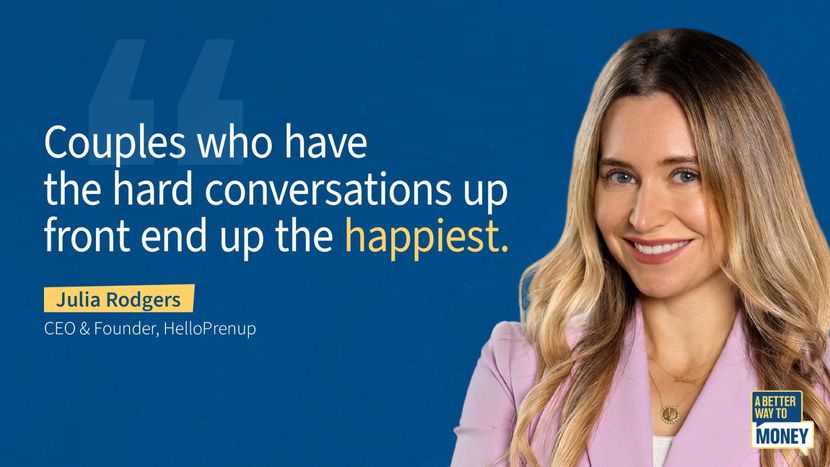
Want your relationship to go the distance? One of the most powerful things you can do is have an honest money conversation—and attorney Julia Rodgers has built a company around making that easier.
In this episode of A Better Way to Money, the HelloPrenup founder joins host Jennifer Borget to reframe prenuptial and postnuptial agreements as something far more hopeful than their reputation suggests. These documents, Julia explains, are less about planning for the worst and more about building toward your best life together—covering everything from debt protection and spousal support to business ownership and inheritance. Her framework for getting started is simple, warm, and judgment-free: Share three numbers, have one honest conversation, and let the plan grow from there.
Wherever you are in your relationship, this episode gives you something to work with.


From job changes to raising financially-savvy kids to setting yourself up to retire, we'll have deeper conversations.
Julia Rodgers: [00:00:00] What could be more romantic than sitting down and having a conversation about your future? And a prenup is really just a life-planning conversation. It's a [00:00:10] conversation where you are talking about your future successful marriage.
Jennifer Borget: [00:00:20] Welcome back to A Better Way to Money. I'm Jennifer Borget. The share of US couples signing prenuptial agreements has jumped from about 3% in 2010 to nearly [00:00:30] 15% today, and that's not wealthy people protecting family fortunes. It's regular couples with student loans, small businesses, and hard-earned savings.
They're having the most [00:00:40] important money conversation of their lives before marriage. Today, I'm joined by Julia Rogers, divorce attorney and founder and CEO of HelloPrenup, a platform that's helped hundreds of [00:00:50] thousands of couples do exactly that and protected more than $27 billion in assets along the way.
By the way, if a prenup sounds like the last thing you and your partner need [00:01:00] to talk about, stay with me because this conversation is really about what happens when couples get honest about money before they have to and why that changes everything. If [00:01:10] you're ready to start the conversation with your partner, we have the perfect tool for you.
Jennifer Borget: Download our free Family Finances workbook at northwesternmutual.com/podcast. All right, let's [00:01:20] dig in. Julia, thank you so much for joining us.
Julia Rodgers: I'm so excited to chat. Thanks so much for having me today. I'm excited to be here.
Jennifer Borget: So prenups are a hot topic, so I'm just [00:01:30] ready to, like, pick your brain on all of this. But before you founded HelloPrenup, I know you had your own experience, so how was that? Tell us about that process.
Julia Rodgers: [00:01:40] Yes, absolutely. I was working as a family law attorney in Massachusetts, and I was talking to all these potential prenup clients, mostly millennials, and they all had the same concerns. They were getting [00:01:50] married and in love and wanted to get a prenup for various reasons, but the process was long, drawn out, expensive.
And so some of the main complaints I would [00:02:00] hear from fiancés was, "It's too expensive. Why do I have to spend thousands of dollars and hire a divorce attorney before I'm even married? How [00:02:10] uncomfortable is that?" So they wanted autonomy over the process. And it took a while to actually draft the document, right?
So most attorneys would require a minimum of three months, [00:02:20] uh, between the, the beginning of the prenup and the wedding. And that was important because attorneys need time to go through the terms with their client and come to something [00:02:30] that is mutually satisfactory. And then on top of that, there was just this extreme discomfort with the price.
A lot of customers would say, "Well, you know, if I'm gonna spend [00:02:40] $5,000 on a prenup and I have to choose between a prenup and my wedding flowers, I'm just gonna get my wedding flowers and worry about the prenup later." And so I saw so many [00:02:50] couples forfeit the opportunity to get a prenup. And I thought, as an attorney and a person in the world with a lot of friends who are getting married, like, there's gotta be a better way to do [00:03:00] this, and that's kind of how HelloPrenup came to be.
Jennifer Borget: And you invested your life savings to build this company, and then you got rejected by investors, [00:03:10] and then you ended up on Shark Tank in a wedding dress? In a wedding dress. Make me talk to that. Like, I wanna know the whole story behind that. I love that show. How did this happen?[00:03:20]
Julia Rodgers: Yeah. So Shark Tank actually reached out to us. They were looking for COVID businesses. And at the time, I had just partnered with my former co-founder, and so we just [00:03:30] kinda jumped into it. And we started the audition process and said, "Let's just go for this." And the Shark Tank experience was a really incredible one. It was, you know, really [00:03:40] strange walking onto the Shark Tank set, like something I've watched on television hundreds of times, and being literally in the tank.
But the experience with the investors was [00:03:50] just wonderful. It's ultimately very real. You know, you're having real conversations with the Sharks about your business, about the potential, about the market size. And [00:04:00] yeah, it was just a really fun experience to be able to talk to the US audience about the importance of prenuptial agreements on a national stage that [00:04:10] no other legal tech company had done before or has done since.
Jennifer Borget: Yeah. It seems like a very unique kind of business that you have. And also, this is a topic, like [00:04:20] money is something that really can make or break a lot of couples. Like research published in several scientific journals ranks money among the top [00:04:30] reasons that marriages fall apart. What is it about money that makes it so hard for couples to, like navigate it together?
Julia Rodgers: I think money is very emotional. [00:04:40] It's tied to so many things. Um, I always say a prenup is just as much an emotional document as it is a legal one. And- Again, it, a lot [00:04:50] of what we've learned about money, what we've internalized, is tied to how we were raised, what we believe we deserve, and how safe we feel.
And, and very specifically in a relationship, [00:05:00] two people can be completely in love and have wildly different money mindsets. Maybe, you know, one is more scarcity-focused, one is more [00:05:10] abundance-focused. You have the spender versus saver. And oftentimes, a prenup is the very first time anybody's talked about money in a relationship, like really talked [00:05:20] about it.
It's oftentimes the first time that they have disclosed how much debt they have, or savings, or assets, or even potential inheritance. I've seen that go [00:05:30] wrong, where, you know, two people get engaged, they start the prenup process, and then one finds out that the other has this insane trust fund that they [00:05:40] receive distributions from every month.
And that was actually a very negative thing in that relationship, because they felt like their partner had been lying to them all these years. And so money can bring [00:05:50] up a lot of emotion, and that's why I think people tend to avoid those conversations, unfortunately. We spoke with, uh, Wendy De La Rosa in a previous [00:06:00] episode, and she talked about how it was, like, on her third date, she's like, "Yes, here" Like, "Let's lay it all out there, all the money.
Let's talk about our finances. Where do you stand?" Do you feel like that's a good idea to do that so [00:06:10] early in a relationship? Well, Kevin O'Leary always says, third date, second glass of wine, you should have the prenup conversation. I'm a true believer that you should be watching for signals, [00:06:20] right? You should be watching for how someone conducts themselves, how they talk about money, maybe what their goals and aspirations in life are, and, and how that will [00:06:30] impact finances.
I don't think you need to lay out all your bank statements on the dinner table on the third date, but I do think watching for those signals is really [00:06:40] important and indicative of how they probably save or spend.
Jennifer Borget: And I love dating shows. I mean, Shark Tank real- maybe I'm just a reality TV person, so I love Shark Tank, also love the dating [00:06:50] shows. And it's so interesting to me how when the prenup conversation comes up, it usually, like, they kinda go dark. And it becomes this, like, "Oh, you don't trust me. You're already [00:07:00] planning for our marriage to fail." Why do you think that's the wrong approach to thinking about a prenup?
Julia Rodgers: I think first of all, people need to understand that everybody has a prenup. Whether you get a [00:07:10] prenup or not, if you're getting married, you have a prenup because the state controls, right? So do you want some legislator or some judge sitting in a black robe to [00:07:20] decide what's yours versus what is yours to divide in the event of a divorce? I don't. I wanna make those rules for myself.
So because you always [00:07:30] have a prenup, whether or not you get a prenup at all, it's really smart to just take the time before you get married, sit down, have the hard conversations, and draft something up. Just like when you get [00:07:40] in a car, you put on your seatbelt, not because you're planning to get in an accident, but because that's just what you do.
I feel the same is about a prenup in a marriage. [00:07:50] And you've said it can actually, like, bring couples closer together when they're having these conversation. Why do you think that is? Yeah. Well, we actually just did a study with the University of Michigan that proved that the [00:08:00] majority of couples who had a prenup reported that they had better marital satisfaction.
And I think it's because you're having the hard conversations up front. I always like to remind people [00:08:10] that, you know, the wedding is kind of this beautiful experience, but there's going to be a lot of life lived in your marriage after your wedding. You're gonna have to file [00:08:20] taxes together. When you have kids, you're gonna have to decide, you know, is someone gonna stay home to take care of them and sacrifice their career, or, uh, are we gonna [00:08:30] hire nannies, or where are we gonna send them to school?
And all of these things are ultimately boiled down to financial conversations. Um, and so I think that the couples who sit down and are really [00:08:40] intentional about having these uncomfortable conversations up front are the ones who end up happier throughout the course of their marriage because they knew they were on the same [00:08:50] page before getting married.
Jennifer Borget: Yeah. So for people who maybe think that a prenup is taking the romance out of a marriage or their relationship, what would you say to that?
Julia Rodgers: What could be [00:09:00] more romantic than sitting down and having a conversation about your future, about what your shared goals are? That, to me, is the most [00:09:10] romantic thing in the entire world, and I think because a prenup is really just a life-planning conversation.
It's a conversation where you are talking about your future [00:09:20] successful marriage. It's a financial plan for that marriage. It's, in my opinion, how two people say, "I love you enough to have the hard conversations now [00:09:30] so that we can live a long, happy marriage later."
Jennifer Borget: All right, Julia makes the case that a prenup conversation is really a financial planning conversation in disguise, and that couples who [00:09:40] have it come out stronger.
But here's the thing, that conversation doesn't end on your wedding day. The financial decisions you make together in those early years of a partnership, how you protect your [00:09:50] income, how you save and invest, how you plan for the unexpected, they have an even bigger impact on everything that follows, and that's where a Northwestern Mutual advisor makes the [00:10:00] difference.
They help you build a plan that accounts for what you're each bringing in, what you're building together, and where you wanna go, whether you're merging finances for the first time, buying a home [00:10:10] together, starting a family, or making sure you're protected if life takes a turn. Coming up, Julia will break down how to have this conversation even when one partner is hesitant.[00:10:20]
Jennifer Borget: Let's bring her back in.
So let's, like, actually, like, open this up a little bit, 'cause I think most people assume that a prenup is things like, you know, okay, who's getting the house? Who's getting, [00:10:30] you know, this amount of money? But there's a lot more to this than just that. Can you walk us through, like, maybe the main categories of a prenup, what it covers, what it doesn't [00:10:40] cover?
Julia Rodgers: Yeah, absolutely. So the main categories of a prenup are property and asset division, so what's yours, mine, and ours. It also helps [00:10:50] protect against debt, so absorbing your partner's debt. Your partner may have really significant student loan debt, so it's important to ensure that debt is indicated in a prenup [00:11:00] as belonging to one party versus being split in the event of a divorce, which is possible.
A prenup can also address something that's really important people rarely think about, [00:11:10] is spousal support or alimony. Now, those two terms mean the same thing, um, they are just named differently depending on the state that you're in. And whether spousal support at, or [00:11:20] alimony is waived or waived in the instance of, you know, whether or not you have kids or if someone stops working to take care of a family member or children.
[00:11:30] And that is really important because in the vast majority of marriages, women are the ones who step back from their careers when they have kids. They're the ones that when they [00:11:40] have a sick family member are taking care of that family member and forfeiting their career and earning potential. And so spousal support is important to consider, [00:11:50] important to talk about.
In the event of X, what would that mean for my personal finances? And this, I think, is really how you make sure that you remain [00:12:00] on fair financial footing throughout the course of your marriage. You can also do that with something called a lump sum payment. That is a payment from one party to the other that can be [00:12:10] tiered out depending on income disparity, depending on length of marriage.
And again, this is really important in, in the instance where you have one party who becomes a stay-at-home parent or a caregiver. [00:12:20] Um, business ownership is something we are increasingly seeing in prenuptial agreements. About almost 30% of our customers own some type of [00:12:30] business or have stock options in a business, and business ownership protections, uh, ensure that entrepreneurs are able to maintain the majority [00:12:40] control of their company or their income in the event of a divorce.
This is also something that's really important if you're going out and raising capital. You know, it may be a question that you [00:12:50] get. So a prenup can really cover everything that you would need to talk about, all of these important life conversations, and act as a framework for your financial [00:13:00] life together.
Jennifer Borget: Hmm. Are there, like, big surprises that typically come up? Like, I'm-- I would think if you haven't had a financial talk by this point, like whoops. [00:13:10] You know? What are some of the big things that you, that- Comes up in these types of discussions.
Julia Rodgers: Yeah, I think debt is a really big one. People are often really shocked to learn [00:13:20] that their partner has significant student loans or credit card balances that they didn't disclose.
This is something, again, you should be talking about because debt [00:13:30] and finances generally are going to impact how you live your life. If one person has a ton of debt, whether that's credit card debt or student loan debt, [00:13:40] um, you know, it's gonna, it's gonna cause an issue when you wanna go buy your first house.
It could potentially require that both of you work in order to pay off that debt. So you have to have those [00:13:50] conversations early. Another one that I mentioned earlier is inheritance, right? So either inheritance meaning one party is receiving distributions [00:14:00] from a trust that they have, or inheritance expectations.
People might assume that they're getting money from family. This may or may not materialize. This is important to have a [00:14:10] conversation about, um, with your partner in what that might mean. You know, is one of your parents going to pay for private school for your kids? This is something that Boomer parents are [00:14:20] often seen, uh, giving their Millennial or Gen Z kids.
You know, it's called the bank of mom and dad. Mm-hmm. Ugh. Right? So they're contributing to their, um, household and their lifestyles, [00:14:30] and having a conversation about how that may impact you as a couple I think is really important. And then I think there's, like, the spending habits, right? Again, spending habits can be [00:14:40] observed over time, which I think is very important.
But if one partner is a saver, one's a spender, you have to have a conversation about what that means and what your [00:14:50] shared financial goals are. Because without that conversation, it might lead to, um, some tension in the relationship.
Jennifer Borget: Yeah. I think one perk of when I got married so young [00:15:00] was that we didn't have anything. Like, we- neither of us had debt, neither of us had much money in our bank accounts. Like, we were just kinda like, "Oh, whatever," you know? We didn't have [00:15:10] money. We weren't even thinking about our prenup. So what about the couples, like, let's say someone's listening to this, and they're like, "Whoops, we're married already. We didn't think about this." What can they do?
Julia Rodgers: [00:15:20] Postnuptial agreement. So If you're already married and you didn't get a prenup, you're not out of options. A postnuptial agreement, uh, is essentially the same thing as a prenup, it's just done after [00:15:30] marriage. They're not as commonly known, but they're becoming more popular, um, and they are valid around the country.
They're less enforceable than prenups, generally [00:15:40] speaking. They have stricter requirements, um, because they are made during marriage, but they're still increasing in popularity and incredibly valuable. They allow you to [00:15:50] tier out what assets should be, again, yours, mine, and ours. In certain states, they allow you to actually tier out what spousal support might look like in the event of a divorce.[00:16:00]
Um, they cannot address child-related issues, just like prenups can't. You know, you can't indicate child support, you can't indicate child custody in a prenup or a postnup. [00:16:10] Um, but a postnup really is effective for couples who maybe they had some life changes, right? Maybe they had a prenup, and they want to modify the terms of the prenup.
[00:16:20] In certain states, that's called a postnup. Maybe they didn't have a prenup, and they just missed the opportunity and they wish they did. Well, no problem. Postnup is really [00:16:30] easy to obtain if you have only been married a couple of years. Or maybe they've been married a significant amount of time, 10, 15 years, and one party started a business, [00:16:40] or there was some significant life change.
One came into inheritance, and you wanna have financial conversations. You wanna make sure you're on the same page. You wanna set your marriage up for [00:16:50] success. A postnup is the best way to do that.
Jennifer Borget: All right, so there's still options for people who maybe, you know, drop, dropped the ball or didn't know about it, you know, or something like that. Um, so let's [00:17:00] say, you know, you're... That someone's dating someone, and they're like, "Hey, this sounds like a great idea. I wanna bring this up to my partner," but they're worried about it coming [00:17:10] across like it's this accusation. How does starting this conversation look?
Julia Rodgers: I think, first and foremost, framing is everything. Instead of saying, "I just want a [00:17:20] prenup"- You need to start with something like, "I'd love to sit down. I'd love to talk about our financial futures together." You need to be really vulnerable and honest about [00:17:30] why you want a prenup. Maybe your parents got divorced, right? 24% of millennials are children of divorce.
Maybe, you know, you started a [00:17:40] business. Maybe you're getting married, and you have a lot of assets or a lot of student debt that you wanna protect your partner from. But you need to be vulnerable in explaining why a prenup is [00:17:50] important to you because people can have very emotional reactions to it. You could also lead with a question like, "Have you thought about how we might handle finances once we're [00:18:00] married?
Do you want to stay home if we have kids?" So this type of conversation needs to be handled very delicately. You need to signal collaboration, and I think [00:18:10] timing matters. Don't bring it up in the middle of a fight or the night before the wedding. Make sure, you know, if you're getting engaged, either talk about it before you even get [00:18:20] engaged or immediately upon getting engaged.
Um, do not wait until the last minute because that is when, you know, people feel a lot of pressure, and [00:18:30] it just puts a really bad taste in your mouth before you have this beautiful wedding.
Jennifer Borget: So the ring's on. They're celebrating that. Let, wait until, like, you know, the celebration [00:18:40] settles a tiny bit, and then it's like, "All right. Now let's talk about next steps." Okay. But what if they don't have the best reaction to that? Like, what if one of the partners is just, like, completely [00:18:50] resistant to the idea? Yeah. Maybe they see it as, you know, a sign, like we were talking about, like, "Oh, do you think this relationship isn't gonna work?" How do you navigate that?
Julia Rodgers: Yeah, I think usually [00:19:00] resistance is rooted in fear. It's fear of the unknown, right? Yeah. Fear that maybe you don't trust them, that you're being pessimistic, and so it's very [00:19:10] important to address this directly. You have to say I'm not doing this because I think we're gonna fail. I'm doing this because I take our future really [00:19:20] seriously.
I wanna set us up for success. And then again, be vulnerable with the why. You know, I saw my parents get divorced, and I saw this is what it did to our family. I wanna make sure we are [00:19:30] never in that position. Or I started a business, and I wanna be really fair to my business partners, ensure that, you know, the business is never something that could be a part of the [00:19:40] conversation.
And I think that it helps to even bring in a third party if you need to. That can be a financial planner. That can be a therapist. HelloPrenup has a [00:19:50] ton of resources on its website about how to bring up a prenup with a partner, and also conversations for the partner around how a prenup can be protective of [00:20:00] both parties, and it should be.
Because a prenup should never be just about protecting one party and not the other. This is a mutual document. This is something that both parties [00:20:10] should feel really good about. Um, and I, I worked on a prenup for this couple, so we represented one side. Um, his family was very, very [00:20:20] wealthy. They were billionaires.
This was one of the instances where I saw an inheritance go awry. You know, she didn't even know he was that wealthy until the prenup [00:20:30] came up. And what I thought was really sad was she didn't realize how the prenup could protect her. She didn't see how the prenup could actually allocate her more rights [00:20:40] than the law would.
And in the instance where she was planning to be a stay-at-home mom, you know, a prenup could actually do more for her than spousal support or [00:20:50] child support ever would in that state. And so I saw it really destroy the communication between her and her in-laws, and even her and her [00:21:00] fiancé at the time, and right before their wedding.
And I just think if it were approached differently, and he had had conversations with her about how this could protect her, [00:21:10] it would've been a very different outcome.
Jennifer Borget: Did they get married?
Julia Rodgers: They did. They did. They got married. Um, they're still happily married, but unfortunately she doesn't [00:21:20] even talk to her in-laws anymore.
I mean, the prenup destroyed her relationship with her in-laws, which is really sad. And again, if it were addressed differently, if it were approached differently, then [00:21:30] the result would've been far more favorable. Yeah. Have you seen people who have gone from a place like that where maybe they're completely in disagreement [00:21:40] about it, but then they ended up being on the same page?
I have. I have, and I think that the disagreement is usually... It's a process, [00:21:50] right? It's several conversations, and it's not just one conversation and done. The first conversation might be really uncomfortable, and that's okay, and I've, I've seen a lot of that. But I think [00:22:00] what matters is couples are able to work together.
They're able to come back to it. Once you actually start talking about the specifics, meaning, like, what's [00:22:10] fair, what feels right Are we going to have kids? Is one party gonna stay home type of thing. What are our life goals? I think that's when [00:22:20] couples feel a lot more aligned. And so it's getting ... You know, sometimes the document itself can be really stressful, like just the idea of it.
But once you start to get into the [00:22:30] details, I think it really is a reflection of the trust that they've built and, and not just this transaction. Mm-hmm. Yeah. Yeah. That's really important. And I think [00:22:40] maybe once you get past the misconceptions too, 'cause I mean, it does kinda sound like a scary thing, but you're talking about all these protections that you can have.
Like, hopefully that will continue to shift [00:22:50] as people, you know, learn more about these. I think so. I think so. And, and, uh, like HelloPrenup has all these great resources for couples who are considering a prenup. Um, and [00:23:00] again, one of the reasons we offer the most free information on this topic possible is because we wanna make sure that people have access, [00:23:10] democratized access to legal information about how a prenup could be helpful to them individually and as a couple.
Jennifer Borget: Yeah. That's so important. [00:23:20] Okay, so two-part question. For someone who's engaged or the relationship's getting serious, and they haven't had a real money conversation, what's one thing that they should do [00:23:30] this week?
Julia Rodgers: This week if you do one thing, sit down together and share three numbers. What you earn, so salary or take-home, what you owe, any debt, student debt, credit [00:23:40] card debt, and then what you're saving.
Make sure that when you're having this conversation, it's not a conversation that is built on judgment. There's no agenda. You're just sharing. [00:23:50] You're just being as transparent as possible. This single conversation will tell you more about your financial compatibility, I think, than anything else, [00:24:00] just based off of how you're able to work together and approach the conversation.
The numbers are less important than how you handle [00:24:10] talking about the numbers. And if this feels really hard, that's actually a sign that you need to have this conversation. There's no reason to avoid it. [00:24:20]
Jennifer Borget: All right. And then what about the couples maybe who've been married a while, but they've been avoiding these conversations? What, what's their move?
Julia Rodgers: I think the same thing. If you've been married a while, [00:24:30] you've probably been paying bills together. You might have a shared bank account. If you have kids, you know, you've certainly dealt with child-related expenses. But what [00:24:40] you should do is sit down and have the same conversation, right?
Know your numbers. You'd be surprised how many married couples have no idea what their household income is. [00:24:50] Um, so sit down, know the numbers, have the conversation, and then plan to continuously have the conversation. Maybe it's a money date every single month, maybe [00:25:00] it's, you know, every quarter, but make sure you have a working cadence that you both feel comfortable with, and make it fun.
You know? Maybe have a glass of wine, maybe go to [00:25:10] dinner first, and then when you come home, make sure you sit down and have allocated 45 minutes to an hour. But ensuring that you're having consistent conversations is a really good first place to [00:25:20] start.
Jennifer Borget: Great. We do love talking about money dates here. I've, I love money dates , so I love that you brought it up again, too. Thank you so much for [00:25:30] your wisdom, sharing your thoughts on this, that hopefully people listening are gonna just feel so much more confident bringing up these conversations.
Julia Rodgers: So thank you so much. Thank you so much for having me. [00:25:40] This was so much fun.
Jennifer Borget: That's Julia Rogers, founder and CEO of HelloPrenup. So what did you think? Did that change how you look at prenups? My biggest takeaway, whether you're considering [00:25:50] signing one or not, the most important thing is that you have the open, honest conversation with your partner, and it's a lot easier to do that if you're not looking at a blank page.
So for a step-by-step [00:26:00] guide to get you started, download Northwestern Mutual's Family Finances Workbook. It'll walk you through everything you'd wanna cover with your partner, from budgeting, saving for big milestones, [00:26:10] retirement, and more. You can grab it for free at northwesternmutual.com/podcast. Next time on A Better Way to Money.[00:26:20]
Candace Dellacona: I think that advocating for someone that you love, whether related by blood or not, is, like, one of the greatest blessings in life.
Jennifer Borget: You're raising [00:26:30] kids, supporting aging parents, and somehow trying to build your own financial future at the same time. Estate planning attorney Candace Dellacona knows that squeeze, and she has [00:26:40] a plan for it.
Tap follow in your podcast app to tune in. Northwestern Mutual is the marketing name for Northwestern Mutual Life Insurance Company, NM, and its subsidiaries, [00:26:50] including Northwestern Mutual Wealth Management Company, NMWMC, Investment Advisory Services and Federal Savings Bank. NM and its subsidiaries are in [00:27:00] Milwaukee, Wisconsin.
Not all Northwestern Mutual representatives are advisors. Only those representatives with advisor in the title or who otherwise disclose their status as an advisor of [00:27:10] Northwestern Mutual Wealth Management Company, NMWMC, are credentialed as NMWMC representatives to provide advisory services. [00:27:20] Julia Rogers and HelloPrenup is not affiliated with Northwestern Mutual, and the views expressed by Julia Rogers do not necessarily represent those of Northwestern Mutual or its [00:27:30] subsidiaries.
Building a life together starts with a plan. Let’s build it.
Your advisor can help you and your partner create a financial plan that reflects your shared goals, protects what you’ve worked for, and grows alongside you through every chapter of your life together.
Find your advisor