Money, Meaning and Your Purposeful Life
- A BETTER WAY TO MONEY SEASON 2 EPISODE 8
- Sep 04, 2025



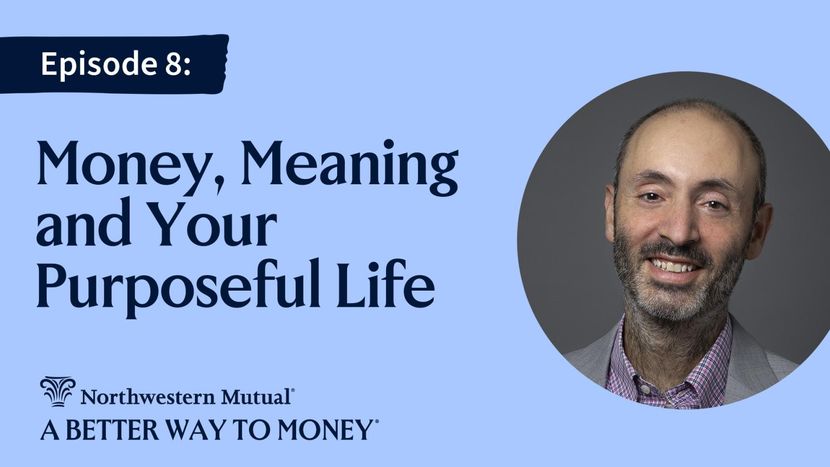
Building a life full of meaning, adventure and connection sounds like a dream come true. But if you find your day-to-day failing to measure up to that ideal, you’re far from alone.
Figuring out what lights you up is easy, according to former hospice physician and author Jordan Grumet. What’s harder is actually building a life that moves you toward your purpose every single day.
Use our No Regrets bingo card to help identify what matters most.
Dr. Grumet himself thought he had it all figured out—he was going to be a physician, just like the father he lost at age seven. But over time he realized he needed to develop his own path to find joy.
In this week’s episode of A Better Way to Money®, Dr. Grumet joins host Jennifer Borget to share the questions you can ask to help uncover your true purpose, as well as how to align your finances with your purpose—all while moving past unhelpful comparisons with those around you.
Whether you’re just starting to identify your purpose or you’re well down that road, this episode helps point you in the right direction to move forward.
[00:00:00] Dr. Jordan Grumet If we start by thinking about purpose—what's important to us, what lights us up, how do we want to use this precious time that we have, we then can start thinking about the different trade-offs involved with building a career and building a financial framework.
[00:00:19] Jennifer Borget What happens when the path you've worked toward your entire life doesn't turn out to be the right one? That's exactly what today's guest, Dr. Jordan Grumet, had to confront. After years of practicing medicine, he found himself burnt out, questioning everything—and ultimately decided to walk away. He's since left clinical practice to pursue his passion for deep conversations about purpose, money and life. Now he brings his perspective to how we think about purpose. In this conversation, we talk about the regrets people share at the end of their lives, why chasing someone else's idea of success can leave us feeling unfulfilled, and how to rethink the relationship between financial freedom and happiness. No matter where you are in either your personal or financial journey, I think you'll enjoy this conversation.
If you like this episode, don't forget to leave us a review and visit NorthwesternMutual.com/podcast for tools to help you take the next step in your financial journey.
All right, let's dig in. So, Jordan, I know you made a big career change from medicine and now you're sharing your personal finance and things like that. What led you to that decision to leave something that you've been working on for so long?
[00:01:37] Dr. Jordan Grumet Interestingly enough, Jennifer, I thought being a doctor was going to be my whole existence. So, my father was a doctor. He died suddenly when I was 7 years old. He was 40. And I thought, Okay, I'm going to just walk right in his footsteps, become a doctor like him. And that really formed the sole sense of purpose and identity that I had. And it really did fill me up. As a kid, this was really exciting. This is what I wanted to do. I had a learning disability. I overcame it because I knew that I was going to become a doctor. I went to college, studied really hard. When everyone else was at the football games, I was in the law library studying, and I became that doctor I wanted to be. But something happened. I didn't find it as joyful as I thought I would. For one, I thought by walking in my father's footsteps, I could somehow get rid of the sadness and trauma of him passing. And that was the sadness and trauma of a 7-year-old, but as a 30-year-old, I just realized, You know what, this didn't really do it.
[00:02:34] Jennifer Borget I think so many people probably can relate to that, like hitting at a certain point in their lives where they had these dreams of I'm going to do this forever, and I know that was me, too. You talked about saving the world; that was what I wanted to do as a journalist: I am going to uncover the stories and help save the world. But then at some point I had this realization of Oh, this isn't exactly what I want. Things evolved. We started a family. Things were different. Do you feel like that's something that a majority of people go through?
[00:03:08] Dr. Jordan Grumet I think it's quite possible, and the reason is what we think something is going to be doesn't necessarily reflect the realities. But it's really only when you're out there practicing that skill or trade that you actually find out if it's something that connects with you. But there can be a reckoning when you actually become that thing, and you realize that maybe it was everyone else's version of purpose, and it wasn't necessarily yours. And then there is a reckoning.
A lot of people don't even pay attention to the reckoning; they're just like, Well, this is what I have to do. This is how I'm going to make money. This is how I'm going to live my life. And they whittle away the one precious thing that we actually have no control over, which is time. Time passes—and I'm a hospice doctor, so I take care of dying patients, and almost every one of them says, Boy, I wish I had more time. Time passes no matter what we do. So what we fill that time up with is very precious. And unfortunately, most of us just don't think much about what really lights us up and what could feel like purpose.
[00:04:09] Jennifer Borget You mentioned being a hospice doctor and talking to people who feel like Oh, I'm running out of time. I wish I had more time. I imagine that gave you so much insight into how people are feeling at this time in their lives: Oh I should have lived my life this way or that way or maybe the regrets that they're talking about. What did that teach you about living your life more meaningfully?
[00:04:37] Dr. Jordan Grumet Well, here's what's interesting. I'm interested in personal finance. So, on one side, I wrote a blog and did a podcast about personal finance, but on the other side, I'm sitting with people who are on their deathbeds and talking about their regrets. And so half my time is spent talking to people all about net worth and building businesses and work. And then I go talk to these dying patients, and none of them say, I wish I worked more. None of them are saying, I made it to a net worth of a million dollars, but boy, do I really wish I hit two. No one says, Gosh, I should have worked more nights and weekends. That's just not what people say. They say some mixture ... if they're going to have regrets, they're going to say, I regret that I never had the energy, courage or time to ____, and then they fill in that blank with something that's deeply personal.
[00:05:24] Jennifer Borget Then what do you do with that? Does that impact how you talk to people about money? I imagine it changes how you, yourself, have looked at it, but that's got to be a great marriage of perspective, I think.
[00:05:37] Dr. Jordan Grumet Yeah, what it taught me ... I wrote actually wrote a book called Taking Stock, and one of the main premises of that book is we need to put purpose, identity and connections first and then build a financial framework around it. A lot of people build the financial framework and spend so much time thinking and worrying about it that if they're lucky enough to get to a point where that financial framework is stable, they're completely lost on what to do with that. On the other hand, if we start by thinking about purpose—what's important to us, what lights us up, how we want to use this precious time that we have, we then can start thinking about the different trade-offs involved with building a career and building a financial framework.
Look, I'm not Pollyanna. I'm not saying, Go follow your passion, and don't worry about money. Money's important. It's a really good tool, but we have to know what purpose looks like in our life so that we can then build that financial framework around it.
[00:06:36] Jennifer Borget I know in the purpose code, you write about two different types of purpose. And sometimes people hear the word “purpose” and they get stressed, anxious, like Oh, I have to pick; I have to decide what my purpose is, and I have stick with it. Can you break down what they are specifically, those two different types, and give us an example of that?
[00:07:01] Dr. Jordan Grumet Well, let me tell you how this came about. I wrote my first book, Taking Stock, based on that premise: We have to put purpose first and then build a financial framework around it. I went to a bunch of conferences and gave a bunch of talks, and I found two things that kind of contradict each other.
The first is that when you look at the studies, and there are tons and tons of studies, having a sense of purpose in life is associated with health, happiness and longevity. I mean, it's well studied. On the other hand, I found research, especially by Larissa Rainey, that showed that up to 91 percent of people at some point in their life get something called “purpose anxiety”—this idea that trying to figure out what your purpose is causes frustration, depression and anxiety. It actually makes you feel bad. So, I was left with this big question, this paradox. How could purpose be both the most important thing and yet incredibly anxiety provoking?
What I realized is that we just get purpose wrong. A lot of times we think purpose is one thing; I actually think it's two things. And I think one of those things is probably more associated with the anxiety, and the other is associated with the health, happiness and longevity. So, I gave them two different names. Big-P Purpose, the bad one, is goal oriented purpose, which is usually oriented toward big, audacious goals, especially here in the U.S. because we think, Boy, if I can think it, I can make it, right? This is becoming a billionaire, running that seven-figure business, becoming president. The problem with this type of purpose is (A) it's goal oriented, and (B) it's usually really hard to achieve. You have to be the right person at the right time, saying the right things, probably with the right genetics and then a whole bunch of luck. And if you don't have all those things, you're probably going to fail. Little-P purpose, instead of being goal oriented, is process oriented. And so instead of being all or nothing, it's kind of all or all. There's no way to fail; you find something that lights you up, and you do it. And if it stops lighting you up, you do something else.
[00:09:00] Jennifer Borget Jordan's work reminds us that wealth isn't just about numbers. Purpose doesn't have to be some massive calling. Sometimes it's just something that brings you joy. Up next, we'll hear how Jordan helps people connect their financial plans with the lives they actually want to live. But first, a quick message from Northwestern Mutual on how planning with purpose can help you create a more confident future.
[00:09:24] Speaker We all want our lives to be rich with meaning, adventure and connection, but too often the things we dream of doing can get pushed aside. That's why it's important to put your money where it matters. How? Meet with your financial advisor. They'll ask better questions that get to the heart of what matters to you. Then they'll help you design a comprehensive plan tailored to you that puts your top priorities first. If starting a business is important to you, your advisor can discuss strategies to help ensure you're financially prepared to take that step. If retiring early and traveling with your kids matters, you can explore tax-efficient retirement strategies that can help provide the flexibility you need down the road. Though it may seem like one more thing on your to-do list, the sooner you get started, the better. And getting started is easy. Go to northwestermutual.com/podcast and download our No Regrets bingo card. It'll help you get your thoughts in order so you're ready to build a financial plan with your advisor that prioritizes what matters most.
[00:10:22] Jennifer Borget What do you think are healthier ways to think about where purpose comes from? We talked about it a little bit, with the “what,” but why do you think a job is something that a lot of people do that with?
[00:10:38] Dr. Jordan Grumet I think a job is what we spend most of our time doing, so we believe it must be part and parcel. Purpose is easy. What lights you up and excites you? What do you lose track of time when you're doing it? When you're about to fall asleep and you imagine and dream what your best life looks like, what are you doing? Most people are scared to talk about it, but they'll dream of being a rock star, being an author or being a professional sports player, whatever it is. And you might not be the rock star or the New York Times best-selling author or the professional baseball player, but those things hold some real joy for you. And maybe you can start building a life of purpose around those things.
Most people don't do that deep work. They're told that their job is supposed to fill them up. They're told that they should do something important where they make money or have an impact. Society has pushed them in this direction, so that's all they know. And of course our job is supposed to be our purpose because we're spending 40, 50 hours a week doing it. And we spent all this time getting an education and being told that this was the key to success. How do we then turn from that narrative that America has taught us (and our parents have taught us, and social media has taught us) and then just walk away and say, Oh, it's just a job. I think people have trouble doing that.
[00:12:01] Jennifer Borget That's hard. Especially like you're saying, so much of our success is tied to career titles or how much money we have in our bank accounts. So, do you have any tips for getting out of that mindset?
[00:12:13] Dr. Jordan Grumet First and foremost, I think purpose is a very personal thing. When we're talking about our job titles, and we're talking about our money, and we're talking about how nice our house is or what things we have, a lot of times we're comparing ourselves to others. And I think that's where we end up having this purpose crisis; a lot of us try to take on what looks like purpose in other people, especially social media influencers, etc., who look like the perfect life, and then we try to recreate that.
I think the first and foremost is we really need to look inside and do something that's a little uncomfortable, which is asking, If you were on your deathbed, what would you look back at in your life and say was important, or what would you regret that you never pursued? Not what your neighbor would pursue. Not what your favorite influencer would pursue. Not what your parent would pursue. But what's really deeply important to you? And that's the first step. I tell people you don't find purpose, you build purpose. But it is true, you have to connect with those whisperings, those inklings, those things that are important to you. I call them purpose anchors.
If you're new to this and you're like, I feel lost and don't know what purpose is in my life, but I like what you're saying, and I think purpose is important, your real first job is to start thinking, What are the purpose anchors in my life? And there are some really easy, simple ways to do that. And then once you figure out the purpose anchors, which is actually the easy thing, you have to do the hard thing, which is start building a life of purpose around it.
The first step, though: What lights you up? And if you're having trouble doing that, both in the book and we can talk about it right now, there are some really easy ways to start thinking about what lights you up. I always tell people that other people, including your kids, should never be at least your sole version of purpose, and we'll talk about that in a moment, but how do you find your purpose anchors? Those are the inklings, the whisperings, the beckonings. Here are four really easy, quick and dirty ways.
Number one is a regret audit. That's what I talk about with the dying. If you found out you were dying tomorrow, what would you regret never having the energy, courage or time to do? Conduct your own regret audit with the looming possibility of your death ahead of you, and then realize that you're not dying. You actually have some agency, and let's turn those regrets into purpose anchors. Completely what I did. Ten years ago, I looked at my life and I said, Well, if I was to find out that I’m going to die tomorrow, I would really regret that I didn't traditionally publish a book. Well, guess what? That became a purpose anchor. Now, I had to do a bunch of hard work then, right? I had to look into an agent. I had to learn how to write. I was a blog writer; I had to learn how to actually write actual manuscripts as opposed to blogs. I had to talk to a bunch of people who had done it before. I mean, I have years of work ahead of me, but at least now I have an anchor to build a life of purpose around. Way one, a regret audit.
Way two, easy: the art of subtraction. Look at your job. Write down all your roles and responsibilities. Let's say you do 15 things regularly at your job. I want you to start crossing out everything you don't like or at least is boring to you. And at the end, are there one or two things that are left over? If so, those could be purpose anchors. Again, I'm a perfect example. Being a physician had me burnt out, and I didn't love it, but when I did the art of subtraction and did an audit of actually what I do at work, I found that there was one thing I would do even if you weren't paying me for it—and it was hospice work. So, that became a purpose anchor. I could start building more of that into my career and getting rid of other things. Remember, winning the game, adding in things you love, getting rid of things you loathe. It doesn't have to be cataclysmic; it doesn't all happen at once. You just slowly build that better life.
Way three of finding your purpose anchors: the joys of childhood. What were the posters in your room? What were the trophies? What were you drawing when you were a little kid? The thing about it is little children actually have a very clear sense of purpose, and usually it's not even goal oriented. They just love doing what they do. They want to be on their bikes all day. They go to the basketball court and play all summer long and don't even think about it. They forget to come home for dinner, right? We lose that as we get older, and we get pushed into school and careers and all those kinds of things. And all of a sudden, the things you loved in childhood you let go of. Those can be great purpose anchors. Again, with me, I loved baseball cards when I was a kid. And even now on Facebook when I see something about baseball cards my eyes light up, but if I'm ever looking for some purposeful activities, I could always go back to that.
And then last but not least, this is something it sounds like you do a lot, which is what I call the “spaghetti method.” If none of these other things help you find purpose anchors, throw a bunch of spaghetti against the wall and see what sticks. Say yes to things you normally don't say yes to. Hang out with people you normally don't hang out with. Do something that maybe makes you feel a little bit uncomfortable for a day, and at the end of the day, was it fun? Did you learn something? Would you do it again? If the answer is yes, then that could be a purpose anchor.
So, four really easy ways to start thinking about purpose anchors, and—I do coaching, and I do these exercises with someone where we talk about each way—I've never found someone who doesn't have at least 15 ideas at the end of going through those. The hard part is not finding the purpose anchors; it's building a life of purpose around them.
[00:17:18] Jennifer Borget I know you've talked to a lot of people on different ends of the spectrum: younger people who are trying to figure out what they want to pursue and older people (I guess they're not always older) at the end of their lives. You gave a great example of Well, you could be doing more now and maybe you're working a little longer; is that a common misconception you hear from people—this idea that financial freedom is the answer?
[00:17:47] Dr. Jordan Grumet Well, interestingly enough, the idea of financial independence and financial freedom have evolved over the last decade. Originally, the people who first started talking about this were the FIRE people—financial independence, retire early. Make a lot of money, quit your job and live happily ever after. These were a lot of frustrated people with very high-paying jobs who grinded it out doing things they didn't like until they had some net worth number and then took off. Over time, as the movement has evolved and millennials and Gen Z specifically have had more say, a lot of these people don't want to wait 10 or 15 or 20 years to live a good life. They don't want to put purpose off. We've really moved to something that's more akin to lifestyle design. Instead of saying financial independence is some net worth number or some amount of passive income, we're really changing the script to say that financial independence is living a life full of purpose, identity and connections. If you can do that without having a million dollars, you've won the game already.
[00:18:50] Jennifer Borget Exactly.
[00:18:52] Dr. Jordan Grumet So, there are a lot of different ways to get to financial independence. I would argue you are financially independent if you find a job that lights you up, a job you would do even if you don't get paid for it, but you happen to get paid enough to cover your monthly needs. Yes, you're going to need basic protective things like insurance, and you're going to have to do some retirement savings and do the basics. But you're kind of financially independent from day one if you're doing something you love, because what's the whole point of retiring? It's so you can stop working to start doing something you love.
[00:19:21] Jennifer Borget Not putting that off. I like that explanation; you don't have to have this number that you're okay with. You could potentially grind it out, but make sure you're having those experiences and filling your life with things that you love.
[00:19:39] Dr. Jordan Grumet And becoming the person you want to be. I get very philosophical about these things, and I think lots about happiness. You can try to buy your way to happiness, but it doesn't work really well. You buy something that makes you happy for a brief period of time, you hedonically habituate or adapt back down, and you're at your baseline level of happiness pretty quickly. Getting to this point where you truly feel like I am a better version of me because I'm doing things that are important to me—to me, that's the highest rung of happiness. And I think, again, we need to make the rest of our lives serve that.
[00:20:14] Jennifer Borget Thank you so much, Jordan. I feel like I could talk to you for another two hours! This is great. I've learned so much. Is there anything else that you want to add that I didn't ask you?
[00:20:25] Dr. Jordan Grumet I would just tell people, and I say this at the end of almost every podcast: Purpose is easy and abundant, although no one thinks it is. Purpose is out there. All you have to do is figure out your purpose anchors. The hard part is to build a life of purpose around them. But purpose is everywhere. It's not this pie-in-the-sky, ephemeral thing that's unreachable. It's here. It's palpable. You can do this. Purpose is the same exact thing. It's very manageable. It's abundant. It's easy. You've just got to learn the steps.
[00:20:59] Jennifer Borget A huge thank you to Dr. Jordan Grumet for this conversation. I loved how he reframed purpose not as a single monumental “why” but as a collection of meaningful “whats.” And when we center our financial lives around that kind of meaning, it can lead us to stop chasing someone else's dream and start building our own version of success.
If you're ready to align your finances with the life you actually want, visit northwesternmutual.com/podcast. There, you can download our free No Regrets Bingo card. Thanks so much for listening, and we'll see you next time.
[00:21:35] Speaker Northwestern Mutual is the marketing name for the Northwestern Mutual Life Insurance Company, NM, and its subsidiaries, including Northwestern Mutual Wealth Management Company (NMWMC), investment advisory services and federal savings bank. NM and its subsidiaries are in Milwaukee, Wisconsin. Not all Northwestern Mutual representatives are advisors. Only those representatives with “advisor” in their title or who otherwise disclose their status as an advisor of Northwestern Mutual Wealth Management Company, NMWMC, are credentialed as NMWMC representatives to provide advisory services.
Jordan Grumet is not affiliated with Northwestern Mutual, and the views expressed by Jordan Grumet do not necessarily represent those of Northwestern Mutual or its subsidiaries.


From job changes to raising financially-savvy kids to setting yourself up to retire, we'll have deeper conversations.
Feel better about taking action on your dreams.
Your advisor will get to know what’s important to you now and years from now. They can help you personalize a comprehensive plan designed to give you the confidence that you’re taking the right steps.
Connect with an advisor