Financial Curveballs: How to Take a Hit, Make a Plan, and Come Back Stronger
- A Better Way to Money Season 3 Episode 7
- Jul 09, 2026


Key takeaways
The Dreaded D’s—divorce, downsizing, disability, debt and more—aren’t rare. Plan for them before they happen.
Attack the pain points that weigh on you most first—it's the fastest way to build momentum and stick with a plan.
Shame keeps more people stuck than any interest rate. You don’t have to do this alone.


Have a plan for your money at every stage of life. Get our Family Finances Workbook.
Most people wait for a better time to deal with their debt. Lynnette Khalfani-Cox did, too—while covering personal finance for a living—before she confronted it, paid it all off, and built the financial stability she now teaches others to create. In this episode of A Better Way to Money, she breaks down exactly how she did it and what it takes for anyone to bounce back from a financial low point.
Debt is just one thing that can knock people off course. Lynnette's Dreaded D's cover the full list—divorce, death, disability, downsizing, and more—and her advice will genuinely help in the long-run: Get your mind right, build your community, and attack your pain points first. There's never been a better time to sit down with a financial advisor and figure out what that path looks like for you.


From job changes to raising financially-savvy kids to setting yourself up to retire, we'll have deeper conversations.
Let’s build a plan that holds up when life gets hard.
Whether you’re dealing with debt right now or trying to get ahead of it, we can build a financial plan designed around your unique situation—your income, your goals, and whatever comes next.
Find your advisorLynnette Khalfani-Cox:[00:00:00] If you have sleepless nights or anxiety or depression, and you’re worried about your finances [00:00:05] and your bills, that’s telling you something, right? And for a lot of folks, part of what tends to right the [00:00:10] ship is starting to make choices that are in alignment with their values.[00:00:15][00:00:20]
Jennifer Borget: Welcome back to A Better Way to Money. I’m Jennifer Borget. According to a recent Northwestern [00:00:25] Mutual survey, one in three Americans admit to spending everything they earn each month, [00:00:30] including a lot of people who, on paper, look like they’re doing just fine—a [00:00:35] good salary, a nice house, a life that looks solid from the outside, not [00:00:40] a paycheck-to-paycheck situation.
Today’s guest knows that story better than almost [00:00:45] anyone. Lynette Khalfani-Cox, known as The Money Coach, spent nearly a decade as a Wall [00:00:50] Street Journal reporter for CNBC, covering personal finance for a living, and the whole [00:00:55] time she was quietly carrying over $100,000 in credit card debt. [00:01:00] Eventually, she paid it all off and wrote Bounce Back: The Ultimate Guide to Financial [00:01:05] Resilience, the book she wishes someone had handed to her when things were at their worst.
[00:01:10] Whether a financial curveball comes out of nowhere or you experience a slow [00:01:15] creep into a place you don’t want to be, this conversation is for you. Before we get into [00:01:20] it, if you want to take control of your finances right now, grab Northwestern [00:01:25] Mutual’s free Family Finances workbook at [00:01:30] northwesternmutual.com/podcast.
All right, let’s dig in. Money stress [00:01:35] has a way of quietly taking over even when everything looks fine on the outside, and I know [00:01:40] you know that firsthand. You were a Wall Street Journal reporter for CNBC covering [00:01:45] personal finance for a living while also carrying over $100,000 in [00:01:50] credit card debt.
So, take us through what that chapter of your life was like.
Lynnette Khalfani-Cox: Well, in a lot of [00:01:55] ways, I tell people now that when I was deep in debt, I was very much in [00:02:00] denial. I had this sort of misconception that because I [00:02:05] wasn’t missing any payments, that it was okay somehow, the debt that I was carrying. [00:02:10] I was like, “What’s the problem? Debt collectors aren’t calling me. They’re not banging down my door. [00:02:15] I don’t have any late payments on my credit report.” And so I [00:02:20] felt like I was lulled into a false sense of security. Also, I had a really [00:02:25] good-paying job. I was making a very nice six-figure salary. So I was like, [00:02:30] “Everybody has debt. What’s the problem?”
But obviously, it was [00:02:35] a problem. It did get to the point where I was like, “This is [00:02:40] excessive.” I was maxed out with my credit [00:02:45] cards and all of the things that I was using to kind of float the lifestyle. [00:02:50] And so after a while, I got fed up with that. I was like, “Okay, this is [00:02:55] insane to live this much on the edge financially.”
I knew I had to make a change.
Jennifer Borget: [00:03:00] Debt is so easy to rationalize, right? People will [00:03:05] say, “I’ll deal with it after my next paycheck. I deserve this; it’s [00:03:10] not that bad yet.” A lot of us have been in these types of situations, [00:03:15] so when you were in it, what were you telling yourself, and how did the story you were [00:03:20] telling yourself change as the debt kept growing?
Lynnette Khalfani-Cox: Well, part of what I told [00:03:25] myself was “I’m handling this. This level of debt is sort of [00:03:30] normal. I can deal with it.” And the [00:03:35] rationalization came in because, A, I wasn’t missing payments; B, I had a good [00:03:40] income and a good job; and C, I felt like I could[00:03:45] “afford a lifestyle” that I clearly was not able to [00:03:50] afford.
So, it was just like a little perfect storm of [00:03:55] mental gymnastics, where you just convince yourself and maybe[00:04:00] gaslight yourself into thinking everything is okay when deep [00:04:05] down, subtly, like emotionally, you know it’s [00:04:10] not. And the red flags, the warning signs that I had too [00:04:15] much debt were absolutely there.
Jennifer Borget: And then you turned [00:04:20] everything around. You managed to pay off your debt in three years. You went [00:04:25] from making minimum payments—“Hey, I’m making my payments”—to not missing [00:04:30] a single payment while also launching a business, raising a family. Walk us through what [00:04:35] that strategy was, as well as your mindset that you had to have.
Lynnette Khalfani-Cox: Sure. [00:04:40] At the time, I wish I could say that there was some magical strategy to it [00:04:45] or some complex formula that I put together or some step [00:04:50] one through five that I knew to take to make it all magically disappear. Not by a long [00:04:55] shot. Some of it was trial and error. For me, one [00:05:00] of the strategies that I started doing was not paying minimum payments. [00:05:05] Again, I now realize that minimum payments in the short run [00:05:10] really mean maximum payments in the long run.
So, it felt comfortable to pay [00:05:15] minimum payments because I was like, “Okay, good, this is good for my cash flow.” But of course, [00:05:20] doing that—minimum payments only—is just like making the banks and the credit card [00:05:25] issuers get rich off of you because your credit comes at a [00:05:30] cost, which is their profit, and I don’t begrudge them their right to make a profit.
But [00:05:35] every time you extend and delay and put off [00:05:40] making more aggressive principal payments on your [00:05:45] debt, it just keeps you stuck in that cycle month after month, year after [00:05:50] year. So I started doubling and tripling the [00:05:55] payments that I was making to allow me to chip away at my obligations [00:06:00] at a much faster clip.
I negotiated some of my [00:06:05] credit card interest rates; as a matter of fact, I just got on the phone and asked [00:06:10] all of my creditors for lower interest rates. Literally nine times out of 10, when [00:06:15] I would ask, they would do it. And so I found out that a lot of [00:06:20] times, getting such deals is yours for the asking.
But a lot of [00:06:25] people don’t want to ask. They feel like, “Oh, it’s me against the big, bad bank,” and they’re [00:06:30] reluctant to do so. I tell people now, “Don’t be afraid to ask. [00:06:35] A closed mouth doesn’t get fed.”
Jennifer Borget: That’s a really good tip, asking for the lower rate. [00:06:40] You know, you’re getting these offers in the mail, and you’re like, “Dang it,” but just ask the bank you’re already [00:06:45] with.
Now, I know not everyone’s story looks the same, but at some point most of [00:06:50] us are going to face some kind of setback, right? So, your book Bounce Back is [00:06:55] built around what you call the Dreaded D’s. Walk us through this list. What are we [00:07:00] actually talking about, and why is it smarter to plan for the hard stuff than to [00:07:05] assume it’s just never going to happen?
Lynnette Khalfani-Cox: Well, even though I personally am not a millennial [00:07:10] (I’m a member of Gen X), when I was in my [00:07:15] 30s and early 40s, that’s when stuff started going south [00:07:20] in a lot of ways, and I started personally encountering a lot of the so-called [00:07:25] Dreaded D’s. It’s things like Downsizing from a job, a Death in the [00:07:30] family of a main breadwinner, Divorce, Disability, [00:07:35] Debt (of course), and Damaged credit. Even things like [00:07:40] Discrimination, which packs a powerful punch, emotionally and financially. [00:07:45]
And so I tell people that, again, none of us is immune [00:07:50] to these life challenges, right? What I share with people now [00:07:55] is that the smarter way to move in your life [00:08:00] and in your personal finances is to anticipate and to plan [00:08:05] around some of these things that are just naturally, cyclically, and [00:08:10] statistically likely to happen to all of us at one point or another.
Jennifer Borget: You’ve been [00:08:15] running a personal finance education company since 2003, and I think it’s great because you’ve [00:08:20] actually lived these things that you’re telling people about. Are you [00:08:25] seeing anything new or different in how people are experiencing these setbacks or how people are [00:08:30] thinking about them these days?
Lynnette Khalfani-Cox: I am seeing some differences. We’ve certainly [00:08:35] seen evolution in the types of debts that people have succumbed [00:08:40] to. I remember when there were peer-to-peer loans—P2P [00:08:45] loans came in vogue and were very popular. Right now it’s BNPL: Buy now, [00:08:50] pay later, and that’s a huge category for a lot of millennials.
[00:08:55] Again, the research around this—and I’ve been sounding the alarm about it, to be honest, but [00:09:00] the research around this that we’re seeing is that the people who get into [00:09:05] debt with things like buy now, pay later, they are more [00:09:10] likely to be millennials or younger people, or they’re more likely to have already faced [00:09:15] a Dreaded D and a setback. They may have been [00:09:20] priced out or not have credit, traditional forms of credit, like credit cards [00:09:25] at their disposal. So now to be able to afford a lifestyle, to keep [00:09:30] up, to buy things, to purchase what they want, et cetera, whether that’s travel, [00:09:35] clothes, electronics, furniture, anything that they can put on a type of installment [00:09:40] plan, the thinking is, “I’ll pay this off in three equal payments.”
[00:09:45] The idea is that this is no interest, so this is going to be good for me. This is a better [00:09:50] form of obligation. It’s not a traditional credit card debt. [00:09:55]
Well, again, we’re seeing some of the numbers come out from this now. A lot of millennials [00:10:00] and others are saying, “Oh my God, I regret this,” because they have so many buy now, pay later [00:10:05] obligations that they can’t even keep up with or they’re not tracking appropriately.
[00:10:10] We’ve seen an evolution in terms of products that are [00:10:15] offered to people. We’ve seen an evolution in terms of people’s abilities to [00:10:20] handle debt. In my estimation, I think the debt problem in America has gotten [00:10:25] worse over the last two decades, unfortunately, not better.
[00:10:30] So much of consumer spending, 70% of the economy, is [00:10:35] built around debt and around consumer spending, but also jobs, right? To the [00:10:40] extent that people feel comfortable and they feel like, “Okay, my job is secure,” then [00:10:45] they’re willing to spend; they’re willing to take on credit and loans of various kinds. [00:10:50] But obviously right now we’re dealing with an uncertain economy at so many levels. [00:10:55] Inflation is still rearing its ugly head, and I think that for a lot of [00:11:00] people, they feel like the walls are closing in a little bit here—that there’s [00:11:05] just too much to handle.
Jennifer Borget: And you talked about buy now, pay later. I think of [00:11:10] my vice: Sometimes I was like, “I’m never paying for a monthly [00:11:15] subscription. I hate monthly subscriptions.” But now there are so many things that I have, [00:11:20] and I have to weigh “Okay, do I do the annual? Do I do the monthly?”
I usually do the annual to save [00:11:25] money, but then sometimes I stop using it and I forget, and then it renews. You forget ... [00:11:30]
Lynnette Khalfani-Cox: We’ve all done that. Yes. We’ve all totally done that. [00:11:35] And listen, we’ve moved to a subscription-based economy. You know, [00:11:40] when you asked about what’s different now, a lot has changed. I was [00:11:45] referencing jobs. I want to complete a thought there ... because AI, obviously that’s something new, right? Right. And to the extent that AI [00:11:50] is now, [00:11:55] in part, responsible for an ongoing trend of job [00:12:00] losses, that’s taking away people’s feeling of comfort and security. [00:12:05] And for some people, it’s forcing them to turn toward debt. If they haven’t [00:12:10] righted the ship before or set a game plan for how you deal if you [00:12:15] have, say, one income in the family now where you previously had two, [00:12:20] then the typical thing that people do is rely on plastic or on credit of some [00:12:25] form.
So yeah, we see that people are turning to credit [00:12:30] cards more often, turning to buy now, pay later; turning to personal loans; [00:12:35] or they’re part of that gig economy, right? Another shift that we’ve [00:12:40] seen where it’s like, “Let me have a side hustle. Let me have a freelance contract job. Let me have a [00:12:45] second or third position.” And there’s only so far hustle culture can [00:12:50] take you. Because keep living, as I’ve [00:12:55] done. It gets exhausting, and you’re just like, “What am I working for? I’m just literally working to keep a roof [00:13:00] over my head.”
So yeah, we’re up to our eyeballs in debt in this [00:13:05] country, and it really does behoove us to think about what are the strategies [00:13:10] to mitigate some of this and to make sure that we don’t [00:13:15] wind up in a spiral where it kind of seems hopeless and [00:13:20] helpless. Because that’s where they get stuck, where they feel like, “Ugh, I can’t get out of this.” [00:13:25] Or they kind of throw in the towel mentally. They may not say it, or sometimes they do, [00:13:30] but when you’re deep in debt, and I know this, again, from personal experience, there’s [00:13:35] a part of you that goes, “I already owe $30,000. What’s another thousand or two?” [00:13:40]
When you want to do something or rationalize or justify it or say, “Oh, just this one time” [00:13:45] or whatever, it tends to create this mindset like, [00:13:50] “Jeez, I’m already screwed here. How much worse can it get?” You know, that kind of [00:13:55] thing.
Jennifer Borget: Life events don’t come with a warning. A layoff, a [00:14:00] health scare, a divorce, a new baby. Any one of them can completely reshape [00:14:05] your financial picture overnight. And the people who recover fastest aren’t the ones who [00:14:10] earned more or saved perfectly; they’re the ones who had a real plan in place before [00:14:15] things got complicated. That’s exactly what a Northwestern Mutual advisor is there for.
They’ll work [00:14:20] with you to build a financial plan that’s designed around your actual life, your income, your [00:14:25] goals, what you’re protecting, and what you’re building, so that when life takes you off course, you’re [00:14:30] not starting from scratch.
Coming up, Lynette gets specific: the new reality of [00:14:35] debt, the practical moves, and her best advice for people who feel like their spending is [00:14:40] slowly getting out of hand. Let’s bring her back in.
I’m curious what you [00:14:45] think some of the big warning signs are. I know sometimes when we think of other people [00:14:50] and their debt, we look at it differently. There’s that movie Confessions of a Shopaholic (I don’t [00:14:55] know if you’ve seen that), where she has to freeze her credit cards because she just loves shopping and she’s addicted to [00:15:00] that.
But it’s not necessarily like that experience for everyone. So, from your own personal [00:15:05] experiences as well as maybe your professional knowledge, what are some of the big warning signs that the [00:15:10] debt someone’s accumulating is dangerous for their financial health versus something [00:15:15] that’s maybe normal for this stage of life?
Lynnette Khalfani-Cox: Well, “normal” is a [00:15:20] really weighty, loaded, subjective kind of word. [00:15:25] So I guess part of what I would say is it’s really not the financial [00:15:30] side as much, because honestly, people know the financial side. If you’re like, “I can’t pay my [00:15:35] bills. I don’t have enough money to pay my bills,” you know that’s a problem.
But I think that, [00:15:40] really, where we first get information and get data that’s [00:15:45] relevant is in our own minds and our emotions and our [00:15:50] hearts and in our relationships. The personal stuff shows up [00:15:55] before the actual financial stuff shows up. And here are some examples [00:16:00] of what I mean by that.
If you are stressed to go to the [00:16:05] mailbox or to open up your credit card statement, that’s telling you something, [00:16:10] right? If you’re like, “Oh, I got a bad feeling in the pit of my stomach,” if you have sleepless [00:16:15] nights or anxiety or depression, and you’re worried about your finances and your bills, that’s a [00:16:20] strong signal.
If you’re arguing with your partner or your spouse over money issues [00:16:25] or who spent what and whatnot, again, those are all tells [00:16:30] that your finances need more attention, more love and attention, more time [00:16:35] spent, and perhaps a reorienting of things. [00:16:40] And for a lot of folks, part of what tends to right the ship is starting [00:16:45] to make choices, spending choices, investment choices, [00:16:50] debt payoff choices, et cetera, that are in alignment with their values and what they [00:16:55] really want and what they say they want.
Sometimes there’s a disconnect. People might say, [00:17:00] “I totally value education. This is so important to me.” And then you’re like, “Oh, okay, are you [00:17:05] saving for your kid’s college education?” They’re like, “Uh, not yet.” You know? And it’s like, [00:17:10] “Okay, well, how important is that education really for you? Because you know you had student loan [00:17:15] debt; and you know when your kid, who’s now three years old, 15 years from now, [00:17:20] college is going to be a lot more expensive.”
Sometimes we try as money [00:17:25] coaches and as financial experts to help people to close the gap between what [00:17:30] they actually do and what they say they want or what they say they want [00:17:35] to do. And it’s not for us to judge. It’s not for us to point a finger or to wag [00:17:40] our ... and say, “Oh, you’re doing something bad or wrong” because all the shame and the blame and all that, honestly, [00:17:45] it doesn’t work. It’s counterproductive. It’s easy for us to say, “Well, jeez, you [00:17:50] make $60,000 a year. You can’t spend $70,000.”
On math, on paper, of course, [00:17:55] we know that. Yeah, of course you don’t spend more than you earn. Duh, we get it. But [00:18:00] have we taken the time to kind of do a deep dive with somebody and to talk through [00:18:05] what it is that they’re spending on? If they’re saying, “I go [00:18:10] out to eat three times a week,” or, “Every Friday night, my friends and I do this,” and you ask [00:18:15] them, “So, what do you get out of that? And do you feel like what you’re doing is about [00:18:20] right, a healthy amount, a little less than you’d like, or more than you’d like?” Let them come [00:18:25] to the answer on their own. Sometimes when they kind of talk it out and look [00:18:30] at it, they’re like, “Honestly, I don’t really need to go out three times a week. I could probably do like once a [00:18:35] week and maybe cut back here or ...” You kind of explore things with them, [00:18:40] again, without judgment.
I mentioned to you before that I didn’t have a [00:18:45] plan at first, right? I knew the advice; people were like, “Pay off your high interest rate credit card [00:18:50] debt first.” That absolutely didn’t work for me, not at all. Now, [00:18:55] again, two decades into this, I don’t teach people that method. I tell people, “Attack your [00:19:00] own area of pain. Whatever it is that’s bothering you, [00:19:05] go after that most aggressively first.” Because that’s what somebody’s going to stick [00:19:10] with over time. They’re going to see the results of their actions, and they’re going to feel good about it. [00:19:15]
Some people, yes, they’re really upset, especially in this current interest rate environment. [00:19:20] They’re like, “Oh my God, my credit cards are like 20-something percent. I can’t stand to see all this. I’m paying [00:19:25] these payments, but my balances aren’t really shrinking.” That frustrates them, so maybe they [00:19:30] do want to focus on high interest rate debt. But other people have a [00:19:35] lot of credit cards outstanding, and they’re like, “I can’t even keep up with it all. I’m juggling. I [00:19:40] forgot. I missed payments. I got dinged with a late payment.” And for those [00:19:45] people, the better strategy is actually to pay off the cards with [00:19:50] the lowest dollar balance first so little by little, they can [00:19:55] chip away and eliminate some of the cards. They might have a card that has just [00:20:00] a $400 balance on it. Maybe they pay $200, $200, that one is gone. And then they [00:20:05] take the next $200 that they were applying, and they go to the next card. So [00:20:10] that’s another strategy to address that person’s pain point.
[00:20:15] I know that was a long-winded way of what I’m trying to say, but really the strategy is [00:20:20] tackle the pain point. Whatever’s bothering you, [00:20:25] go after that first, and marshal more resources toward that.
Jennifer Borget: [00:20:30] I know you’ve mentioned this, and you talk about this in your work, how shame [00:20:35] surrounds the financial struggle. Why does that silence [00:20:40] about it make the problem so much worse, and then how can people start to [00:20:45] break it?
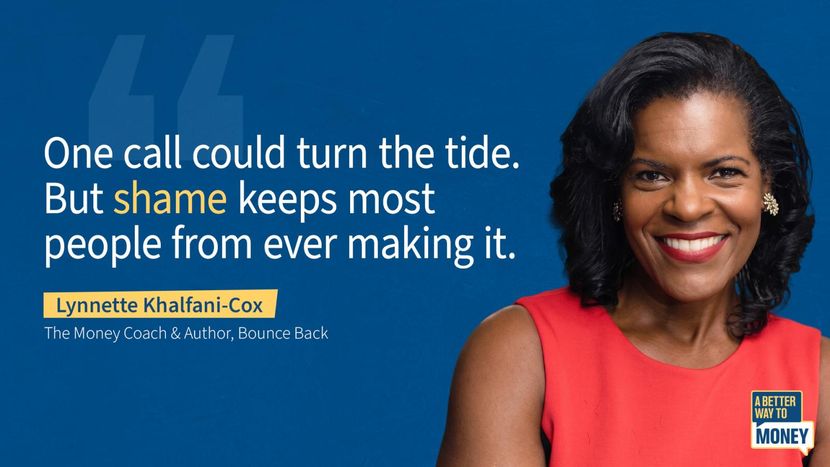
Lynnette Khalfani-Cox: I think the reason that shame really prevents [00:20:50] people from moving ahead with their finances in general, and certainly with debt, is that it [00:20:55] prevents them from reaching out to get help. And so many [00:21:00] times it’s one phone call could turn the tide.
[00:21:05] Unfortunately, most of us who’ve been in debt, we suffer in silence. And [00:21:10] for those of us who are college educated, it’s almost worse. [00:21:15] We’ll say things—for me, I’ll say, “I have a master’s degree. I should have been [00:21:20] smarter than this. How could I have gotten myself into this hole?” Or we’ll say things like “I made my [00:21:25] bed; I have to lie in it. I got myself into this, I have to get myself out.” No, you don’t. [00:21:30] You don’t have to do this alone by any stretch of the imagination.
[00:21:35] One of the things that I share in Bounce Back, the first couple of chapters, is not personal finance [00:21:40] advice. It’s not like prescriptions on how to financially recover immediately. No, the [00:21:45] first part is about getting your mind right. It’s about establishing [00:21:50] community and connections and doing a lot of self-care to be able to [00:21:55] move forward in the best possible manner. [00:22:00] So, one of the things that I talk about in Bounce Back is getting help, [00:22:05] not being afraid to reach out.
We also think [00:22:10] mistakenly that we’re the only ones. We’re like, “Okay, everybody else is out there”—you’re seeing your friends on social, [00:22:15] traveling, living their best lives (ostensibly living their best lives), you know? [00:22:20] They’re giving you the curated social media version. You don’t see the stress when [00:22:25] the bills come.
But the idea is if you [00:22:30] have connections of various kinds, the people who recover from setbacks [00:22:35] like the Dreaded D’s more quickly and in a more robust [00:22:40] and full manner are those who prioritize community and people [00:22:45] and relationships. It’s not really like the personal finance advice that people are like, “What? [00:22:50] This sounds kind of woo-woo here. What are you talking about?”
Having the right people helps in [00:22:55] so many ways. Lost your job? Okay, you might take some time, [00:23:00] take a beat to regroup because it’s a devastating emotional blow to get a pink [00:23:05] slip, right? But then when you get back in the saddle and start searching for another [00:23:10] job if you’ve been downsized, and that’s the Dreaded D you’re facing, who’s going to [00:23:15] help you to get that next one? Probably a friend, a colleague, a former [00:23:20] co-worker, somebody you know. Having those relationships can help you to [00:23:25] get reoriented in the job front. Again, people who’ve gone through a divorce, I’m not telling you to jump [00:23:30] back in the saddle there immediately and try to go, “Let me find another [00:23:35] spouse.”
Jennifer Borget: Yeah, that’s one way to do it!
Lynnette Khalfani-Cox: It could be, you know? But [00:23:40] later, after you’ve processed, you’ve done your own work, and you’re [00:23:45] ready, it might be your social circles or connections. It could be [00:23:50] through your church, your synagogue, your mosque. It could be through your [00:23:55] place where you volunteer or do any kind of civic engagement, [00:24:00] social activities that you do.
It's going to be the relationships and the people around you, and you’re like, “Oh, wow, I just happened [00:24:05] to meet somebody. I wasn’t even looking” kind of thing, you know? So, it’s better to get [00:24:10] yourself together first before you go on to the next phase whenever you’re trying to recover [00:24:15] from one of the Dreaded D’s.
Jennifer Borget: Now, Lynnette, I want to ask you a little bit about savings too, like [00:24:20] emergency funds, savings. That’s for long-term goals. That’s kind [00:24:25] of Personal Finance 101. But contributing to those things while you’re already [00:24:30] in debt can feel really impossible. So how should we be [00:24:35] reframing this problem? How can we have a financial plan, [00:24:40] and how can that help achieve this balance while we’re in debt and we’re also trying to [00:24:45] save?
Lynnette Khalfani-Cox: Well, Jen, you said the key word, “balance,” and I’m often [00:24:50] asked, “What should I do first? Save more money or pay off debt?” And sometimes people [00:24:55] don’t like the answer because you have to do both simultaneously. [00:25:00] I know it’s hard; I know it’s a challenge, but there’s a method to this [00:25:05] madness, and there’s a reason why doing one or the other [00:25:10] exclusively actually hurts you financially in the long run.
If you, say, [00:25:15] just want to focus on debt payoff—if you’re taking your income, for [00:25:20] example, and you’re like, “I can’t take it with these student loans or this credit card debt or these buy now, [00:25:25] pay later obligations, and all I want to do is just focus on getting rid of the debt, that’s it, that’s it, that’s it,” [00:25:30] and you don’t have any savings whatsoever, let me tell you what’s going to happen.[00:25:35] Something is going to go wrong in your life. It might not be one of the big Dreaded D’s. [00:25:40] It could be a smaller thing. You might get a flat tire. Your toilet could [00:25:45] leak in the house or an apartment, and you absolutely have to call a plumber. Now, all of a [00:25:50] sudden, your $200 tire or your [00:25:55] $500 plumbing visit, the bill is due, and you have no [00:26:00] savings whatsoever.
So, what are you forced to do? Whip out the credit card, [00:26:05] relying on plastic, and then you go deeper into the cycle of [00:26:10] debt. Without that emergency savings on hand, you [00:26:15] put yourself back in that debt cycle time and time again. [00:26:20]
Ditto for the opposite end of things. If you’re like, I just want to keep [00:26:25] saving because I’m trying to reach a goal, or I want to do this, and I’ll worry about the debts later,” [00:26:30] if you only focus on saving, saving, saving so much that you’re not aggressively paying [00:26:35] down that credit card debt (you could still be making your payments), your debt balances [00:26:40] actually grow, especially given double-digit interest rates. So, [00:26:45] again, you have to do both.
Jennifer Borget: And a lot of people think that they want to do this later. [00:26:50] They are like, “I’m going to wait. I’m going to [00:26:55] worry about paying off all that until after my kids are through school. Things are going to settle down a little bit.” [00:27:00] What would you say to someone who keeps waiting for the right time to start [00:27:05] this, and what are the moves they should be making right now no matter what position they’re in?
Lynnette Khalfani-Cox:[00:27:10] There is no ideal time to start. I don’t know if it was Warren Buffett or [00:27:15] somebody else who said the best time to plant a tree was yesterday, you know? [00:27:20] And the next best time is now, today. You have to get it going [00:27:25] to be able to plant those seeds that later you can profit [00:27:30] from.
It’s always better to ... if you think something is of value to you right now and [00:27:35] aligns with your values and what you think is important, better to start now, whether that’s [00:27:40] saving, paying off debt, investing, being prudent with your [00:27:45] finances overall, looking for ways to connect with professionals.
If you think [00:27:50] it’s a good strategy—and I absolutely know that it is—to have advisors, [00:27:55] then why wouldn’t you start assembling your team now? You can look for a [00:28:00] financial advisor. You can look for a CPA. You can look for a money [00:28:05] coach or just an educator of any kind that you feel aligns and can teach you something. [00:28:10] You don’t have to wait for some magical point in the future to [00:28:15] get started.
Jennifer Borget: Lynette, for people listening right now, there’s a lot of millennials who [00:28:20] are experiencing their first ever real financial curveball, maybe a [00:28:25] Dreaded D, a layoff, a medical bill, a divorce. What’s the first [00:28:30] move when everything feels like it’s falling apart? What should they do?
Lynnette Khalfani-Cox:[00:28:35] I think the first step after you’ve had a setback is to take a step back [00:28:40] and to assess. This is a hard thing for people to do [00:28:45] because the inclination, the instinct, is, “Let me fix it. Let me jump right back in. [00:28:50] I lost a job; let me go back out there and go get another job,” or “I had a [00:28:55] credit problem; let me just try to double down on that and do something to fix the credit problem.” [00:29:00]
But without any sort of thought or analysis or expertise or [00:29:05] guidance, and you could have just restarted the clock. It’s not always a good idea to [00:29:10] just be like, “Let me just fix the problem. Let me just jump right back in there.” The first step is [00:29:15] actually pause, do nothing, sit still [00:29:20] because the emotion that is tied to whatever event [00:29:25] that’s gone on means that you’re just not in your right perfect or more [00:29:30] ideal frame of mind to make good financial choices.[00:29:35]
I know it’s counterintuitive, but the pause [00:29:40] is actually part of the process. The pause is actually part of what [00:29:45] will help you to move forward.
Jennifer Borget: That’s Lynette Khalfani-Cox, [00:29:50] the money coach, New York Times bestselling author, and someone who’s lived every [00:29:55] part of this conversation. Here’s what her story makes clear: It never feels like the right time to [00:30:00] get your finances together. Life doesn’t wait. A layoff, a medical bill, a [00:30:05] relationship ending, any of life’s curveballs can hit before you feel ready, but the earlier you have your [00:30:10] plan, the less it knocks you off course.
That’s where a Northwestern Mutual advisor comes [00:30:15] in. They’ve seen it all, the debt, the avoidance, the pivots, the fresh starts.[00:30:20] They’re not there to judge where you’ve been. They’re there to help you build a flexible [00:30:25] plan that can keep up with whatever life throws at you next. Start with Northwestern Mutual’s free [00:30:30] Family Finances workbook at northwesternmutual.com/podcast. And when you’re [00:30:35] ready to talk to someone, an advisor is right there.[00:30:40]
Next time on A Better Way to Money ...
Jonathon Gais: There’s always something that [00:30:45] feels like I’m just not ready yet. There’s some hurdle in the way, and being able to just start the plan [00:30:50] matters more than if the plan is perfect.
Jennifer Borget: We’ve spent this season talking about the big [00:30:55] life moments that reshape your finances, but what about the blind spots hiding in plain [00:31:00] sight?
Jonathan Gais from Northwestern Mutual joins us to talk about what most people get [00:31:05] wrong about money, why intention matters more than income, and how to finally close the gap [00:31:10] between what you know and what you do. Tap “follow” in your podcast app so you don’t miss it.[00:31:15]
Northwestern Mutual is the marketing name for Northwestern Mutual Life Insurance Company (NM) [00:31:20] and its subsidiaries, including Northwestern Mutual Wealth Management Company (NMWMC), [00:31:25] investment advisory services and federal savings bank.
[00:31:30] NM and its subsidiaries are in Milwaukee, Wisconsin. Not all Northwestern Mutual representatives [00:31:35] are advisors. Only those representatives with “advisor” in the title or who otherwise [00:31:40] disclose their status as an advisor of Northwestern Mutual Wealth Management Company [00:31:45] (NMWMC) are credentialed as NMWMC representatives to [00:31:50] provide advisory services.
Lynette Khalfani-Cox and themoneycoach.net are [00:31:55] not affiliated with Northwestern Mutual, and the views expressed by Lynette Khalfani-Cox do not [00:32:00] necessarily represent those of Northwestern Mutual or its subsidiaries.