What You Do With Your Money Matters More Than How Much You Have
- A BETTER WAY TO MONEY SEASON 3 EPISODE 11
- Sep 03, 2026


Key Takeaways
Meet Michael Norton, Harvard's spending and happiness expert shares his secret to happiness and other charitable spending tips.
Follow the golden rule of spending: some for you, some for others, some saved
It's not the amount you spend—it's the direction of your spending.
Pause before buying and ask if it'll truly make you happier.


Have a plan for your money at every stage of life. Get our Family Finances Workbook.
We spend a lot of time on this show talking about how to grow and protect your money. But Harvard Business School Professor Michael Norton has spent most of his career asking a different question: Does how you spend money actually change how happy you are?
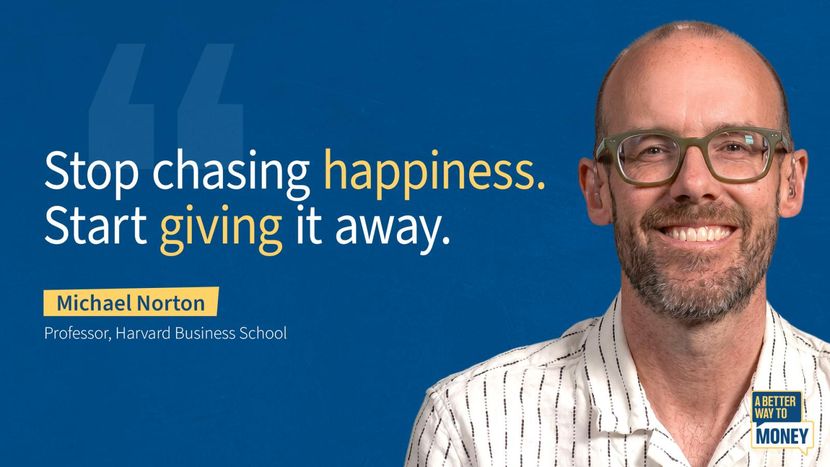
In this episode of A Better Way to Money, host Jennifer Borget talks with Norton, co-author of Happy Money: The Science of Happier Spending, about what years of research reveal about generosity, spending, and joy, including a golden rule for spending: some for you, some for others, some saved.
Norton's findings cut against instinct: Buying things for ourselves rarely moves the happiness needle, while spending on others—even in small amounts—reliably does. So the next time you treat yourself, consider treating someone else too. That small shift tends to maximize happiness in the long run, and it gives your hard-earned money real meaning.
And if you want to get in on the good feelings right now, hit follow on A Better Way to Money. For every new follower in September, Northwestern Mutual will donate $10 to Alex's Lemonade Stand Foundation—up to $5,000.
This supports Northwestern Mutual's larger commitment to accelerating the search for better treatments and cures for childhood cancer, while also supporting families and survivors living with long-term side effects. That’s the kind of giving Michael’s research says actually means something.


From job changes to raising financially-savvy kids to setting yourself up to retire, we'll have deeper conversations.
Let's build a financial plan around what actually makes you happy.
Whether you're rethinking how you spend, save, or give, we can help you build a financial plan that reflects what matters most to you.
Find your advisorMichael Norton: [00:00:00] We're not good at knowing what is going to make us the happiest, and we focus on [00:00:05] the very short term of what makes us happy. So think about your spending. Is it reflecting your [00:00:10] values? And if not, maybe make some changes and see what happens. Then I can be happier in the end. [00:00:15] [00:00:20]
Jennifer Borget: We spend a lot of time on this show talking about how to manage money, how to budget, [00:00:25] how to protect what you have, and how to plan for what's ahead. But today's guest has spent his career [00:00:30] asking a different question: Once you have money, does the way you spend it actually [00:00:35] change how happy you are? Turns out, yes, just probably not in the [00:00:40] way you'd expect.
Michael Norton is a professor of business administration at Harvard Business [00:00:45] School and co-author of Happy Money: The Science of Happier Spending. His research [00:00:50] shows that spending on other people freely—by choice, not out of [00:00:55] obligation—tends to make us happier than spending on ourselves. It's a finding that holds across [00:01:00] countries and income levels, with amounts as small as $5.
And [00:01:05] that finding has some real implications for how we should think about building a financial life. [00:01:10] Whether you're just starting to figure out what to do with your first real paycheck, or you're already [00:01:15] doing all the right financial things and still feeling like something's missing, this [00:01:20] conversation's for you.
And one more thing: This episode drops during Childhood Cancer [00:01:25] Awareness Month, and Northwestern Mutual is marking it with action. For every new follower [00:01:30] of A Better Way to Money in September, they'll donate $10 to Alex's Lemonade Stand [00:01:35] Foundation, a leader in advancing innovative childhood cancer research, up to [00:01:40] $5,000. This supports Northwestern Mutual's larger commitment to accelerating the [00:01:45] search for better treatments and cures for childhood cancer while also supporting families and [00:01:50] survivors living with long-term side effects. Since 2012, Northwestern [00:01:55] Mutual has funded more than 860,000 hours of childhood cancer [00:02:00] research and contributed more than $75 million to the cause overall.
Hit [00:02:05] follow in your podcast app to help find better treatments and cures.
All right, [00:02:10] let's dig in. Now, Mike, what got you interested in this work, and how did [00:02:15] you think about generosity growing up?
Michael Norton: I was doing [00:02:20] research on things like income and wealth inequality, which I still do research on [00:02:25] and I think is a very important topic.
But my friend and eventual collaborator, Liz Dunn, [00:02:30] said, "You're a bummer. You're studying these things that are really [00:02:35] sad, and they're making you sad." And she said, "We're going to study happiness together." And [00:02:40] I said, "It's a very nebulous concept. What is happiness?" And she said, "Too bad. We're going to do it." [00:02:45] And that shift was incredibly important for me.
She said, "What [00:02:50] if we start by just asking people to give money away instead of spending it on [00:02:55] themselves?" And I just thought it was such a simple and elegant idea that no one had looked at [00:03:00] before. So I said, "Oh my God, we have to do that." And that got me in, and then we kept [00:03:05] working together, and then eventually we wrote this book.
It really actually changed my trajectory [00:03:10] of my research to be more about ... I still study the bummer things, but more [00:03:15] about helping people in their everyday lives think about how to maximize their happiness.
Jennifer Borget: Yeah. [00:03:20] And I would hope that it helped your mood, too, and your research day to day with [00:03:25] your work and things like that, having a little more balance there.
Michael Norton: We'll have to ask Liz. We can, we can bring Liz in and [00:03:30] see if I'm any happier.
Jennifer Borget: Yeah, we should. Do you have a chart showing [00:03:35] how the trajectory's gone? When you first started studying the relationship between how we [00:03:40] spend money and our own happiness, what were you expecting to find? And then what [00:03:45] actually happened?
Michael Norton: With my collaborator, Liz Dunn, there was a lot of research on the [00:03:50] relationship between money and happiness. You know, you ask people, "How much do you make this year?" And [00:03:55] then, "How happy are you?" And you look at the correlation. Lots of fascinating research. But there was [00:04:00] nothing in it about what you should do with the money.
Let's say [00:04:05] you and I both made $50,000 this year, and I burned mine, and you used yours [00:04:10] to fund something that you care about. Obviously, it's going to be a different year for the two of us, [00:04:15] but on paper it just looks like $50,000 for each of us.
So, we really were thinking, [00:04:20] of course how much money you make is important, obviously. But do we have any [00:04:25] guidance for people on if you have money to spend, if you're lucky enough to have money to [00:04:30] spend, what should you spend it on to get the most happiness out of it?
Jennifer Borget: So what did you end up [00:04:35] finding? I'm curious now.
Michael Norton: We looked first at the research on not necessarily things that [00:04:40] don't make you happy but things that don't pay off in much happiness.
A huge category [00:04:45] is stuff. If I had you go through your credit card statement and [00:04:50] code which things are kind of just stuff for yourself. It's not negative actually, so [00:04:55] buying a lot of stuff isn't correlated with unhappiness, which is the good news for many of us. [00:05:00] But the bad news is it's not associated with more happiness, meaning that the money we [00:05:05] spend on stuff, and I mean like products and shoes and all sorts of things like that, [00:05:10] it just doesn't pay off in any more happiness.
So, we literally thought, "What's the [00:05:15] opposite of buying stuff for yourself? Maybe it's not even what you're buying, but it's the [00:05:20] direction of the spending. So instead of yourself, yourself, yourself, what if [00:05:25] we reverse the arrow and have you spend on other people?"
Of course, people have been doing [00:05:30] that all the time. We all are generous in one way or another. Most religions have something in it [00:05:35] that generosity is important. So we didn't come up with the idea of [00:05:40] generosity, but we were thinking, "If you had money, should you give it away? Should you spend it [00:05:45] on yourself? What should you do with that to make yourself the happiest?"
Jennifer Borget: Most people, if you ask them [00:05:50] whether they'd rather spend $20 on themselves or give it to someone else, would say that [00:05:55] they'd be happier if they were just keeping it. Now, are they wrong? And if so, why do you think that [00:06:00] is?
Michael Norton: I think sometimes what happens is if we think about our happiness, we're thinking [00:06:05] about how I'm going to feel right after I spend. And so it absolutely [00:06:10] is the case that when we buy something for ourselves that we feel really [00:06:15] good about it.
That's the problem, actually. It is a little bit like eating pizza. [00:06:20] When I'm eating the pizza, of course I'm enjoying the pizza. I like pizza. It's later that day that I [00:06:25] feel sick because I ate too much pizza, but I'm not good at connecting it. And giving is a little bit the [00:06:30] same. Of course, if I buy something for myself, I feel great in the moment. It's just it doesn't [00:06:35] last. It doesn't change anything because I've bought so many things for myself in my lifetime. [00:06:40]
But when we give to somebody else, even sometimes if it hurts a little bit in the moment because [00:06:45] I'd rather keep it for myself, that's the thing that in the longer term seems [00:06:50] to lead to more happiness.
So, we really need to think about our theory of not just [00:06:55] today but our theory of next week when we're trying to think about what we should be doing with our money.
Jennifer Borget: [00:07:00] I assume the amount that we give also has to matter at some [00:07:05] level, like giving away $100 maybe feels more meaningfully different than [00:07:10] giving away $5. What does the research actually say about that, and how do you think it surprises people?
Michael Norton: [00:07:15] When we started doing the research, it was around the time that the billionaires' pledge started to be a [00:07:20] thing—where billionaires pledged to give almost all their wealth away by the end of their life. Warren Buffett was one of [00:07:25] the people driving that, which is cool.
I love it if people give money away, but [00:07:30] it's not that helpful for the rest of us because I'm not a billionaire. And so maybe that [00:07:35] makes them super happy when they give away a billion dollars, but it's not helpful guidance for me [00:07:40] because I don't have a billion dollars. So Liz and I wanted to think about small amounts of [00:07:45] money that, again, you could do today.
We did things like $5 versus [00:07:50] $20. And what we tend to find is that for sure at some point the [00:07:55] amount of money is going to matter. But on small amounts, like $5 versus [00:08:00] $20, it doesn't really matter that much, the amount. It matters what you do [00:08:05] with it. So, if you buy yourself stuff for $5 or you buy yourself stuff for $20, [00:08:10] it just doesn't do that much for you.
If you give to somebody else something that's [00:08:15] $5 or something that's $20, it does something for you. And the $5 versus $20, it turns out, [00:08:20] isn't as important as to quit spending on yourself and try spending on somebody else. [00:08:25]
Jennifer Borget: Okay. That's a nice tip to know, I guess, if you're feeling like, "Oh, I don't have a [00:08:30] lot to give." I remember reading about Warren Buffett and other billionaires signing a pledge to donate most of [00:08:35] their wealth and thinking the same thing: "Well, what about me? I'm [00:08:40] not going to be able to make that much of an impact." But in your research, you're finding [00:08:45] that even if it's like a smaller amount, it's not necessarily the dollar [amount] but [00:08:50] what you're doing with that.
Michael Norton: Yeah, and I think there's a fair amount of research that sometimes we actually [00:08:55] feel constrained from giving because we're not giving enough. [00:09:00] It's like if you asked me for a donation to your favorite charity and I said 50 cents, [00:09:05] it might feel like, wow, that's not a whole lot of money, and maybe I think you're not going to like it.[00:09:10]
In fact, what the research shows is if you're raising money for something or in other cases, like if you're a [00:09:15] homeless person, my feeling that I'm not being as generous as I could turns out [00:09:20] not to be as important as the fact that the person has zero and anything is better [00:09:25] than zero. I think with small amounts, sometimes we have the wrong theory that we're not being [00:09:30] nice because we're focused on ourselves and what we could do with the money, and we're not [00:09:35] focused on how the other person's life will improve with that amount of money.
It really is [00:09:40] this feeling of "Oh my God, I got a windfall that I wasn't expecting, and I feel good about that, [00:09:45] and I'm going to go get something with it." And as the giver, I help them do that. [00:09:50]
Jennifer Borget: Michael's research keeps circling back to something that sounds almost too simple. [00:09:55] The way you spend your money matters as much as how much you have.
And one of the most [00:10:00] consistent findings in the literature is that spending on connection and [00:10:05] experiences produces more lasting happiness than accumulating stuff for [00:10:10] yourself. That's an insight that works at every income level, but it works best when you're [00:10:15] not constantly anxious about the basics. A Northwestern Mutual advisor can help you [00:10:20] build a financial foundation tailored to your goals and circumstances to help you make [00:10:25] financial decisions with confidence.
By developing a plan that addresses areas like [00:10:30] income protection, long-term savings, and unexpected things life tends to throw at you, you [00:10:35] can better position yourself to make intentional decisions about the rest, how you [00:10:40] give, how you spend on what matters, how you build a life that aligns with what you care about.[00:10:45]
And speaking of giving, if you haven't followed the show yet, go ahead and do it now. Every new [00:10:50] follower in September triggers a $10 donation from the Northwestern Mutual Foundation [00:10:55] to Alex's Lemonade Stand Foundation.
Now let's get back to Michael. [00:11:00] Let's say someone takes your research seriously, and they decide they want to spend more [00:11:05] intentionally. Maybe they treat a friend to dinner instead of buying something for themselves. Six months [00:11:10] later, are they measurably happier, or does that effect start to fade [00:11:15] like other things do?
Michael Norton: Yes, we do. We can ask people to do an audit of [00:11:20] their credit card. If you printed out your credit card statement, you could do spending on others and spending on [00:11:25] yourself, but you could also code it for experiences versus stuff.
You can think of lots of different [00:11:30] ways to try to categorize your spending. But there we do see when people are spending [00:11:35] most of their money on themselves, it's not as good as spending on somebody else, and [00:11:40] experiences also tend to be better than stuff. So in the long run, we can see that people who [00:11:45] give are happier than people who don't.
And we have in the short run ... if I tell [00:11:50] you today, "Five dollars, go spend it," I know that'll make you happier. What we don't have [00:11:55] is the five dollars that I gave away today lasts forever. [00:12:00] And so if I give five dollars, I go up a point in happiness, and I stay there forever. [00:12:05] Unfortunately, that's just not how we work as humans because things wear off.[00:12:10]
Everything wears off. It isn't the case that a little bit of generosity today builds [00:12:15] up over time. I think what it is is people who make a habit of [00:12:20] giving periodically rather than just once a year or something like that. [00:12:25] That's the people that we tend to see end up happier.
Jennifer Borget: Hmm. That makes sense, making it a habit. Now, [00:12:30] I know experiences themselves have kind of become a little bit of a [00:12:35] competition sometimes with social media, like destination bachelorette [00:12:40] parties, Coachella tickets, trips to Japan that end up on everyone's Instagram [00:12:45] feed. When an experience is basically obligatory, does it still give you what your [00:12:50] research says experiences are supposed to give you?
Michael Norton: The example that I use sometimes: I [00:12:55] play the guitar, not well, but I play the guitar. And if you buy a guitar, some [00:13:00] people buy the guitar to play the guitar for an experience. They think they're going to impress people around a [00:13:05] campfire or something like that. But in any case, they're going to use the guitar and play it.
And [00:13:10] other people who buy a guitar buy one that was signed by Eric Clapton, and they put it on their [00:13:15] wall, which is cool. I wish I had a guitar signed by Eric Clapton, just to be clear. [00:13:20] But when you buy a guitar and put it on your wall, you've turned it into stuff. And when [00:13:25] you buy a guitar and you play it, you've turned it into an experience.
And so sometimes the exact same [00:13:30] purchase can be either more like stuff or more like an experience. And [00:13:35] so if you're going to Coachella solely to brag about it and show pictures of it [00:13:40] on Instagram, it's more like stuff, right? You're not actually in the experience. You're [00:13:45] using it to show how amazing you are.
Other people obviously use these [00:13:50] experiences and really dive into them. And there again, I think the research shows that the [00:13:55] more you treat something like stuff, the less of an impact it has on you. And the more you [00:14:00] treat it like an experience, that's where the happiness comes.
Jennifer Borget: All right. I want to think about [00:14:05] this financially also. A lot of us are already feeling behind [00:14:10] on our financial goals, and when you feel behind, giving feels like a luxury [00:14:15] that you can't afford. But your research suggests that framing might actually be [00:14:20] working against people. So how do you make room for generosity when the to-do [00:14:25] list never feels like it's done?
Michael Norton: I want to say it's absolutely true that some people have [00:14:30] no flexibility in their spending. Everything goes to credit cards and debt and mortgages [00:14:35] and things like that, so I'm very sympathetic to people saying, "This guy is not helping [00:14:40] me in the slightest because I don't have $5 to throw around."
But we do things; for [00:14:45] example, if you go through your credit card statement and you count up how much money you spent on coffee. [00:14:50] For some people, it's a lot of money every month. For some people it's hundreds of dollars. [00:14:55] And in that frame, I can say, "Do you want to have one less coffee a week and [00:15:00] give money to charity instead?" And then people will say, "Yeah, I actually [00:15:05] do want to do that." But if I don't have you think about it, every day I want a coffee. So [00:15:10] I'm kind of in the I need a coffee.I do it, too. I need a coffee to get going, and I don't [00:15:15] think, “Huh, all this coffee is adding up to a big amount of money. Am I using that [00:15:20] money in the way that will make me the happiest?” Maybe coffee is the one thing in the world [00:15:25] that makes you happy, but probably there are other things that would make you happy as well.
And one of [00:15:30] those things, if you can carve a little out of that, is instead of buying yourself a [00:15:35] coffee, give it to somebody else. And we've even done research where we have people buy coffee for somebody else, [00:15:40] and it feels great. If you buy a coffee for somebody behind you in line, [00:15:45] you feel like a hero. They think you're amazing. The barista thinks you're amazing for [00:15:50] doing that. And think what happens if you buy a coffee for yourself [00:15:55] Nothing. You just drink a coffee and go away.
So you can feel how these situations get very, very [00:16:00] different for the same amount of money and the same purchase even when you're changing the arrow [00:16:05] from yourself to anybody else.
Jennifer Borget: Now, I'm also wondering, because so [00:16:10] far we've been talking about it in terms of monetary giving, like writing a check or giving some [00:16:15] cash, but there are a lot of different ways you can give, like volunteering your time or maybe [00:16:20] donating things that you have or buying supplies for a cause that you care about.
Does the form [00:16:25] of giving change the emotional return, or does the research say that the dollar [00:16:30] donated and an hour spent produce like the same thing?
Michael Norton: It's such a great question, and we [00:16:35] asked ourselves that question as well. So we tried to do the same kinds of experiments [00:16:40] that we did with money, where I give you $20 in the morning and I say, "Go spend it [00:16:45] on somebody else."
We tried to do it where we said, "You have an hour off from work. [00:16:50] Go and volunteer." We were conceptually trying to do the same thing, [00:16:55] and the problem is for volunteering, nobody shows up. With [00:17:00] money, if we give people money, they're pretty good about following the instructions, and they go out and spend it the way we [00:17:05] want them to.
If we tell people, "Here's some time," they often use it for [00:17:10] anything else in their life that they need time for because we're so time constrained that an [00:17:15] extra hour, if you think, "Should I go volunteer or should I clean the bathroom that I [00:17:20] haven't cleaned in months?" People will switch away. And so it's actually, just [00:17:25] practically speaking, harder to do the research on giving time because it's in some [00:17:30] ways harder for people to give time than to give money, which is more straightforward and people [00:17:35] are more likely to do, which is not a satisfying answer for us either because we don't know [00:17:40] in the way we know about money the parameters of giving time that make us the happiest [00:17:45] and all those important questions.
Jennifer Borget: Wow, that's really interesting. That's surprising. I don't [00:17:50] know that I would've guessed that. I will say I know if I ever [00:17:55] volunteer, when I volunteer my time, it definitely feels nice. As I was [00:18:00] listening to you talk about that and thinking about ways that we can donate time and our things [00:18:05] versus money, like taking a bag to Goodwill or something, it's [00:18:10] not the same feeling as a posting in a buy-nothing group or [00:18:15] having someone specifically that's like, "I want those."
I don't know if you've done any research on that [00:18:20] too. Am I on the right track [00:18:25] with how I'm feeling then?
Michael Norton: We have. Absolutely, yeah. So, when we feel ... actually with money or [00:18:30] time or giving, the more we feel like we had an impact on a specific [00:18:35] person, the more we get out of that action.
When I donate to a charity that [00:18:40] I don't know much about, it's good. But if I donate to a charity where I know [00:18:45] exactly where the money is going, that's better. And it's very similar with giving [00:18:50] things like clothes. If I give it to Goodwill, it's good. I know I'm doing a good thing, and I feel good [00:18:55] about it, but I don't see where it goes.
If you can see where the giving goes, that [00:19:00] makes us feel even better about our giving. We do see, in fact, that when you [00:19:05] target giving for somebody else, that's something that does feel better.
Jennifer Borget: Right. So [00:19:10] charitable giving can reduce your taxable income also, and it's a benefit I think maybe [00:19:15] a lot of people don't think about. Does knowing that there's a financial upside change the [00:19:20] emotional experience of giving, or does a deduction-motivated donation still feel as [00:19:25] good?
Michael Norton: We looked, actually, to think about when you have external motivations in [00:19:30] general, does that interfere with the happiness you get from giving, or does it enhance the [00:19:35] happiness you get from giving?
At Harvard, we have donors who like to put their names on [00:19:40] buildings, for example. So, is it worse or better to give a building and your name's on [00:19:45] it versus give a building anonymously? And what we tend to find, and I think [00:19:50] what we might want, is that the anonymous giving is the amazing kind, where you [00:19:55] truly get no benefit out of it and it's just purely altruism.
But what we tend to find [00:20:00] instead actually is that if there's a benefit beyond the giving, that actually makes [00:20:05] you happier. So if you, if for example, give to somebody not face-to-face, it doesn't [00:20:10] make you as happy as if you give to them face-to-face because you're getting approval from [00:20:15] somebody else, and they're saying you're a great person and things like that.
So, we do see [00:20:20] in general that the external at least doesn't interfere with the happiness when you're getting [00:20:25] some other benefit, and in some cases actually it can increase the happiness because you're [00:20:30] getting both the feeling of giving and then separately some other benefit that feels really good, [00:20:35] too.
Jennifer Borget: Kind of like I think if you pay for the person behind you, an example you [00:20:40] used earlier, you want to wait a second and see their reaction before you just [00:20:45] drive off, you know? Or if you get that, do you pay it forward? My husband and I [00:20:50] have had a discussion about this. Like, "Oh, if they pay for me, I'll pay for the next," keep it going.
And he's [00:20:55] like, "No, you just take the gift. You don't ..." Because then it's, I don't know, taking away from their [00:21:00] gift, I guess. But I'm like, "No, you keep it going." I don't know. Have you noticed any [00:21:05] research on that one way or the other?
Michael Norton: Yeah, people have very, very different theories about paying it [00:21:10] forward versus not paying it forward.
If you gave me a gift right now, and I immediately regifted it to [00:21:15] somebody else, that wouldn't feel that good for you. So, if paying it forward is like that, then you [00:21:20] shouldn't do it. But if paying it forward is giving generosity down the line, then you should do it. So [00:21:25] his theory isn't necessarily incorrect; it's just different from other people's theories.
Jennifer Borget: [00:21:30] Okay. I think you and I are kind of on the same wavelength there, though. But is there a version of [00:21:35] giving that doesn't actually work, maybe where the emotional return is just flat or [00:21:40] maybe even negative?
Michael Norton: People have, certainly, stories where they've given [00:21:45] to a charity, and they didn't feel great about it. Often, it's a co-worker pokes their head in your [00:21:50] office and says they're running a marathon for some cause that you don't care about, and will you sponsor them? [00:21:55] Or they say, "My kid is doing something. Will you sponsor them?" And we say yes because you have to say yes. [00:22:00] And people do say, "I didn't love that. I didn't like being forced to [00:22:05] give and being put on the spot."
At the same time, though, we're always trying to think about [00:22:10] compared to what. So, you might not have felt great about giving this [00:22:15] thing to this person you don't like at work for some charity that you don't care about, but [00:22:20] what would you have done with that money instead? And you probably would've just bought stuff for yourself.[00:22:25]
We tend to see that the type of giving doesn't matter as much [00:22:30] as the fact that you're giving. And of course, people have stories where they felt [00:22:35] terrible about giving, and I have some, too, but on average, overall, it really [00:22:40] is the case when we look at the data that the giving tends to beat what you might do with [00:22:45] it otherwise.
Jennifer Borget: So there's still hope if you're like, "Man, I could have used that," if you think, [00:22:50] "Well, I did a nice thing. I would've just bought myself another drink or something," you know? [00:22:55]
Michael Norton: And it can actually be satisfying to donate money to somebody you hate because you're [00:23:00] putting yourself as morally superior to them.
Jennifer Borget: Yeah.
Michael Norton: You know? Like, I’m such a wonderful [00:23:05] person. Yes. Exactly.
Jennifer Borget: It can inflate your self-esteem a little that [00:23:10] way. Oh, I like that. I'm pretty sure I've been there. Now, there's research [00:23:15] suggesting that people feel as psychologically distant from their [00:23:20] future selves as they do from a stranger. Is there an argument that [00:23:25] saving for retirement taps into the same instinct your work is [00:23:30] describing? Like generosity aimed at someone that you haven't even met yet.
Michael Norton: [00:23:35] I think one of the key curses of being a human is that we're really, [00:23:40] really good at maximizing happiness today, right now, and we're really, really not good at [00:23:45] maximizing it in the long run.
If you think about your [00:23:50] eating habits, I'm really, really good at maximizing my happiness today because I want pizza, [00:23:55] and I'm going to eat it, but I'm not really doing a great job about my future health because it's hard [00:24:00] for us to give up something now in order to get something later.
And you're right; it is a [00:24:05] little bit like giving up something for myself and donating it to somebody else. It has [00:24:10] kind of the same property that there's this old me ... well, I'm already old ... there's this older me [00:24:15] in the future who I know I should care about, but I don't know that guy. I haven't met him yet, so why would [00:24:20] I do anything positive for that person?
One of the things that we try to do is make that [00:24:25] person and make that saving category more meaningful to you. So, for example, [00:24:30] we can work with banks where we ask, when you start an account for retirement or any savings [00:24:35] account, we can let you label it. And when people label one of those accounts for [00:24:40] experiences, they tend to be more likely to open an account, and they're more likely to put money into [00:24:45] the account.
Because I can think about my future self wanting to go to Paris. [00:24:50] That is salient enough to me that I think, "Oh, maybe I should actually save for that person in 10 [00:24:55] years. They want to go to Paris." If I think, "This person's going to have some bills that I'm not sure what they [00:25:00] are,” it's really, really hard to get motivated to save for that person.
So, we use some of [00:25:05] the same principles of the spending, where experiences make you happier than stuff, and we try to [00:25:10] apply them over to saving and see if we can do helpful things there, too.
[00:25:15] The human nature problem is we're not good at knowing what is going to make [00:25:20] us the happiest, and we tend to focus, as we were discussing, on the very short term of what makes [00:25:25] us happy.
And so, there is this sense that if I can just lengthen your time horizon, [00:25:30] do you want to have 100 coffees this month, or do you want to have 99 coffees and [00:25:35] give some money to somebody else? Then I can be kind of this better self that [00:25:40] I might be happier in the end. And we never try to make people do anything.
We just tell [00:25:45] them, "Let's think about this. Look at your spending. Does it reflect your values?" [00:25:50] And sometimes people say it does, and other times people say, "Wow, this is really misaligned with the [00:25:55] things that I care about or that I want my kids to care about," and they'll change their [00:26:00] spending to get more in line with that.
We're never saying you must spend money on [00:26:05] somebody else. We're saying, “Think about your spending. Is it reflecting your values? And if not, [00:26:10] maybe make some changes and see what happens.”
Jennifer Borget: I like that because I know a lot of times we have these [00:26:15] discussions, and we talk about taking a pause; have a date, sit down, look at your finances, think about your goals. [00:26:20] But this is looking at maybe philosophically how you feel [00:26:25] about giving and where your time and energy is going and what maybe kind of [00:26:30] mark you want to leave on the world. I don't know if that's too deep, but ...
Michael Norton: [00:26:35] For sure. And I mean, as a parent, if parents think about when their kids start to use money, [00:26:40] we're trying to teach them what money is for.
Money can be for all kinds of different [00:26:45] things in the world. I worked with a nonprofit years ago where they started giving kids an allowance of $3 a [00:26:50] week, which to a five-year-old may as well be a million dollars. You know, it's very exciting to have three [00:26:55] singles. And what they did was they said $1 you spend on yourself, [00:27:00] $1 you spend on somebody else, and $1 you save.
And that's a [00:27:05] very, very simple way to think about your spending in life. But wow, if you did that, it'd [00:27:10] be really, really good for your happiness and for your overall financial well-being. And [00:27:15] we know with kids, we should encourage them to learn about saving, for example, and [00:27:20] learn about giving. And then for ourselves, we kind of forget because we just want another coffee.
Jennifer Borget: Now, if someone's [00:27:25] sitting with this conversation and they want to actually do something, [00:27:30] not someday but this week, what's the smallest version of [00:27:35] any of this that still moves the needle?
Michael Norton: For me, I think it's really simple, which is the next time [00:27:40] you reach for your wallet or you are about to pay with an app on your phone or whatever it might be, the [00:27:45] next time you're just about to buy something, whatever it is, pause for a moment [00:27:50] and think, "Is this going to make me any happier, or is this not going to make me any happier?"[00:27:55]
And sometimes the answer will be, "This is going to make me happier," and you should go ahead and do it. But [00:28:00] sometimes if you just think about that quick second of wait, before I click purchase, [00:28:05] is there something else I could do with this money? Sometimes that helps people say, "Yeah, I actually [00:28:10] do want to do something different with it."
It's a very small change. It's just like an extra second in [00:28:15] each purchase, but it can change your behavior in meaningful ways.
Jennifer Borget: That's Michael [00:28:20] Norton, professor at Harvard Business School and co-author of Happy Money.
So, what do you [00:28:25] think? Did that shift how you see your own spending? Because my biggest takeaway is this: The [00:28:30] budget line most of us have never included is probably the one that would actually [00:28:35] make us happier.
A giving allocation doesn't have to be big, but making it [00:28:40] intentional is where it starts. If you want to get in on the good feelings right now, hit follow [00:28:45] on A Better Way to Money. For every new follower in September, Northwestern Mutual will [00:28:50] donate $10 to Alex's Lemonade Stand Foundation, up to $5,000. This [00:28:55] supports Northwestern Mutual's larger commitment to accelerating the search for better treatments [00:29:00] and cures for childhood cancer while also supporting families and survivors [00:29:05] living with long-term side effects.
That's the kind of giving Michael's research says actually means [00:29:10] something. And if you want to make this a sustainable practice, you can download [00:29:15] Northwestern Mutual's free Family Finances Workbook at [00:29:20] northwesternmutual.com/podcast. It walks you through all the conversations worth having, from budgeting, [00:29:25] saving, protecting what you've built, so you're not staring at a blank page when you start [00:29:30] planning.
Next time on A Better Way to [00:29:35] Money ...
Robert Waldinger: There are ways to structure your life so that you're not [00:29:40] alone, so that you are connected with other people, and hopefully in the [00:29:45] process you're doing things you enjoy, doing things you care about.
Jennifer Borget: Michael Norton showed us that [00:29:50] giving money away might be the smartest thing you can do with it.
But what does a life well spent [00:29:55] actually look like in the end? Dr. Robert Waldinger oversees a study that has been tracking that [00:30:00] question for 85 years. And what the data says about who ends up healthy, [00:30:05] connected, and at peace is the right note to end on. He joins us for the finale. [00:30:10] Tap follow so you don't miss it.
Northwestern Mutual is the marketing name for Northwestern [00:30:15] Mutual Life Insurance Company (NM) and its subsidiaries, including Northwestern Mutual Wealth [00:30:20] Management Company (NMWMC), investment advisory services and federal [00:30:25] savings bank. NM and its subsidiaries are in Milwaukee, Wisconsin.
Not all [00:30:30] Northwestern Mutual representatives are advisors. Only those representatives with "advisor” in the [00:30:35] title or who otherwise disclose their status as an advisor of Northwestern Mutual Wealth Management [00:30:40] Company (NMWMC) are credentialed as [00:30:45] NMWMC representatives to provide advisory services.
Michael Norton is not affiliated [00:30:50] with Northwestern Mutual, and the views expressed by Michael Norton do not necessarily represent [00:30:55] those of Northwestern Mutual or its subsidiaries.