Think Like an Investor When You Buy a Home
- A BETTER WAY TO MONEY SEASON 3 EPISODE 2
- Apr 30, 2026


Key Takeaways
Before you fall in love with a house, ask: What does this look like financially when I'm done with it?
Research down payment assistance and homebuying grant programs before you start looking.
Look for neighborhoods on the rise and opportunities to build equity through smart, targeted renovations.


Have a plan for your money at every stage of life. Get our Family Finances Workbook.
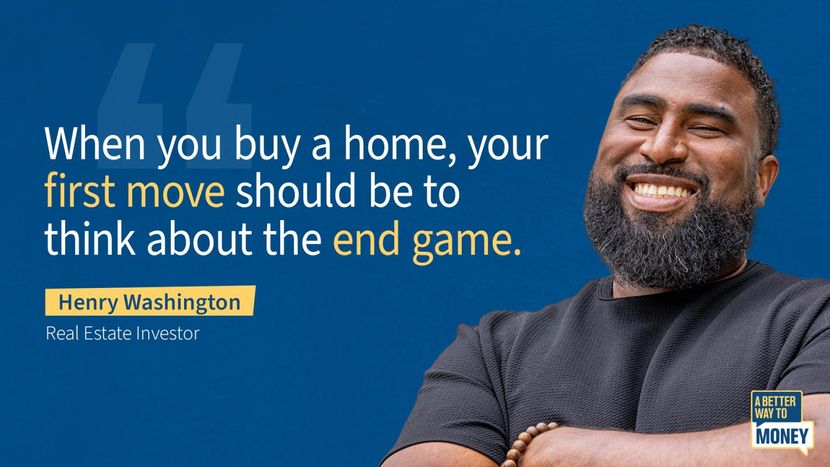
Buying a home is emotional—and real estate investor Henry Washington wouldn't have it any other way. But in this episode of A Better Way to Money, he makes the case that the buyers who build real wealth are the ones who bring a second lens to the process: an investor's eye for what a home means financially, not just personally. Henry went from living paycheck to paycheck to owning more than 100 properties, and he shares the
framework (and cheat codes) that made it possible—from spotting up-and-coming neighborhoods to knowing when to hold and when to move on. The goal isn't to take the heart out of the decision. It's to make sure the head shows up, too. First home or third, just starting to look or ready to sign—Henry has something for you.


From job changes to raising financially-savvy kids to setting yourself up to retire, we'll have deeper conversations.
A home touches everything. Let's look at your whole picture.
Your retirement timeline. Your family's needs. The goals you're working toward right now. A home decision affects all of it—and your advisor can help you think through exactly how. Wherever you are in the journey, you don't have to figure it out alone.
Find your advisorHenry: What's the property going to rent for in the future? What's it going to sell for in the future? How long do I have to live here before I can actually make money for living here? What does this property do when I'm done living in it?
Jennifer: Welcome back to A Better Way to Money. I'm Jennifer Borget. According to Northwestern Mutual's 2026 planning and progress study, 75% of Americans say home ownership is essential for building wealth. But as we learned in our last episode, knowing what to do and actually doing it are two very different things.
So, how do you turn that belief into reality, and how do you make sure your home becomes a wealth generator instead of a financial anchor? Today I'm joined by Henry Washington, real estate investor, author of Real Estate Deal Maker and co-host of BiggerPockets On the Market podcast. Whether you're buying, planning your next move, or already own, Henry is going to show you what separates a smart deal from an expensive mistake and how to unlock the wealth most homeowners leave on the table.
Looking for more step-by-step guidance on home buying? Grab our free Family Finances workbook@northwesternmutual.com/podcast.
All right, let's dig in.
Jennifer: Henry, thank you so much for joining us today.
Henry: Thank you for having me. I'm happy to be here.
Jennifer: I just want you to take me back. First of all, how did you go from working in IT at Walmart to now owning more than a hundred properties?
Henry: I got married, and I needed to make money. Long story short, I needed to figure something out fast. In all seriousness, that is the baseline of the truth. I was single prior to starting to invest in real estate, and then I got married. We got married very quickly, a year after the day we met. So, I went from somebody who was single, living paycheck to paycheck, to realizing that now I have a wife who does not want to live paycheck to paycheck.
And I had to do something about that fairly quickly. I actually, true story, had a panic attack in the middle of the night one night after my wife and I were having a conversation about our financial future, and when I started to realize that I couldn't give her the life that I felt like she deserved, and in that panic attack, I started Googling how to make extra money.
And through that Google search I learned about real estate investing. And something in my brain said, You should buy houses as a fix to your poor financial situation. And, I don't know, I can't explain to you why that just made sense to me, but it did, and that's literally what happened. I decided to go full steam ahead.
Jennifer: Wow. I mean, that takes a lot of bravery, I think, gumption, because how many people think like, Okay, I'm, I want to get into real estate, or I want to do something, and then maybe it doesn't work out, you know? So, from a Google search, what then from there?
Henry: Just magic—and you buy a house.
So yes, there was something comforting about the thought process of doing it and, and most of that comfort, I think, just came from, as I was researching, seeing how many people had figured it out. It was the first time that I paid attention to people who owned real estate. Before I researched any of this, I just thought super-rich people and businesses owned real estate.
I didn't think that the person that lives next door to you might have some rental properties. But the more I researched, the more I saw that it was just regular folks. And I just thought, If all these people figured it out, there's got to be a way to do it. So, I'm just going to figure out how to do it.
My first step was to surround myself with people who were doing it. I'll just go hang out with them, and worst-case scenario, I'll learn something. Best-case scenario is I'll actually start buying property. It was like a win-win situation for me. And the next thing I did was I started telling everybody I was a real estate investor.
I wanted anybody that was looking to sell something at a discount to reach out to me and call me. And then you have to start analyzing properties and making offers, whether that's on the market or you can start looking for off-market deals, which is a whole other conversation. Most people are just going to make offers on the market.
And about 90 days into my research, I've got my first lead from my very first deal.
Jennifer: Wow. Okay. So all this knowledge that you have, we're going to try to like pick your brain and figure out how to get into it in 30 minutes.
Henry: Got you. I got you.
Jennifer: Okay, I know you approach every property like an investor. Why should someone buying a house—maybe they're not wanting to invest it, maybe they want to live in it—why should they think about it in that same way?
Henry: I think, don't get me wrong, buying a house for personal use is a very emotional decision, and I it should be. You're going to live there.
You probably have a family. Your family's going to live there, right? You want to live someplace safe. You want to live someplace where you're going to feel comfortable. Those things shouldn't change as a normal home buyer, but the ways in which you should think about buying your first home to live in (like an investor does)—you should think about What does this property do when I'm done living in it?
And if you think about that from the front side, one of my mentors recently told me to think about every situation that you're getting into, how does it end? And you approach it with that in mind in the beginning. Not that you're saying everything's going to fail, but everything does come to an end. And when you're dealing in investments in business, you want to think about what the end looks like so that you can be prepared for the front side.
So, most people, when they're buying their first home in particular, they don't plan on living there forever. Some do, and that's great.. That's cool that you should do that. But most people are planning to use the first home as a stepping stone to get to wherever the next or the dream home is, right?
So, think about what the end game looks like from an investment perspective. Research what rents are in the area, and research what the average rate of rent increases is historically for your area so you have some idea of what this property could rent for in, you know, one, three, five years. Research what the average rate of appreciation is for homes in your area just to have an understanding and conservatively predict what this home could be valued at in the future to help you have an understanding of, Okay, how long would I have to live here if I want to get out, right? Because you could move there and hate it. And if you buy, and you're going to pay retail value, typically, if you're buying your first home.
But if you move there and you hate it? If you're not going to be upside down when you want to get out, you'd have to stay there for two years, three years, five years. So just a little bit of understanding: I'm not saying those things should stop you from buying the house, but I am saying they're good things that you should understand on the front side that can help you make a more informed financial decision when it comes to buying your first home.
Jennifer: Interesting. Funny, in my situation, because our first home that we bought was a condo, and we lived in it for two years. It was, it was during the boom, like 2006, 2007...
Henry: Oh, pre, pre-crash!
Jennifer: Yeah.
Henry: Oh, man. Yeah.
Jennifer: So yes, we bought our condo. It was when everyone was like, Oh, get into real estate. It's the perfect time. And then I got a job out of state. We could not sell it. And we became accidental landlords.
So, you know, this took,, I think, was it 10 years? I think it was about 10 years. We lost like a few hundred dollars because our HOA, you know, we had to pay the management company, and we finally sold it before we bought this house, which was our third house. And then everything like went up and I was like—
Henry: Boom!
Jennifer: We held onto it a little bit longer, but I mean obviously no one has a magic ball to see the future, but are there any good indicators to know like, All right, is this a good one to hang onto right now and to try to rent it out? Or should I just try to sell it?
Henry: Yeah, absolutely. And that's part of the research that, I was just talking about. What you want to be able to do is rent the property out and have it cover not just your mortgage, but it needs to cover your mortgage plus 30%. Because you've got your mortgage, you've got your taxes and your insurance, you've got your maintenance. Things break; you have to fix them.
I would say you budget about 30% of your monthly rent to go toward those expenses. Just being able to understand what some of those numbers are—what's the total rent, how much do I set aside? Then what's left is my net number.
That's why it's important to research, and this isn't deep research that people need to be doing. You can literally ask ChatGPT, What's the average rent—no, we did not have it back then!—What's the average rent growth for Rogers, Arkansas, over the last 20 years? Pull 20 years of history and find out what the average is. And if it's going up 1% or 2% a year, then that's fairly easy for you to estimate what rents might be at that time, and then you can make a more informed decision about what may happen in the future.
And to your question, right, you couldn't have predicted the real estate crash of 2008, and you couldn't have predicted COVID in 2020. But what we can predict is that outside of those outliers, real estate typically goes up in value some percentage each year. So that might've been able to give you some comfort to let you know, If I just sit on this, this is how long I'd have to sit on it for it to make sense. And you probably made the right decision; 2% a year is not a ton. You couldn't predict a crash that big.
You make the best decision you can with the information that you have at the time. So, I've sold things that I ... hindsight's 2020 ... I wish I would've kept, but at the time, that was the only information I had. I had to make the decision, so I pulled the trigger.
Jennifer: All right, Henry's helping us understand what separates a wealth-building home from a liability. But here's the thing: Home ownership isn't an isolated decision. It's connected to everything else in your financial life—your retirement savings, your kids' education, your emergency fund—and that's where a Northwestern Mutual advisor makes the difference. They help you build a plan that keeps all your goals on track, whether you're buying your first home, downsizing, or refinancing to pull out equity, because there's room for everything when you plan for it.
Coming up, Henry's going to talk about how current homeowners can unlock more value from what they already have.
Okay, so let's go through this. We're buying a house that we want to live in, but we're thinking about this like an investor. What are we looking for? Let's start with the neighborhood. What kind of neighborhood are we looking for?
Henry: You want a neighborhood that's got year-over-year appreciation. So, you don't want somewhere people are moving out of and not moving back into, because that could be a sign that values are declining slowly or going to decline over time. You want something that has gone up in value year over year.
You're going to have outliers though, so you have to be able to factor out the outlier, so you're looking for median, not average. You want the median value increase. It doesn't have to be a hockey stick up; just, we know it's going up in value year over year.
You're also looking for amenities. Are there things in the neighborhood that people like? And are there more things coming in the future? Are they building, rearranging, and adding more amenities, or are amenities moving away to other parts of town?
One of the things that you can do is just go on your city's website, and typically, right on their homepage, they'll tell you what planning and development projects are coming to the area, where they're planning on building things for the future.
People call it the Chick-fil-A method. There are businesses and companies who are very good at market research, so you don't have to be; you can just follow what they do. They don't put Chick-fil-As in neighborhoods that are going down in value, right? They're looking to put those things in paths of progress. So, follow the companies.
Jennifer: All right. Look for the radius of a Chick-fil-A. That could be a good indicator of a next neighborhood. And when you're looking at a house, what are some types of properties that you particularly like and maybe red flags that you try to stay away from?
Henry: If you're trying to buy your next property, and you're trying to think about it like an investor, then let's get into it. Let's be an investor.
There is a whole lot of value in buying a multifamily to live in and living in one of the units and renting it out. They call it “house hacking,” but it is the best way to start building wealth. Several reasons.
One, multifamilies are typically valued higher than single-family homes. So, it's great for resale in the future because there's a lot of people who, A, want to house hack, or B, want to own multifamily homes. If you can get into one, live in one of the units and rent the other unit out. You can not only buy an asset that is going to go up in value a little faster than a single-family home, but you can use home occupancy loans just like you would for a single-family.
You can put only 5% down and buy a duplex. You can put only 3.5% down with an FHA and buy a duplex, and then offset your highest expense because most people's highest expense is typically their mortgage. And since you'll be renting out one of the units, that will cover the majority of your mortgage, which drastically decreases what you pay to live every month and allows you to start saving money while owning a home. Also, when you're applying for loans for these, the banks will consider the rents the property produces as additional income for you to help you qualify for more.
So, it's kind of a cheat code. If you really want to think like an investor, house hacking is an amazing way to build wealth, reduce your highest expense, and start building equity in a higher-value asset.
Now, set that aside. If you're just looking for that single-family home, as I've learned through the years, things that I would be looking for are concrete foundation, not a crawl space. I would be looking for something built in the ’60s or newer. Nothing older than that. It's just you're going to get a ton of maintenance that comes with those things. Yes, there's lots of character in those old homes, and it's so fun, and you get to restore the Victorian house, but you got a lot of expenses that come with owning those really old homes. So ’60s or newer, preferably ’70s or newer. It's going to save you a ton of headache to own an asset like that. Also, it's going to help you a ton when you go to sell that asset because an older home just gets older. The older you buy, the older the home gets when you're looking to sell it, and you could start losing value in that home. So you want to look for something that's going to stand the test of time.
Jennifer: Yeah. As an investor, I know you use leverage and equity strategically. How should like regular homeowners think about something like this?
Henry: Your equity is your wealth, right? So, you can leverage equity to improve your home and push the value of the home up, right? If you're buying a house, or if you've bought a house and you've lived in it for a few years and it's got some equity, but you've got some work you want to do to the property, then you can take out a home equity line of credit so you can tap into the equity very quickly.
What that means is your bank will do an assessment of the property, and they will determine the value of the property. And then based on what you owe, they'll give you access to a percentage of the equity.
Jennifer: The HELOCs, right?
Henry: Yes. HELOC, yes, that's correct.
For really ease of numbers sake (because I'm very bad at math in my head), if your house comes in at a value of $200,000, and you owe $100,000, that means you have $100,000 of equity in the property. Most home equity lines of credit are going to give you access to somewhere around 75% of the equity, which means you would have access to $75,000 on a line of credit. And you don't pay anything for that money unless you use the money. If you don't take out any of the line of credit, then you don't have an interest payment. But let's say you take out 20 grand to do an improvement project; well, then you're paying interest-only payments on $20,000 of that $75,000 on the line of credit.
So, if you want to improve the property—let's say you're going to make your kitchen bigger, and you're going to add a bathroom. Well, those things do cost money, but they also add value. It may cost you $25,000 to do that, but you don't want to do those improvements unless, A, you're going to live in the house for a very long time, or B, the value of the home will increase more than what it cost to fix it. So, if you spend 20 grand, I would say you want your value to be somewhere around $30,000 or $40,000 for doing that work. So that way you get your money back, and you get to put some money in your pocket if you decide to sell.
Jennifer: Let's say someone has been in their home for three to four years; they're thinking about selling it. What should they do now?
Henry: Depends on what's the next move. It's all about what your cash position is. What do you need to improve your family's life? If you need to buy this next property, and you don't have the cash for the down payment then, and you have to sell the house to get the cash for the down payment, well, then you have to sell the house, right?
If that's the move for your family, the better move in my opinion is to keep the house and rent it out. So you have some options at that point: If you need the cash for the down payment and you don't want to sell the house, then you can consider doing a HELOC on the first house. We talked through what that process means, but you can get access to a percentage of that equity; then you can take the money from that HELOC and use it as your down payment to buy the next property.
As long as what you're able to rent your property out for once you move out will cover the HELOC payment and plus your expenses. So, it really truly depends on if those numbers work out.
Jennifer: And I know we talked a little bit about emotional decisions and things like that. How do you keep your emotions from clouding your financial judgment?
Henry: That one's always tough. As an investor you just learn that if it doesn't make sense on paper, then you just let it go. But as a traditional home buyer, I do think some emotion is important. Like I said, this is going to be where your family lives, but you do have to keep it in check.
That's why it's important to understand what financial aspects you need to pay attention to, to help keep you in check from making a poor financial decision just because you love a house. Yes, there should be some emotion tied to it, but there should also be some financials tied to it. And both should make sense. And if one doesn't work out in your favor, then the other side needs to be so skewed that it makes sense for you to give up one side. If you're going to make an emotional decision to buy a home even though it's a poor financial decision, what are you getting in the home or on the home side that skews it so much that it doesn't matter? Maybe it's just the location is so ridiculously good that it's just going to make your life so much better, or you're getting so much more house for your money ... it's such an amazing, big property that it makes sense for you to give up some of the financial aspects.
Jennifer: Okay. I have a couple of takeaway questions. First one is, for someone maybe just starting their home-buying journey, what is one thing they should do this week?
Henry: People, there are so many first-time home buyer—even if it's not a first-time home buyer, there are down payment assistance programs, there are grants. There are so many opportunities. You need to be researching down payment assistance. Or just home-buying assistance programs. There are tons of them out there, but you've got to go looking for them. So, call banks; ask your agent what programs they're aware of. Call your city. Sometimes there are certain parts of town that they're trying to develop.
Do the research, ask ChatGPT a million questions, put it on that deep research mode, and ask it to go look for home-buying assistance programs. Just do the research on these assistance programs, and look for opportunities to buy at a discount.
Jennifer: Okay, and then for current homeowners listening, what's the one move they can make to better use their home as a wealth-building tool?
Henry: The longer you own the home, the more wealth you're going to create. So, if you've got a home, try not to sell it. Try to be able to keep that thing and rent it out. I know it doesn't sound fun, but the longer you own a home, the more wealth and value that that home's going to provide you in the future.
You can look into tapping into equity, but only do that if you have a plan for that equity. If you have a plan for what your next move is going to be, then you might consider tapping into that equity, but it's just a matter of how long can you hold onto the property. The longer you hold onto it, the better your financial position's going to be, because equity is essentially buying power.
At some point, you may want to invest in something, and the equity in your home can allow you to be able to do that. I will just tell people: I get that being a landlord can be overwhelming, and I get that investing in real estate can be overwhelming. But you have to decide.
I'm not saying everybody needs to be a real estate investor, but I am saying if you're wanting to build wealth, like something in this conversation was like, Yeah, this seems like something I would look into, but it's scary, you're right. It is scary. But wealth is not built inside of a comfort zone. If it was, everybody would be wealthy.
You're going to have to be willing to get a little uncomfortable if you want to build wealth. And that's in any industry. Whatever you want to invest in, it's going to take you being uncomfortable.
So, do you want to be wealthy, or do you want to be comfortable? And if you want to be comfortable, keep doing what you're doing, that's fine. That's okay. You can live a very comfortable life and not invest.
At some point, it's going to get uncomfortable, though, if you're not investing right. At some point, if you don't have something saved up to supplement your retirement, it's going to get uncomfortable. I know zero people who retired on their 401(k) and are living a very comfortable life.
At some point you have to figure it out.
Jennifer: Fantastic. Thank you so much for joining us today.
Henry: Happy to do it. Great to talk to you.
Jennifer: That's Henry Washington, author of Real Estate Deal Maker and co-host of the On the Market podcast from BiggerPockets. So, there you have it: how to think like an investor about your primary residence. Spot the decisions that actually pay off, and turn your home into a wealth-building asset instead of a financial drain.
And turning these ideas into a personalized plan is exactly what a Northwestern Mutual advisor helps you do. They help you see how this purchase fits into your bigger financial picture and build a plan where there's room for home ownership and all your other goals.
Ready to take the next step? Download our free family financial planning workbook at northwesternmutual.com/podcast. It's a step-by-step guide to navigating life's biggest money decisions.
Next time on A Better Way to Money ...
Simone Stolzoff: I think the most important thing about work is that it pays you enough to live the life that you want to live. And it may sound crass to talk about work this way because we're told that work should be a calling or a vocation, but I actually think this clear-eyed perspective can be incredibly empowering.
Jennifer: Your job will change, your industry will evolve. So how do you build a sense of self that doesn't crumble with it? Author Simone Stolzoff shows the way. Tap follow in your podcast app to tune in.
Northwestern Mutual is the marketing name for Northwestern Mutual Life Insurance Company (NM) and its subsidiaries, including Northwestern Mutual Wealth Management Company (NMWMC), investment advisory services and federal savings bank. NM and its subsidiaries are in Milwaukee, Wisconsin. Not all Northwestern Mutual representatives are advisors. Only those representatives with “advisor” in the title or who otherwise disclose their status as an advisor of Northwestern Mutual Wealth Management Company (NMWMC) are credentialed as NMWMC representatives to provide advisory services.
Henry Washington is not affiliated with Northwestern Mutual, and the views expressed by Henry Washington do not necessarily represent those of Northwestern Mutual or its subsidiaries.
All investments carry some level of risk, including loss of principal invested.