Want to Know How to Live a Good Life? 85 Years of Harvard Research Has the Answer
- A BETTER WAY TO MONEY SEASON 3 EPISODE 12
- Sep 17, 2026


Key Takeaways
The strength of your relationships largely determines longevity and happiness.
Financial stress can do real damage to your body today.
Face your finances head-on—it’s good for your health now, and later.


Have a plan for your money at every stage of life. Get our Family Finances Workbook.
What does it take to build a genuinely good life? Dr. Robert Waldinger has been studying that question for decades.
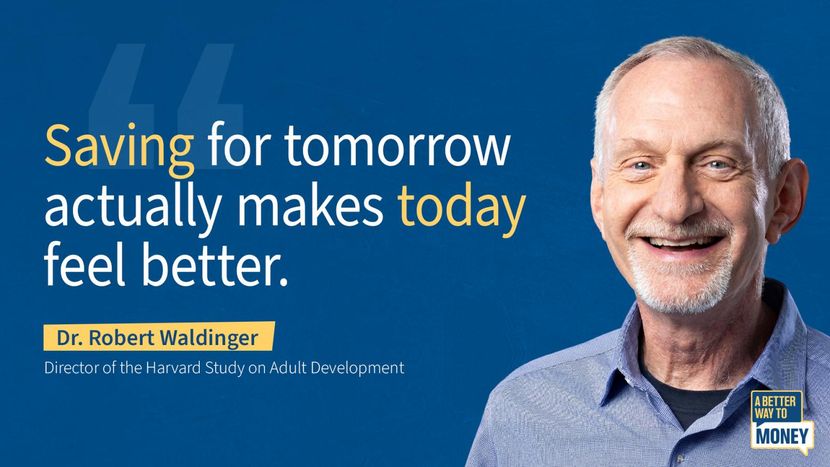
In this season finale of A Better Way to Money, host Jennifer Borget sits down with the director of the longest-running study on human happiness ever conducted to explore what the data actually shows. The findings are clear: Meaningful relationships are the strongest predictor of long-term health and longevity—more than wealth, status, or professional success. Dr. Waldinger also draws on what research shows about chronic stress more broadly: that it increases inflammation, weakens immunity, and does lasting damage to the body—and that financial stress is no exception. Facing your finances head-on isn’t just smart planning. It’s genuinely good for your future self.
His message: What you invest in right now—your relationships, your well-being, your financial security—shapes the life ahead. And it’s never too late to start.


From job changes to raising financially-savvy kids to setting yourself up to retire, we'll have deeper conversations.
Build a plan that reflects what actually matters to you.
Whether you’re feeling the weight of financial stress right now or you’re ready to get intentional about the future, your Northwestern Mutual financial advisor can help you build a plan that serves your whole life—not just your bottom line.
Find your advisor.Dr. Robert Waldinger: [00:00:00] What really matters to you? What do you really care about? And that can include [00:00:05] financial things. That can include I care about being sure I have a comfortable retirement. Those [00:00:10] things matter.[00:00:15]
Jennifer Borget: Welcome back to A Better Way to Money. I'm Jennifer Borget. We've spent this entire [00:00:20] series talking about money at life's biggest turning points: having kids, [00:00:25] getting married, surviving a setback, starting over. And through all of these [00:00:30] conversations, one question kept coming up in different forms. What does it actually [00:00:35] mean to build a good life?
Not just a financially secure one, a genuinely [00:00:40] good one. I saved today's guest for last because I think his work answers that question [00:00:45] better than anyone. Dr. Robert Waldinger is a professor of psychiatry at Harvard [00:00:50] Medical School and the director of the Harvard Study of Adult Development, one of the [00:00:55] longest-running studies of human life ever conducted.
His TED Talk on happiness has been viewed [00:01:00] more than 40 million times, and his book, The Good Life, distills eight [00:01:05] decades of research into practical wisdom. Today we're going to close out this series by [00:01:10] zooming out, looking at the full arc of a life—what the data says about who [00:01:15] thrives and how the decisions you're making right now are quietly shaping who you'll [00:01:20] be at 80.
Grab our free Family Finances workbook at [00:01:25] northwesternmutual.com/podcast. All right, let's bring it home.
So [00:01:30] for anyone who hasn't heard of it, can you tell us what the Harvard Study of Adult Development is [00:01:35] and what drew you to it?
Dr. Robert Waldinger: This study is the longest [00:01:40] study of human life that's ever been done. It began in [00:01:45] 1938.
I'm the fourth director, and it [00:01:50] consisted initially of a group of Harvard College sophomores [00:01:55] and a group of inner-city boys from Boston's poorest and most [00:02:00] troubled families. There were [00:02:05] 724 of them, and then eventually we brought in their spouses, and we brought in their children. [00:02:10] Almost all of the original men in the study have [00:02:15] died.
There are only about 10 still alive, and they're all over age 100. [00:02:20] But the baby boomer children are very much still alive, and we've [00:02:25] been studying them. And so it's a real effort to [00:02:30] study what helps people thrive as they go through life. What are the [00:02:35] paths to thriving?
What drew me was just the [00:02:40] incredible experience of being able to look at one [00:02:45] person's records, which were this high, and being able to [00:02:50] read about what somebody thought about life when he was 19 and then [00:02:55] what he thought about life when he was 30 and what his life was like when he was 60 [00:03:00] and how he looks back on life in his 80s.
It was just [00:03:05] wonderful to be able to view entire lives as they [00:03:10] unfold through time.
Jennifer Borget: Wow. Wow. Yeah, that's a lot of data. [00:03:15] So, after this 85+ years of [00:03:20] data, what do you think is the single most important thing that the study has actually taught us [00:03:25] about trying to live well?
Dr. Robert Waldinger: Well, two things. One didn't surprise us. [00:03:30] It was that taking care of our physical health, taking care of our bodies, [00:03:35] really matters for how long we live and how long we [00:03:40] stay relatively healthy. So that's the thing that didn't surprise [00:03:45] us because many other studies had already started to reveal these things. [00:03:50]
What surprised us was that the people [00:03:55] who stayed happy and stayed healthy the [00:04:00] longest were the people who had close, warm connections with other people [00:04:05] —that people's relationships actually predicted how [00:04:10] long they were going to live and stay healthy.
And we didn't believe that [00:04:15] because the question was Well, how could your relationships actually get into your body [00:04:20] and shape your health, shape your physiology? How could that even be possible? [00:04:25] Now, many other studies have begun to find the same thing, and [00:04:30] we've been spending a lot of time in our laboratory working to understand [00:04:35] how that actually works, how relationships foster [00:04:40] good health.
Jennifer Borget: And you talked about how you noticed different people and [00:04:45] how they aged and felt as they got older. Can you give us some examples of people in the [00:04:50] study that really show how relationships impact our health?
Dr. Robert Waldinger: Yeah. [00:04:55] One, in a kind of sad way. There was a man who was super accomplished, [00:05:00] a really accomplished lawyer, and won all kinds of awards and worked really hard, [00:05:05] but he never really got along with people very well, and he had a first [00:05:10] marriage that ended in divorce, and he was kind of estranged from his children.[00:05:15]
And then he had a second marriage, and that marriage ended in a kind of [00:05:20] stalemate. They didn't divorce, but they were kind of at a standoff, really unhappy with each other. [00:05:25] And his health declined so badly later in his life, and he really [00:05:30] had a miserable end of life because of that.
On the other hand, there [00:05:35] was another man who was not very so accomplished. He was a high school teacher and [00:05:40] really happy being a high school teacher. He'd gone to Harvard, but then he taught high school history [00:05:45] his whole life, and he really enjoyed it. He enjoyed his students, his colleagues. [00:05:50] He had a wife he loved and three daughters who he really cared about, [00:05:55] and lots of grandkids, and he was really happy and lived a [00:06:00] much longer, healthier life.
Jennifer Borget: Wow. Yeah, that says a lot about what you're doing for work and [00:06:05] who you're around. So, what kinds of relationships are we talking about? Is it just romantic [00:06:10] relationships? What about when it comes to pets or having friends online and social media and [00:06:15] things like that? Have you noticed a difference?
Dr. Robert Waldinger: No, we're talking about all kinds of [00:06:20] relationships, but what we're talking about is emotionally important relationships, [00:06:25] relationships where you really feel the person knows you, has your back, would be there in [00:06:30] times of need. So we're not talking about Facebook friends or Instagram [00:06:35] followers. We're not talking about that at all. We're talking about real connections.
Jennifer Borget: In [00:06:40] talking about relationships, I've seen research saying that loneliness is as [00:06:45] bad for your health as something like smoking 15 cigarettes a day. Does that [00:06:50] square with what you've seen in your work?
Dr. Robert Waldinger: Absolutely. Absolutely. Wow. And we started to study [00:06:55] loneliness as people began to realize how important it was and how common [00:07:00] loneliness is. And it's true that people who are lonely are more [00:07:05] likely to get all those diseases of aging. And what we know, one of the [00:07:10] reasons why loneliness has a bad effect on our health is because it's a [00:07:15] stressor.
You know, stress of any kind causes bodily systems to break [00:07:20] down sooner. Now, a little bit of stress is fine, and there is stress in everyday life for [00:07:25] sure. It's the kind of stress that doesn't go away that we think is so damaging, where the [00:07:30] body never comes back to a kind of equilibrium.
Jennifer Borget: I'm curious [00:07:35] also: What does the research tell us about the relationship between financial stress and health [00:07:40] outcomes? Did you see any correlation there?
Dr. Robert Waldinger: Well, there is ... We didn't test it [00:07:45] specifically in our research, but financial stress, like any source of [00:07:50] stress, sets the body up for [00:07:55] breakdown. It increases inflammation in the body. It increases [00:08:00] circulating stress hormones. It weakens the immune system. So, if it's really [00:08:05] stressful, and it happens to be because of finances, then that's the cause.[00:08:10]
So, stress, again, is a very personal, subjective [00:08:15] experience.
Jennifer Borget: And if strong relationships are something that helps you and they [00:08:20] help you feel a healthier, happier life, do you feel like investing in those [00:08:25] relationships then becomes a financial decision? Should people actually be [00:08:30] budgeting for connections?
Dr. Robert Waldinger: Well, it's not exactly a financial [00:08:35] decision, as one of the things our research shows is that when you have experiences with other people that you [00:08:40] pay for, like going to a soccer game or going to a concert, [00:08:45] you often build stronger relationships with the people you go with, or you [00:08:50] meet new people, or both.
But beyond that, it's really [00:08:55] about feeling connected, and so there are ways to [00:09:00] structure your life so that you're not alone, so that you are connected [00:09:05] with other people, and hopefully in the process so that you're doing things you enjoy, doing [00:09:10] things you care about.
Jennifer Borget: And how do you know what you actually care about? [00:09:15] One of our guests said they wrote down what they want their lives to look like in five years, [00:09:20] and she gave these really lovely ideas about what she did on the day-to-day basis, [00:09:25] including writing and having a silly household. Do you have any tips like that? [00:09:30]
Dr. Robert Waldinger: For me, it's about paying attention to what lights you up [00:09:35] and what drains your energy.
Beause I think as [00:09:40] kids we get taught to ignore those signals. [00:09:45] We get those signals all the time: "Oh, I really like this," or "This is so exciting. [00:09:50] This conversation is so energizing." And we get the opposite signals: "Ugh, [00:09:55] this really drains me," right? But often, as kids, we're told, [00:10:00] "Okay, now you’ve got to sit still and pay attention and listen to the teacher," and which is, [00:10:05] of course, necessary, but I think we end up learning to [00:10:10] suppress and stop recognizing those signals about what lights us up and [00:10:15] what doesn't.
So, I would say let's get better again at paying [00:10:20] attention to that right now, day to day, moment to moment.
Jennifer Borget: The things that really [00:10:25] light us up and make us happy. So, it's not just about relationships with other people but [00:10:30] relationships with ourselves.
Dr. Robert Waldinger: Yeah. Well, and our relationships with [00:10:35] ourselves are really important because if we feel bad about ourselves, we're [00:10:40] much harder to relate with when it comes to other people, right? If [00:10:45] we feel bad about ourselves and we're very sensitive to slights or we're very [00:10:50] self-critical, it's really hard to be a friend. It's hard to have a friend. [00:10:55] So taking care of your relationship with yourself is [00:11:00] a first priority.
Jennifer Borget: That means the way you spend your time, your [00:11:05] money, and your attention actually matters a lot, which means a [00:11:10] Northwestern Mutual financial advisor is one relationship you really don't want to overlook.[00:11:15]
They can help you build a plan that serves your short- and long-term goals. [00:11:20] Whether you're planning a vacation in a few months, paying for college down the road, [00:11:25] or saving for retirement, there's room for everything if you have a plan. And look, [00:11:30] it can be hard to motivate yourself to think that far ahead until you actually are seeing the [00:11:35] numbers.
Your advisor can show you what compound interest looks like over 20 or 30 [00:11:40] years, what you gain by starting now versus waiting, and once you see that in black and [00:11:45] white, it tends to change how you think about money. It's the kind of conversation your future self will thank [00:11:50] you for. Here's one first step you can take right away. Pause this episode and download [00:11:55] Northwestern Mutual's Family Finances Workbook. It's a step-by-step guide to building a [00:12:00] plan. Grab it for free at northwesternmutual.com/podcast. We'll put a link in the [00:12:05] episode description, too.
All right, let's go back to Robert.
Now, throughout this [00:12:10] series, we've heard from all different kinds of experts who all say that one of the best things people [00:12:15] can do is to talk about their financial issues in order to create a game plan to fix [00:12:20] their finances because it also reduces anxiety. Do you have [00:12:25] any thoughts on why that works and why so many people might be saying this?
Dr. Robert Waldinger: Well, it works [00:12:30] because turning away from a problem just makes it grow worse, [00:12:35] right? You know, if I'm afraid of my financial situation, and I say, "I just don't [00:12:40] even want to look at my bank balance." The anxiety just grows because you know [00:12:45] you're not looking at it. You know you're not facing toward the problem.
What we know is that [00:12:50] facing toward a problem or a worry almost always makes [00:12:55] it better compared with turning away and saying, "Oh, it'll just take care of itself," or [00:13:00] "I'm just going to pretend it's not happening." That usually makes us less happy. It makes our [00:13:05] anxiety grow.
Jennifer Borget: Mm-hmm. Kind of taking the reins on it.
All right, now let's talk a [00:13:10] little bit about our relationships with ourselves. A lot of people experience [00:13:15] saving as taking from their present self to fund some [00:13:20] future distant stranger that they can't imagine. Can you help us think of some ways we can [00:13:25] reframe that a little bit so planning for the future feels like a part of living well now and not [00:13:30] like this sacrifice?
Dr. Robert Waldinger: Oh, yeah. The first thing is to tune into how [00:13:35] much you worry about the future, about not having enough [00:13:40] to retire on, about not having enough to take care of your family in the future. And [00:13:45] if that's a source of stress, that stress is now. So. it's not just the future we're [00:13:50] talking about; we're talking about real stress right now in the moment that may [00:13:55] be breaking down your body if the stress is intense enough.
So, it's [00:14:00] really an investment in feeling more comfortable—safer, if you [00:14:05] will—in the present.
Jennifer Borget: Do you have any tips for people who maybe are feeling [00:14:10] that stress? What would you tell someone who's feeling very stressed out?
Dr. Robert Waldinger: Well, [00:14:15] people have different ways of relieving stress, and so there's no [00:14:20] solution that's going to fit everybody.
But we know, for example, that [00:14:25] exercise is one of the most powerful [00:14:30] antidepressants on the planet. If your mood is low, including if you're [00:14:35] anxious, that exercise really helps calm the body and helps elevate [00:14:40] your mood when you're feeling low. One of the difficult things is that when you're [00:14:45] anxious or depressed, you don't feel like exercising.
So, often it [00:14:50] means getting yourself to do it maybe by meeting a friend at the gym or something [00:14:55] to get you to do that. But there are other ways of relieving stress. Certainly being out in [00:15:00] nature can really help because nature opens us up to a [00:15:05] bigger perspective. We get out of our heads. David Foster Wallace, the writer, once [00:15:10] called this our “skull-sized kingdoms,” where we're totally lost in our [00:15:15] own minds, and we forget that there's a vast, amazing world out there. Being [00:15:20] in nature can really help bring back that perspective and lower stress that [00:15:25] way.
A lot of it is for each person trying to find what works [00:15:30] for them. For me, for example, it's meditation. I meditate every day, [00:15:35] and it has a big effect on my stress levels—gives me a lot of [00:15:40] perspective. When I sit down to meditate, it helps me really come back to what's [00:15:45] real, what's most important, and to notice when my mind is [00:15:50] going off worrying about silly things or things I can't [00:15:55] control.
Jennifer Borget: I feel like I'm definitely one of those people who feels like, "I don't want to exercise," but I [00:16:00] definitely feel better after I do, and I'm like, "Okay, I need to remind myself [00:16:05] of how this feels." But my quick and easy "Okay, I need to reset," is [00:16:10] ... it has to be warm outside; if it's cold, it doesn't work. But I love just walking to the [00:16:15] mailbox in my bare feet. With the heat and the sun, I'm like, "Oh, this [00:16:20] is a breath of fresh air," and being out in nature for a second makes a big [00:16:25] difference, and it's easier than exercise. But I need to do that more. [00:16:30]
So, these people who are making it to retirement or some of these people we're [00:16:35] seeing now that are living longer and outliving others, what has the study found about [00:16:40] who handles it well and who maybe struggles?
Dr. Robert Waldinger: Well, the people who [00:16:45] handle retirement well are the people who stay connected with other [00:16:50] people.
One of the things we found in our study: Many of our [00:16:55] original people of the World War II generation might have worked for a company their [00:17:00] whole lives, maybe 40, even 50 years, and then they retired. So [00:17:05] they worked full time, and then suddenly they were at home, and many of them would [00:17:10] literally look around and say, "Where is everybody?" They [00:17:15] had taken for granted all these co-workers who they were with, and [00:17:20] suddenly they felt like there wasn't anybody in their lives. They didn't have friends. They [00:17:25] hadn't kept up with family, whatever.
One of the things that [00:17:30] really makes a difference is making sure you have connections with people, [00:17:35] with friends, with family, or deliberately [00:17:40] taking on new things in your life when you're retired that involve other [00:17:45] people. Maybe you work for a cause that you really care about. You [00:17:50] volunteer for it in the community, and you do it alongside people who care about the [00:17:55] same thing, and then gradually you strike up conversations, and you might make a friend or [00:18:00] two.
Jennifer Borget: Okay, now I want you to speak directly to someone in our audience with these final [00:18:05] few takeaway questions, okay? And we're going to address people in a few different situations. So [00:18:10] first, for someone who's in their 30s or 40s, they're juggling work, kids, a [00:18:15] mortgage, maybe also trying to save, what's the most important thing that [00:18:20] they should understand about the connection between how they're living today and how they'll thrive [00:18:25] decades from now?
Dr. Robert Waldinger: Investing in [00:18:30] the things that are most important to you, right? So, when [00:18:35] we asked our people in their 80s to look back on their lives, we asked them, "What do you [00:18:40] regret the most, and what are you proudest of?" The biggest regret [00:18:45] that a lot of people had was "I wish I hadn't spent so [00:18:50] much time at work. I wish I had spent more time with the people I cared about." [00:18:55] And many of the women in the study said, "I wish I [00:19:00] hadn't worried so much about what other people thought." [00:19:05]
So, the advice might be to think now about what really matters to you. [00:19:10] What do you really care about? And that can include financial things. That can [00:19:15] include I care about my family's safety. I care about being sure [00:19:20] I have a comfortable retirement. Those things matter. As we said, that keeps [00:19:25] you comfortable now if you feel like you're providing for the future. But the [00:19:30] main thing is to see if you can do less of the things you [00:19:35] just don't care about and more of the things that you do care about.
Jennifer Borget: Taking that wisdom from people who have [00:19:40] been there, I think, is a great tip. So, what about someone who isn't [00:19:45] following a traditional timeline? Maybe they're marrying later; they're deciding not to start a [00:19:50] family. What does a good later in life look like for someone on a [00:19:55] nonconventional path?
Dr. Robert Waldinger: Oh, thereare so many good nonconventional paths. I mean, there are people [00:20:00] who stay home and raise kids and then at age 50 go out into the workforce [00:20:05] and become leaders at age [00:20:10] 55, 60, 65, when other people are retiring. So they're very [00:20:15] unconventional paths. There are people who decide not to have children, who spend a lot more time [00:20:20] traveling, who spend more of their lives doing things [00:20:25] that you don't get to do when you're raising young children.
There are a lot of unconventional [00:20:30] paths, and that's actually one of the [00:20:35] best things that we've seen. Our first generation, our World War II generation, [00:20:40] had pretty conventional paths for most people. The men were in the [00:20:45] workplace. The women were at home raising kids, doing volunteer work. And now that's [00:20:50] all quite varied, which is great because people get to do [00:20:55] more of what they want to do and what they're more suited to doing.
Jennifer Borget: And for someone who's [00:21:00] already in retirement, maybe they're there, and they feel like they didn't quite get it [00:21:05] right. They feel like it's too late for them. Is it?
Dr. Robert Waldinger: No. I mean, [00:21:10] in the book we wrote, The Good Life, the last chapter is titled “It's Never Too Late,” [00:21:15] and in that chapter we have all these stories of people who were sure they had done [00:21:20] life wrong.
They were sure, for example, that they were never going to have friends, that they never had [00:21:25] them before, and they weren't going to have them. And then what we found was that [00:21:30] there were many people who, for the first time in their 60s, 70s, 80s [00:21:35] made really good friends, or people who got married for the first time very late in life.[00:21:40]
And so, if you think that everything is set in stone [00:21:45] and that you know the future, think again, because it's not true. There are [00:21:50] so many possibilities that you need to be open to.
Jennifer Borget: That's [00:21:55] Dr. Robert Waldinger, psychiatrist, Harvard professor, director of the [00:22:00] longest-running study of adult life ever conducted, and author of The Good Life.[00:22:05]
Throughout this series, we've talked about money at life's biggest moments, and we're ending it [00:22:10] here, with 85 years of data on what actually makes those moments matter. [00:22:15] What keeps coming back to me is it's not the milestones themselves that determine [00:22:20] how your life turns out. It's the quality of the relationships and the intentionality [00:22:25] you bring to each one.
Thank you for spending this series with us. If any of these [00:22:30] conversations moved you, share them with someone you care about. That's kind of the whole point. [00:22:35] And if you're ready to build a financial plan that actually fits the life you want to live, a [00:22:40] Northwestern Mutual advisor can help you get there.
Download the free Family Finances workbook to [00:22:45] get started at northwesternmutual.com/podcast.[00:22:50]
Northwestern Mutual is the marketing name for Northwestern Mutual [00:22:55] Life Insurance Company (NM) and its subsidiaries, including Northwestern Mutual Wealth Management [00:23:00] Company (NMWMC), investment advisory services and federal [00:23:05] savings bank. NM and its subsidiaries are in Milwaukee, Wisconsin.
Not all [00:23:10] Northwestern Mutual representatives are advisors. Only those representatives with "advisor” in the [00:23:15] title or who otherwise disclose their status as an advisor of Northwestern Mutual Wealth Management [00:23:20] Company (NMWMC) are credentialed as NMWMC [00:23:25] representatives to provide advisory services.
Dr. Robert Waldinger is [00:23:30] not affiliated with Northwestern Mutual, and the views expressed by Dr. Robert Waldinger [00:23:35] do not necessarily represent those of Northwestern Mutual or its subsidiaries.