The Hidden Forces Crushing Your Money Habits (And How to Fight Back)
- A BETTER WAY TO MONEY SEASON 3 EPISODE 1
- Apr 16, 2026


Key Takeaways
Financial action beats financial education: Small structural changes outperform information alone.
Pre-commit to investing windfalls before they arrive so bonuses and tax refunds don’t go uninvested.
Block time on your calendar for a "financial health day" to consolidate accounts, tackle lingering to-dos and put your plan in place.


Have a plan for your money at every stage of life. Get our Family Finances Workbook.
How is it that we can know exactly what to do with our money and still not do it?
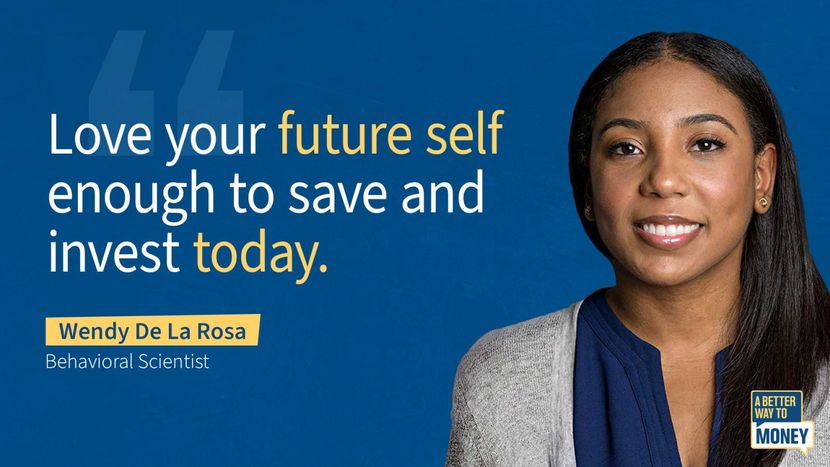
In this week's episode of A Better Way to Money, Wharton behavioral scientist Dr. Wendy De La Rosa joins host Jennifer Borget to unpack why we struggle with money and what actually helps.
Dr. De La Rosa reframes the challenge: It's not a willpower problem; it's an environment problem. You're one imperfect person up against thousands of companies with sophisticated teams all optimized to get us to spend.
Her fix? Stop relying on willpower alone. That means removing temptations from your environment, planning ahead for windfalls like bonuses or tax refunds, and blocking time on your calendar to actually get it done.


From job changes to raising financially-savvy kids to setting yourself up to retire, we'll have deeper conversations.
Let’s solve your money challenges.
Together, we can build a financial plan your future self will thank you for.
Find your advisorWendy de la Rosa: [00:00:00] The formula for financial success isn’t that hard, but it’s never the right time to start implementing because life happens. Life happens, and then it never becomes the right time again.
Jennifer Borget: Welcome back to A Better Way to Money. I’m Jennifer Borget, and I’m excited to kick off our third season with a question I think about a lot: How is it that we can know exactly what we should do with our money and still not do it? Today I’m joined by Dr. Wendy De La Rosa, a behavioral scientist at the Wharton School who studies why we struggle with money, and here’s what she found.
It’s not about lacking information or willpower. It’s about the systems and environments we build for ourselves. So, in this conversation, we’re getting into practical ways to work with your psychology—not against it. If you’re ready to stop relying on willpower alone, you can find helpful tools at northwesternmutual.com/podcast along with links to our other episodes about how to make your money work harder for you.
[00:01:00] All right, let’s dig in.
Wendy, thank you so much for joining us. I’m so excited to chat.
Wendy de la Rosa: I am so happy to be here, Jen. Thanks for having me.
Jennifer Borget: I’m wondering ... the psychology of money—how is that something that you get started in?
Wendy de la Rosa: That is a great question. When my family immigrated to the United States, I often say that the lack of money was a constant companion at our dinner table. It was top of mind for everybody. And so I, as a young kid, was trying to do everything I could to improve our financial situation. I think that obsession [came about] as a young immigrant kid, where so much of your life is translating and navigating financial systems for adults because of the language barrier.
So, I used to sit there and sort of pretend to be the adult as the bill collectors would come or translate bills for my family. That just piqued my interest at an early age. I sort of became obsessed with how we think about money. Why does this shape the behaviors that we make? How can we improve our relationship with money? Why does it always feel so negative? So, when I had the financial freedom to be a researcher full time and get to study these questions, it felt like a no-brainer to me.
Jennifer Borget: Wow. So, at a really young age then, you were very aware of how you were feeling about money and how that was causing you to feel, with the stress about it. And it can be hard for people to save. You talk sometimes about how, for people, it’s kind of like this David versus Goliath battle trying to get around to saving. What do you mean by that?
Wendy de la Rosa: Well, the landscape has fundamentally changed. Every company is getting smarter, more efficient and better at helping you part with your money. As you walk down the street, every ad is optimized to try to get you to spend as quickly as possible. As you scroll, every app is optimized to present the ad that’s most likely to get you to spend in that moment, and it’s not just a one-time thing. You’re followed throughout your entire online history by this ad so that over and over again, it’s not just one person battling temptation with one company.
It is a David versus Goliath story, because we have one person that’s imperfect (by the very definition of being human) going up against hundreds and thousands of companies that have great teams behind them, all optimized to get you to spend. I need us to have a reckoning to realize that the system is fundamentally flawed and set up for consumers to fail.
And by “fail,” I mean not save enough for their future self or meet their own financial goals. And when you start to think about that system up against this one individual person, you can now have a little bit more empathy with yourself. You can start to love yourself a little bit more and say, Okay, I haven’t made the decisions that I’ve wanted to make or couldn’t make. I can change my environment. I can get these Goliaths out of my environment so I can reduce my temptation, so I can set myself up for success instead of setting yourself up for failure.
Jennifer Borget: Yeah, I think you hit the nail on the head talking about how so much has changed. I was just talking to my husband about this the other day, and I was like, Do you remember layaway? I was telling my husband, I bet you don’t even know about layaway. And he is like, No.
My parents used layaway, too. They did that for my back-to-school shopping all the time. I went to Google it because I wondered; I don’t remember that being an interest thing that was accrued. And sure enough, no—you put a deposit down, and then you don’t get to take it with you, but you can pick it up when you pay the rest of it off.
Nowadays it’s like, no, take it now. Take it now. Enjoy it. You know, we’ll just charge you 50 percent interest on it. So, it’s really made things a lot more challenging for us.
Wendy de la Rosa: Well, you know, the one way to categorize that ... I love this layaway example. We now have “Buy now, pay later” when we used to have “Pay now, buy later.” We had an environment that was set up to help you with your self-control. And now we have an environment that is set up to exploit your self-control. And you sort of see that in our debt level, sadly. Our consumer debt has reached all-time highs as a result of that.
Jennifer Borget: And that creates so much anxiety for people. I know the joy that can come from paying off debt. I’ve been there, when I was like, All right, I’ll put a charge on my credit card.
We were newlyweds, and we’d said we weren’t going to do it. But I got a free Subway sandwich if I signed up for a credit card, and I’m like, I’m not going to use it. I ended up using it and I was like, Okay, I’ve got to pay this off before it doubles and triples, you know? I mean that anxiety, that nervousness hanging over you of Am I ever going to be able to pay this off?
What is that doing to our brains?
Wendy de la Rosa: Well, it’s stress, and it’s trauma. I think a lot of times we underestimate how much financial trauma influences our life and just how much finances in general are the underbelly of so many life-changing events.
So, you talked about the fact that you just got married, but when people get married, that’s a huge financial cost if you decide to have the big party and all of the [rest], but we don’t talk about it, right? What we celebrate is a big party. We don’t really talk about the fact that you’ve now gone into debt for $20,000 to have this party.
Or when someone sadly experiences an illness, we’re there for that person. We send meal trains for that person, but we don’t actually talk about How are you working with your insurance company? What’s going to be your out-of-pocket cost?
All of this is to say that we’re dealing with an extreme level of stress that we then don’t talk about. And just like any problem, when we talk about it with someone else, when we get tools and tips and tricks from other people, we tend to feel better.
It feels like less of a taboo, but with our friends, we’re much more likely to know their entire dating history and sexual history and all of the crazy things that they’ve done with other people. Then just how much do you—what’s your balance sheet look like? How can I help you with your best friends?
That’s insane.
Jennifer Borget: Yeah, that’s such a good point. You’re naming all these examples; we go through hard times with illnesses or divorce, but you don’t really ever hear people talking about their financial stress. Do you think that’s because of the shame that comes with it?
Wendy de la Rosa: I think it’s because of shame. I think it’s because we personalize financial success to be this individual pursuit. The thing that I’ll say is that you can change it. We can actively decide we want to live in a different culture. Not all cultures are the same; there are cultures where it’s totally fine and acceptable and encouraged to go out and say, Hey, I’m earning X. What are you earning? How did you negotiate that? What did you ask for specifically? Whereas here, we’ve made it so that because there’s no information sharing, I have to then figure out this incredibly complex landscape by myself. How are we supposed to do that when our brains were not set up to think about compound interest? That is not what our brains developed to do, and yet it has such an important impact in our lives.
The first thing that I say is, you know the best way to get someone to tell you a secret. It’s for you to tell them a secret. Well, the best way for you to start changing the culture of finances being taboo is for you to be open about it, right?
Call up a friend and say, I’m trying to get my credit card set up in a way that works for me. Or I have this credit card. What credit card do you have? Right? Getting open and honest about what is happening is going to help us not just get information shared and get us tips and tricks that we need, but it’s also going to solve this weird culture and hopefully create systems in place that are less exploitative. We can’t fix exploitative systems if we don’t talk about them or acknowledge them.
Jennifer Borget: You know, listening to Wendy talk about all the ways our environment is working against us—the apps, the social pressure, the frictionless spending—it’s kind of exhausting, right? Even when you know what you should do, the whole system seems designed to trip you up, and that’s where the value of a Northwestern Mutual financial advisor really comes in as a partner who helps you redesign your environment. They’re like beneficial friction in a frictionless world. Someone who can help spot your financial blind spots, turn those vague someday goals into actual dates on a calendar and, maybe most importantly, help you make smarter decisions on your own. With the right financial plan, it stops feeling like it’s never the right time and starts feeling like it’s never been a better time to actually take control.
Speaking of taking control stick around because Wendy’s about to walk us through something called a “financial health day.” That might just put you back in the driver’s seat.
Wendy de la Rosa: You know, one thing that I’ll say is that when we love other people, we don’t ignore their pain. So if you know that your friend is battling cancer, it’d be odd for you to not be a good friend—never acknowledge their cancer diagnosis, never talk to them about how their meetings with their doctors are going. Never take them to a doctor’s appointment. Never sit with them and hold their hand. Right? We understand in our core and in our hearts that to be a good partner, that to be a good friend, we have to show up for people, and we have to talk about their pain and sit with them in their pain for whatever reason.
I want everybody to understand that that extends to finances. When we love other people and we’re just ignoring the pain that they’re going through, that’s kind of not love. So I’m just asking anybody who’s listening to this to love a little bigger and to love a little deeper, and let’s get comfortable with talking about the uncomfortable.
Jennifer Borget: You did mention this before, so I guess the way to start that conversation ... you know, sometimes people might be like, Well, how do you bring that up? And a tip you gave before, and I’m thinking this would apply now, is to open up first. Right? How would you do that, though? What’s a good opener for that?
Wendy de la Rosa: The first way to start any hard conversation is to lead with empathy. I’ll give you a personal example from my own life. When I started dating my husband—we’ve been married now for like 10 years, but when we first started dating and I knew that this was getting to be something serious, I was like, Okay, listen. I want to sit down. I want to be totally transparent with you. Here’s my credit report. I want you to share your credit report with me, and let’s talk about what your plan is for your situation, and I’ll share with you what my plan is for my situation. And we were, I don’t know, probably our third date.
I can’t imagine a world or a future with somebody if we’re so off on such a critical piece. Not necessarily to say if you have debt and I don’t have debt, but just in our way of thinking about finances. So we opened it that way. And we actually have a guide that we publish in Scientific American for couples on how to have a financial conversation.
The first thing is you never want to ambush people. I was thinking that we were going to go watch the game, and now all of a sudden we’re having a deep heart-to-heart around our financial situation. No, I think you lead with I love you, and I care about you. I want to chat about this. And I also want to share my experience, too, because I struggled with this or I struggled with this part of it. Can we have a date on Saturday to talk about it?
And you don’t have to have the exact right sentences to have a conversation. People will feel a burden lifted just because you’re acknowledging the elephant in the room that they’ve been taught to ignore their whole life.
Jennifer Borget: That really sheds a light on it, and I didn’t think about it from that perspective. I know that you also say that education isn’t necessarily the answer to these problems. Why is that?
Wendy de la Rosa: Well, look, we’ve been talking a lot about talking, but it’s not enough to talk about it. We also have to be about it, right? One of the things that we know from the research from Daniel Fernandez, John Lynch and George Meyer is that they looked at all of the studies, trying to understand the impact of financial education classes on your financial behavior.
So, I get you in a room; I teach you how to budget. Ultimately, what then do you do after the fact? And what they found is that financial education is helpful in increasing financial knowledge. But when we look at financial behaviors, it accounts for just 0.1% of the variance in financial behaviors. So it’s just—I don’t want to come across and say, No, we shouldn’t teach people financial education. Of course we should. Everybody should have a basic understanding of what an interest rate is or compounding interest, but that’s not enough. It has to be a “yes and” conversation, not an “or,” right? It has to be Well then, how can I translate that knowledge into financial behaviors?
What they found was financial education courses were more effective in just-in-time interventions. For example, we can teach somebody, an eighth grader, how to open up a checking account, but if they’re not getting any money anytime soon, they’re just going to lose that knowledge. It’s not going to be readily applicable.
Whereas if you teach somebody how to open up a checking account right before they get their first paycheck, that’s actually pretty meaningful because they can translate that knowledge right away. It’s a just-in-time sort of framework. Think about instead of financial education, how do we create financial action courses? How can we get people in a room and say, Okay, because time is our most valuable resource, I know that you know probably what your own pitfalls are; you know what your financial addictions are. You know what subscriptions you need to cancel by and large.
You know the formula for financial success isn’t that hard, right? It’s increasing your income, decreasing your expenses, increasing your savings. We kind of know that intuitively, but it’s never the right time to start implementing. It’s never the right time to find all of your passwords and usernames for all of the 401(k) accounts that you have accrued because, oh, you’ve now had six or seven jobs, but you have to consolidate that. It’s never the right time, or it’s never the right time to call up your credit card company and ask them to move your payment date to a date that best aligns with your payment schedule so that you’re less likely to be late.
All of these things that are really effective we know can help improve our financial situation. All of those things take time. So if you’re getting people in a room, why not teach them and have them make the action in that room? Because the motivation to change goes down immediately after someone leaves that room.
Because life happens. Because as soon as you leave that room, there’s your boss calling you again, right? Oh, there’s your kid calling you again. Oh, there’s your family member calling you again. Life happens, and then it never becomes the right time again.
Jennifer Borget: Right? So, almost like a financial bootcamp would be better. Like, Today we’re talking about retirement accounts, and we are going to log in and show you how to start one, or something like that. You know, even if you’re pretending to do it.
Wendy de la Rosa: Yes, and these are the things that we have to recognize. It’s a different thing to say, Go open up a savings account versus Let me help you open up a savings account.
When we’re in a system where every organization is vying for our time and attention, then let’s be more efficient stewards of that time. And we’ve been talking about talking about it and how to be about it, so how do we find the time? I think this is one of the recommendations that I tell people—to find the time for yourself, and the only way that you’re going to find the time for yourself is to create a financial health day.
Jennifer Borget: I’d love you to walk us through that. A financial health day, what does that look like? Is that what you were talking about on your third date with your then boyfriend—just print out your credit report? Or what does that look like?
Wendy de la Rosa: Well, look, when you’re sick, you know that you need time off, and you take a sick day. When you’re burnt out, you know that you need to have time off, and you go on vacation. When you’re not financially well, what do you do? Take the time to give yourself a financial health day where you go to your calendar, and you say, You know what? A couple of weeks from now I’m just going to take a day and I’m going to get my financial house in order. I’m going to finally open up that 529 account for my child. I’m going to finally figure out the retirement platform for my company and increase my retirement allocations because I know that I need to do that.
By and large, most people understand. They know what they need to do to improve their financial situation. It’s just never the right time.
So if you are an employer listening to this, I would say we know that employees who are less financially stressed are more productive at work. And I think about this as a critical HR benefit that employers can give their employees: to say Today (or whatever day we choose as a company), you are going to have a full day where your only task is to do things that you know will improve your financial security. What better way to do that than by blocking off time on your calendar and doing it?
Jennifer Borget: I’d be up for that. That sounds like a holiday. Yeah, it’s a financial holiday, but I’m a nerd, so I’m like that. That sounds like so much fun to me!
Okay, so let’s talk a little bit again about the psychology of finances. I know you say that you—or a lot of people—think that our future selves will save better than we are. Can you explain that idea a little bit?
Wendy de la Rosa: Yeah. One of the reasons why we may not act in our financial best interest today is because we expect our future self to pick up the slack.
And what do I mean by that? In the future, when we think about ourselves, we think about the best versions of ourselves in the future. I’m going to call my mother more in the future. I’m going to be a better parent in the future. I’m going to work out more in the future. We all turn into our personal versions of Beyonce, right?
What we underestimate is the fact that your imperfect self today is highly likely to be the same imperfect self in the future. So, I encourage people to love their future self enough to act today. In fact, Hal Hirschfield has a body of research at UCLA showing that when we increase this connection between our present self, like who we know we are right now, and who we think we’re going to be in the future, either by looking at age-progressed pictures of ourselves or just sitting and mentally thinking What is Wendy or what is Jen going to be like in 20 years? What is her life going to look like? We are then more likely to take steps to set up that future Jen for success, and it’s all about breaking down this bias that we have that expects future Jen to be perfect.
Give her some empathy. Future Jen is going to be dealing with problems that you have no idea about. So let’s help her out, too.
Jennifer Borget: I love this idea, thinking about the future, you talking about the picture. So, if someone does say, I’ll figure this out later, what is one action that they could take this week? Maybe someone who’s listening—something they could do this week to get unstuck.
Wendy de la Rosa: I’m going to look directly at whoever’s listening or watching this. Put time on your calendar. If you can’t do a full day, half a day, and say, Today I’m going to get my financial house in order, I’m going to take the first step. And write down whatever actions you want to make.
So that’s one. You just need to allocate time. Now that you’ve allocated the time, what do you do? Well, the first thing is you have to set up your environment to succeed. You know your own temptations. For me, I’ll tell you, I have ad blockers across every single browser, and I’ve deleted so many apps from my phone. Why? Because I am somebody who can just scroll and scroll and scroll to my heart’s desire. Yeah, and that lipstick or those pair of shoes, or that new sweater becomes more and more attractive the nth time I’ve seen it. So I’d rather just remove the temptation altogether.
I’ve talked to some people who said, Look, shopping for material things is not my problem; for me it’s eating out because I don’t have time. It’s so easy for me to just order in. And that is racking up and wrecking my budget. Well, if you know that that’s your problem, one of the things I suggest is go cold turkey and delete it. If you really, really need it, you can re-download the app, right? There’s nothing stopping you from it. But that additional burden, that additional pause, we know, decreases the likelihood for you to continue spending.
The third thing I would ask people to think about is your own income cycle. There are moments in time where it’s just a little bit easier for us to save, whether that’s tax refund time, bonus time, or even if you get paid weekly or biweekly, there are certain months in the year where you get “an extra paycheck” because there just so happens to be three Fridays in that month instead of two. Figure out a plan today for what you want to do with those extra paychecks because if there’s no contractual plan, we tend to spend that money three times over. Create a contractual plan, such that you write it down, and you say, When I get my bonus, I’m going to put 25% of it away into an IRA, or I’m going to put 20% of it into this investment account. Whatever that plan is for you, it’s all about making sure that you create a contract with yourself—and bonus points if you can get other people involved so you can increase accountability. Set aside the time so that you know if your bonus is coming in March, put that hour in your calendar to say, I need to implement this contract that I told myself in January to set aside.
All of these tools and tips and tricks are all about recreating your environment so that everything in your environment is telling you I’m setting myself up for success based on what my financial goals are rather than spend, spend, spend, spend, spend.
Jennifer Borget: I’m that person that needs that contract, especially when it comes to my birthday, because my husband jokes, Didn’t you already do this for your birthday? I’m like, I’m going to do this. The five times over thing resonates with me a hundred percent. Wendy, this has been such a great conversation. Is there anything else that I didn’t ask you that you want to add?
Wendy de la Rosa: Well, I think the one last thing I would think about: What is the culture that you’re creating for? Not just your future self, but your children—what habits are they picking up from you? Oftentimes, sadly, we don’t love ourselves enough to change behavior for ourselves. That’s problematic in its own right. But if you need an additional incentive to change your habits today, what is your child watching you do? Are they watching you every week that you get paid? Are you verbally saying out loud, Great, I’ve set aside 15% of my paycheck for retirement. Oh, great, I’ve set aside X percent for charity. Or are they watching you put into practice your plans for your financial goals? Because kids are little sponges. They pick up habits from you. If the motivation for yourself is not enough, I want you to think about what you are then explicitly and implicitly teaching your children.
Jennifer Borget: That was a bigger motivator for me, I’ll admit. Yeah, for sure. If it’s not for me, for my kids—that definitely raises my interest level on doing that.
Thank you so much, Wendy. I feel like we could talk about this forever. This has been such a great conversation.
Wendy de la Rosa: Of course. It was so great to talk with you, Jen.
Jennifer Borget: What a great way to kick off this new season. I love the reframe. It’s not that we lack discipline, it’s that we’re up against invisible forces that make it easier to spend than save.
The solution isn’t more information, it’s smarter design. And when it comes to financial planning, that’s exactly what a good advisor does. They help you build the systems and habits that turn your someday goals into concrete actions your future self will be proud of. If you’re ready to stop feeling like it’s never the right time and start taking control, visit northwestern mutual.com/podcast for free planning resources and tools.
Next time on A Better Way to Money:
Henry Washington: Most people are planning to use their first home as a stepping stone to get to wherever the next the dream home is, right? So think about what the end game looks like from an investment perspective.
Jennifer Borget: We’re talking with real estate investor Henry Washington about home ownership, the gap between expectation and reality, and how to nail the biggest purchase of your life.
Tap follow in your podcast app to join us. Northwestern Mutual is the marketing name for Northwestern Mutual Life Insurance Company (NM) and its subsidiaries, including Northwestern Mutual Wealth Management Company, (NMWMC), investment advisory services and federal savings bank. NM and its subsidiaries are in Milwaukee, Wisconsin.
Not all Northwestern Mutual representatives are advisors. Only those representatives with advisor in the title or who otherwise disclosed their status as an advisor of Northwestern Mutual Wealth Management Company (NMWMC) are credentialed as NMWMC representatives to provide advisory services.
Wendy De La Rosa is not affiliated with Northwestern Mutual, and the views expressed by Wendy De La Rosa do not necessarily represent those of Northwestern Mutual or its subsidiaries.