Career Uncertainty Is Normal. Here’s How to Thrive in It
- A BETTER WAY TO MONEY SEASON 3 EPISODE 3
- May 14, 2026


Key Takeaways
Tying your identity to your job title creates dangerous vulnerability—diversify who you are, not just what you do.
Find your anchors: the constants that don’t change no matter what’s happening in your career.
Treat each career decision as an experiment, not a final verdict.


Have a plan for your money at every stage of life. Get our Family Finances Workbook.
What happens when the career path you planned for disappears—and you’re left figuring out who you are without it?
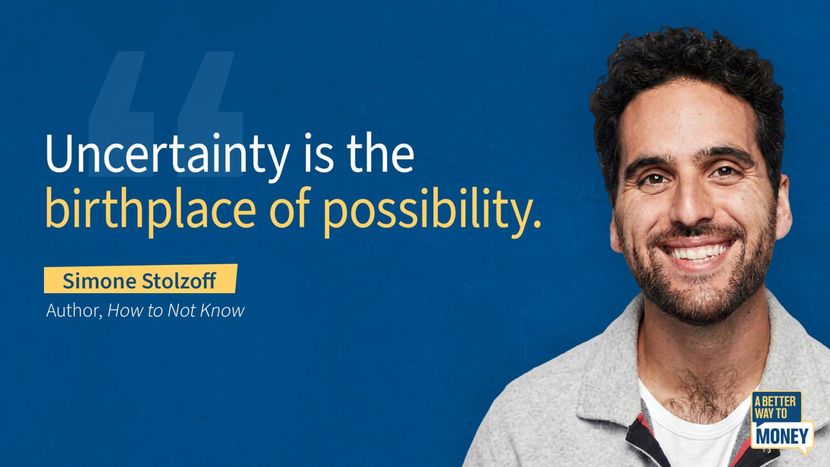
In this week’s episode of A Better Way to Money®, author and journalist Simone Stolzoff joins host Jennifer Borget to make the case that career uncertainty isn’t a crisis to survive. It’s a reality to plan for.
Simone’s argument starts with a warning: When your identity is entirely tied to your job title, you’re one layoff away from losing yourself. The antidote, he says, is building a “portfolio of identities”—investing in multiple pillars of who you are so no single shift can take you down.
He also draws a powerful parallel to financial planning: Just as defining “enough” financially gives you clarity to stop chasing more, approaching uncertainty with curiosity instead of fear can transform an anxious career moment into an intentional one.


From job changes to raising financially-savvy kids to setting yourself up to retire, we'll have deeper conversations.
Your career will change. Your financial plan should be ready.
Together, we can build a plan that holds steady—no matter what shifts in your work or life.
Find your advisorSimone Stolzoff: Uncertainty tolerance is a skill that we can cultivate, and the more comfortable with that uncertainty we are, the more gracefully we can adapt to whatever is on the other side.
Jennifer Borget: Welcome back to A Better Way to Money. I’m Jennifer Borget. When I started out in journalism, I thought I had the path figured out. I worked my way up the ladder through the different markets and eventually landed a job at a major network in a big city. But somewhere along the way, my path took some turns that I didn’t expect.
And honestly, my career today looks nothing like what I imagined when I was starting out. I’ve talked to so many people who are realizing the same thing: The traditional career ladder that we thought we’d climb isn’t there anymore.
Today I’m talking with Simone Stolzoff, author of The Good Enough Job and his new book, How to Not Know.
about what it looks like to build financial resilience when the path forward isn’t clear. We’ll talk about the dangers of tying so much of yourself to your career, how to think differently about that dream job and cultivating new interests and identities outside of work, and how all this can help you build a more resilient, happier life.
If you’re looking for ways to make your own plan for a future you can’t predict, visit northwestern mutual.com/podcast for planning tools and resources. All right, let’s dig in.
Welcome, Simone. Thank you so much for joining us today. I’m so excited to chat.
Simone Stolzoff: Thank you so much for having me. I’m glad to be here.
Jennifer Borget: Okay. I know you spent your twenties searching for what you call a “vocational soulmate.” You were bouncing between tech, journalism, design. What were you actually looking for?
Simone Stolzoff: I was looking for a job that could help me self-actualize. Maybe some of our listeners can relate, but when I was young, I was raised with this idea that I could basically be whatever I wanted to be.
And while that was empowering, in some ways, it also felt like a huge responsibility—that if I didn’t find my dream job, if I didn’t find that vocational soulmate, as you mentioned, that I would be somehow selling myself short or not realizing my potential. And so I played Goldilocks with all these different careers in college.
I studied economics and poetry. (You can already see an exercise looming somewhere on the horizon.) And then I went into advertising, and then I worked in tech, and then I worked in food, and then I went back to school to study journalism, all the while trying to find that job that could help me be the truest version of who I was.
That all came to a head when I was about 28 or 29 or so, when I realized maybe I was putting too much pressure on my job. My identity and my career had become one and the same. And maybe I actually just needed a renegotiation of what role work played in my life.
Jennifer Borget: All right. In your twenties, is that when you had that realization, You know what, maybe the search isn’t exactly what I thought it was going to be.
Simone Stolzoff: Yeah. It’s sort of like if you have a friend that always says that they have a bad roommate, and then again they have a bad roommate, and then again they have the bad roommate. Yeah, maybe it’s you that’s actually the bad roommate. You know, in the words of Taylor Smith, Hey, it’s me, I’m the problem.
I was looking for this sense of perfection in all these different jobs without realizing that maybe it was that hell-bent search for perfection that was actually letting me feel disappointed, and I knew I wasn’t the only one. You know? Especially here in the United States, the country where what do you do is often the first question we ask when we meet someone new.
I didn’t just think of my job as my means of making a living or a way to make an impact in the world. I thought it was the only way that I could self-actualize. And so I put so much pressure on myself to try and find that dream job, that perfect career, and I was just continually left feeling a little bit like I was coming up short.
Jennifer Borget: All right. You are starting to learn that it’s not just the job; you are able to grab some skills and different things from each one, but maybe this isn’t what we thought it was going to be like. Our parents had a completely different kind of, I think, expectation ... This is what we’re going to do, and this is the path we’re going to follow. They were told, You go to college, you get your degree, you start a job and work your way up, and this is where you’re going to retire. Sometimes they would have career shifts, but I don’t think maybe to the point of how our generation is looking at this—especially not like you because you kind of went to vastly different careers.
This road map seemed to work for them, but why don’t you think it works for us anymore?
Simone Stolzoff: I think we live in a different world. For one, the sort of loyalty of that social contract of working for one employer for 10, 20, 30 ... for your entire career has really broken down. Those careers of our grandparents’ generation didn’t exist in the same way.
I think there’s two sides to this. On one hand, there are benefits for individuals, who are able to try and find what researchers call better “match quality,” a better fit between your interests and your passions and what work you do.
But there is also the expectation that you can find a dream job, that your dream job is out there, that the only way to do good work is to find work that you love. And if you haven’t found work that you absolutely love, you have to keep searching. I think this mentality creates a lot of room for disappointment.
I often think about happiness as sort of the difference between our expectations and our reality, and when our expectations are perfection, it leaves a lot of room underneath that for disappointment.
The third thing is the rise of the internet, and I think especially when it comes to social media, there’s a lot of social comparison where you see these highlight reels of your peers: people posting about their job, promotions on Instagram and posting their baby photos on LinkedIn. The sort of line between our professional and our personal lives has really broken down, and so there’s this expectation that our jobs should be a reflection of our identities. Certainly for some people, the social entrepreneurs, the astronauts, the painters, that may be true, but the truth is the majority of people do not work to self-actualize necessarily. They work to survive. They work to pay for their livelihood, their existence.
In this material world that we live in, there’s a brief anecdote that I think hammers down this point. In college, I had the opportunity to interview my favorite [00:06:35] writer in the entire world. He’s a professional spoken-word poet named Anis Mojgani. And here I was, this poetry student, this 22-year-old, about to embark on this unknown future. So I asked him, how do you feel about the mantra Do what you love and never work a day in your life? And he said something that I’ll never forget. He said, You know, Simone, I think some people do what they love for work, and others do what they have to so they can do what they love when they’re not working, and neither is more [00:07:05] noble.
I think that last part is key, understanding that yes, some people work to self-actualize to express themselves, to find their truest calling. Others work so that they can express themselves or find their truest calling or live their values when they’re not working, and neither is more noble.
So, my first book, The Good Enough Job, is an attempt to sort of change our expectations when it comes to work rather than thinking about work as something that has to be our primary source of community and meaning and purpose and identity. I advocate for diversifying our identities, treating work as part of but not the entirety of who we are.
Jennifer Borget: And I love that you advocate for that.
I got chills when you were saying that quote like neither is more noble—because I think that that’s so real! My husband and I even have different takes on this, because I am the kind of person that’s has to love what I’m doing. And if it feels like a means to an end, I’m just like, It’s not worth it. I don’t wanna do it. And he is definitely more of the person that’s like, I’m working because this is what I have to do. I’m contributing to society; I’m doing my duty. And then he can do what he wants after work—or sometime, he thinks, when he retires. I’m like, No, you’ve got to enjoy it now.
You’ve got to find what you love—that’s such a good point because not everyone has the privilege of finding something that they love doing, and maybe I’m putting extra pressure on myself to feel like everything that I’m doing for money has to be something that I love. Do you think [00:08:45] that as a society, we’re all leaning more toward this?
Is the ladder still there? Is the ladder gone? Is the ladder evolving? Are people still trying to climb it? Where do you feel we’re at?
Simone Stolzoff: I definitely think the metaphor of the career ladder is starting to break down. I think there have been many inciting incidents that have led to the ladder exposing its cracks—for one, the pandemic.
You saw this particularly in some of the industries that we traditionally thought of as the most stable or the fastest-growing industries, like tech. Where I live, in Silicon Valley, the companies like the Googles and the Metas that once provided the most stability, the highest pay, the greatest benefits started laying off 10, 15, 20% of their workforce. So, I think that’s one huge cost of over-identifying with a particular job: If you are what you do, and you lose that job, who are you?
The second point, I think, is about expectations. As I mentioned, if we are always expecting our job to be a dream, or if our standard is perfection, it 1) ignores a lot of the monotony and tedium that exists in every line of work; and 2) it creates a lot of room for disappointment.
But the third, which is really the reason why I wrote the book, is that we are all more than just workers, right? We’re partners and siblings and community members and citizens and amateur artists and travelers, et cetera. And if we are solely identifying with one aspect of who we are, which is to say our job title or our professional identity, it becomes a really risky proposition if we want to be more well-rounded versions of ourselves. We have to invest in those other facets of who we are.
So, to be clear, I don’t think there’s anything wrong with loving what you do or looking to work to be a source of meaning or purpose or community, as long as it’s not the sole source of meaning and purpose and community in your life,
Jennifer Borget: I think that’s a really good tip. It can’t be your sole reason for anything. I think people are noticing that it’s more like, I know you can let me go at any time, so I can go at any time and look for something else or get a better raise or a better opportunity, or something like that. Whereas our parents maybe were putting all their eggs in one basket.
This isn’t something that I think is easy. For everyone.
Simone Stolzoff: No. My next book that’s about to come out is called How to Not Know, and the reason why I wrote it is because uncertainty tolerance is a skill that we can cultivate. I think it’s never been more relevant, whether you’re dealing with an aspect of uncertainty in your personal life or in your career or in the economy or in the world.
We’re all faced with so much uncertainty each and every day, and the more comfortable with that uncertainty, the more tolerant of it we are, the more gracefully we can adapt to whatever is on the other side.
Jennifer Borget: Later on, you’ll hear Simone share a few actionable tips to build a tolerance for uncertainty. But here’s the thing: You don’t have to do it alone.
This is where a financial advisor becomes invaluable, because as your career grows and evolves, so should your financial plan. When your career path starts to meander (and it will), a flexible financial plan gives you the runway to take risks, pivot or even step back without jeopardizing your family’s security, which is exactly what your Northwestern Mutual advisor can help you do. They can help you build enough financial resilience so you can handle whatever comes next.
Speaking of resilience, Simone is about to share his framework for building what he calls a “portfolio of identities,” and it might change how you think about career security.
So, you talk about how the good enough job, the job that pays the bills, doesn’t have to be one that consumes your whole life. What do you think we should all be trying to do instead?
Simone Stolzoff: I think one of the best things that you can do to hedge against this economic uncertainty, to hedge against this breakdown of traditional career paths, is to think about the things in your life that will remain constant despite all of the changing winds around you.
I’m glad that we’re talking about this in the context of financial planning or thinking about the future when you have certainty about some aspects of your life. It makes it easier to hold uncertainty in others, so maybe that certainty is around your values or the things that you hold dear. Maybe it’s knowing exactly where you want to live or who you want to be with or what industry you hope to work in.
Or maybe it’s something as simple as financial planning about the future so that you can know even if that worst-case scenario does come true, or even if there’s more volatility in my career path than I once thought, I’ve done the work for my future self to be able to prepare and have a little bit of slack in the system.
One of the things that I like about diversifying your identity is you can think of your identity like a house with all of these different pillars of things that make up your identity. For me, maybe it’s I’m a writer, I’m a journalist, I’m a native San Franciscan and amateur salsa dancer. I am a poet, et cetera. By continuing to invest in these different facets of who I am, if one of those pillars were to crumble, the house would stay standing. But if you’ve, as you said, put all of your identity “eggs” in one basket, and for some reason that basket is taken away from you. I, it can lead to an existential crisis.
It’s a much more precarious position to be in.
So, that’s what I would say: Diversify your identity. Think about the anchors in your life that will remain constant no matter what changes on the horizon. And continue to focus on one step at a time. I think often, especially these days when it comes to AI and all of the uncertainty that so many different industries are facing, it’s really easy to think about what might happen in five, 10, 20 years and get really anxious and
be the cause of lots of worry. But one of the things I often say is that action absorbs anxiety. So if you’re feeling really worried in the world, you can think about what are the small steps that you might take so that you feel like you are the protagonist of your own story, like you have agency of your life as opposed to being the passive recipient of what life is doing to you.
Jennifer Borget: Okay, so uncertainty is something we’re just going to have to deal with, right? It’s like a fact of life. How do you feel we can build a tolerance for this?
Simone Stolzoff: Hmm. I’m glad you asked. There are a few different ways to build uncertainty tolerance.
For one, I think it’s important to recognize that uncertainty is not necessarily a bad thing. Our brains are wired to become uncomfortable with uncertainty. If you think about our ancestors in the jungle, if there was a rustling in the bushes and they didn’t know the source of that sound, or if they were reaching for a piece of fruit and it was potentially poisonous, that uncertainty had the potential to be lethal. And that’s why when faced with uncertainty, our knee-jerk reaction is to tense up, to be fearful.
But I actually think there’s another side of uncertainty, which is that uncertainty is the birthplace of possibility. If you’re able to develop more tolerance for uncertainty, maybe you can reinvent yourself in your career. Maybe you can discover something that you like to do that you didn’t once think you would be interested in. Uncertainty is what allows us to learn and what allows us to grow.
As much as you can, try to treat uncertainty with a mindset of curiosity as opposed to a mindset of fear. There’s some really interesting research that shows that when we are able to approach uncertainty with more curiosity, it literally allows us to see more possibilities when we’re in that sort of fearful, threatening mind space. Our body tenses up. We prepare to get into that fight, flight or freeze response. Blood rushes away from our brains and toward our muscles. But when we are able to approach uncertainty with curiosity, what researchers call the “approach mode,” our pupils dilate, and blood rushes to our head.
We’re literally able to [00:17:50] see more possibilities open up in front of us. So, the metaphor is very clear when it comes to, say, our professional lives. Yes, AI might be threatening, but it might also open up new opportunities or new avenues for you to explore. So, step one, approach uncertainty with some curiosity.
Step two: Find your anchors. These are, like we talked about before, the things in your life that will remain steady. Amidst all that is changing, having certainty about some aspects of your life make it easier to hold uncertainty in other aspects of your life.
And the last thing I’ll say is to try to take an experimental approach to your life, especially when it comes to careers. If you are thinking about that ladder metaphor, you might think the only way to go is up. There’s only one path to success. But if we throw that metaphor away, and we see different lily pads as being a good metaphor for the future of our careers, there are many different potential paths that can be fulfilling, that can be lucrative, that can be enjoyable for you.
Rather than put all of the pressure on yourself to make every decision right, try to empower yourself to see each decision as a learning opportunity, as an experiment that you’re going to try in this particular season of your life. Maybe in one season of your life, you’re really leaning into that sort of security, stability, financial freedom side. Maybe another season of your life, you’re really leaning into that creativity, that exploration, that reinvention side of yourself.
But I think we often discount our own ability to course-correct along the way. We put so much pressure on ourselves that if we just sort of bang our head against the wall at the right angle, we’ll know exactly how our life will unfold.
The most creative people I know, the most [00:19:50] innovative people I know, are all people who’ve been able to develop a tolerance with uncertainty. We’ve been able to say, Hello, old friend. I know my body is trying to protect me and keep me alive in the jungle, but maybe that natural response is not what actually serves me best in this modern world that we live in.
Jennifer Borget: Getting more specific about money, I know a lot of times when people are working hard, maybe putting in those extra hours, trying to get that raise, trying to get that promotion, inevitably when that happens they usually are upgrading their lifestyle at the same time. Like, Oh, now I can get that bigger house. Now I can get a nicer car.
But I know that you argue that you should see that career growth as a chance to invest in other parts of your portfolio. What does that actually look like?
Simone Stolzoff: There’s some really interesting data about this, which is, historically, the more money a company or the country or an individual makes, the less time they work because frankly, they can afford not to. so in the 1970s, the average American and the average German worker worked about the exact same number of hours each year. Now, according to the latest data, the average American works about 30% more than the average German worker. And the question is why?
I think there are many different ways to explain this. You can look at the decline of other sources of meaning and identity in Americans’ lives, like the decline of organized religion or neighborhood and community groups. You can look at the cultural narratives that we say about entrepreneurship and pulling yourself up by your bootstraps, and you’re just on a path to become a millionaire—or if you’re already a millionaire, a billionaire or maybe even a trillionaire (now that we have those [00:21:40] in the world).
I think the most important thing about work is that it pays you enough to live the life that you want to live. And it may sound crass to talk about work this way because we’re told that work should be a calling or a vocation, but I actually think this clear-eyed perspective about this economic contract—of saying, I am giving my time and labor to this mission, and in exchange I’m receiving adequate compensation—can be incredibly empowering.
One of the things that comes to mind as this relates to financial planning is it’s sort of similar to budgeting. I, when I was younger, had this thought about budgeting that it was going to feel constrictive, like I was putting shackles on my own ability to be free or to spend as I wanted. And then when I started sitting down and working with a financial advisor and thinking about a budget for myself my week, my month, my year, it was incredibly freeing. It actually had the opposite effect because every time I went out to dinner or went to the movies, I wasn’t thinking, Oh, is this being irresponsible? Oh, can I actually afford this. It allowed me to spend money in a way that was more free because I had allocated and done the work ahead to plan for it.
It can be similar for work. Once you have your expectation, your understanding of what enough means to you, the goal isn’t always just more; it’s not just up. It’s understanding how much money I need to pay for my material existence. How much money do I want to save to be able to set my future self and my loved ones up for success? And knowing that not all of us want to be billionaires or millionaires. In the same way, the famous words of Mace: More money, more problems.
You know, there is a great freeing ability to understand how much money you actually need to live the life that you want to lead because it allows you to recognize when you do have enough.
Jennifer Borget: I love how you talk about financial planning not being this restrictive thing but actually allowing you to have a sense of freedom because you’re like, I have a line item for this vacation that I want to do or for this going out to eat. And it’s not this uncertainty of I think I have enough for this. You had it planned, you were intentional about it, and I think that’s great. That makes a lot of sense.
I’m wondering, when you talked about the United States and Germany and the work, I don’t know if even “ethic” is the word that I want to use here, but the value we place on work in our identity—how do you feel that we got here?
Simone Stolzoff: Yeah, there are many different ways to answer that question. You can think about it politically—for example, part of the reason why our relationship to work is so fraught in the United States is because the consequence of losing our jobs is so dire when, for example, we tie health care to paid employment; or if you’re an immigrant, your ability to stay in this country is often contingent on your work status.
So that’s one issue. There are lots of cultural reasons, some of which we’ve discussed. I think we live in a country that really lionizes work. I was at a WeWork yesterday; on the wall, it had scraps scribbled Always do what you love. There’s this idea that you have to do what you love. And if you’re not doing what you love, maybe it’s some sort of character flaw, or you’re settling for something that’s less than what you deserve.
I think a big reason is just this internalized idea that I produce, therefore I am—that our output [00:25:45] is a reflection of our worth. And part of the reason I wrote [00:25:50] this book is to try and separate those two things to say that just because someone is “successful,” which in our country often means they’ve just made a lot of money, it doesn’t actually mean that they are happy or that they’re healthy or that they’re a well-rounded person. So I think that’s what we need to do to right the ship: just to change the [00:26:15] cultural conversation a little bit.
I mentioned earlier that the first question we often ask each other in the U.S. is What do you do? I like trying to insert two little words into that question and instead ask people, What do you like to do? Oh, it’s a question that allows people to define themselves on their own terms. And you know, maybe some people like to do what they do for work. Maybe people like to do things that are completely divorced from what they do to make money.
And in the words of my poet mentor: Neither is more noble.
Jennifer Borget: I’m never asking someone what they do anymore. What do you like to do? I like that we’ve talked about so much today. You are amazing.
But one last like takeaway for someone who’s listening and maybe just feels overwhelmed by all the uncertainty in their career right now. Is there anything that you would say they could do this week to move forward? Do you have any tips for them?
Simone Stolzoff: Yeah. Our aversion to uncertainty is much like any other phobia, which is to say that the best way to get over it is through exposure. If you’re afraid of spiders, for example, maybe you could start by looking at some pictures of spiders or researching some interesting facts about spiders, and then maybe you can be in the same room as a spider, and then maybe eventually you can develop the courage to touch the spider.
I think it’s similar with uncertainty. Maybe one thing you can do this week is to think about your past and moments of uncertainty that you’ve gotten through already to build your confidence and your conviction through the data of your life. That uncertainty is something that you’ve faced before, that you’ve been able to make it through to the other side.
Another way to develop more exposure is through intentionally putting yourself in situations that are uncertain. It can be as small as taking a new route to work when you commute, or ordering something on a menu that you might not otherwise order, or trying to expose yourself to rejection by, say, asking for a discount on your cappuccino in the morning, just to remind yourself that you can.
Be in an uncertain situation and often the worst-case scenario, catastrophe, that your mind likes to draw up is not actually the most likely outcome to come true.
And then the third thing is just to try and remember that uncertainty is the precursor to growth. Every single scientific breakthrough, genre-busting piece of art, inspiring career move came from someone getting to a place where they were uncertain and continued to persist. I used to work at this design agency called Idea, and there was this metaphor that I learned there that has always stuck with me, which is to live a creative life, to live an inspired life.
It’s sort of like rowing a boat on a lake that is shrouded in heavy fog. You can’t see exactly where you’re going to end up. You might not even be able to see very far in front of you, but you have two jobs. One is to have faith that eventually you’ll reach land. Remember, you’re on a lake, and the second is to keep rowing.
And that’s what it takes to survive in a volatile, uncertain world. It’s to keep persisting, not in the absence of uncertainty but in spite of the uncertainty and the doubt and the fear that you may hold. So, keep rowing, fellow listener. I’ll be right there with you.
Jennifer Borget: That’s Simone Stolzoff. His new book is called How to Not Know. What a great conversation.
I love the idea of building a portfolio of identities so that when one thing shifts, you don’t lose yourself in the process. And when it comes to financial planning, that’s exactly what a Northwestern Mutual advisor does. They help you build the flexibility and resilience to handle whatever comes next in your career, whether that’s a pivot, a promotion or a complete reinvention.
If you’re ready to start building a financial plan to make yourself more resilient through change, visit northwesternmutual.com/podcast for free planning resources and tools.
Next time on A Better Way to Money ...
Julia Rodgers: What could be more romantic than sitting down and having a conversation about your future? And a prenup is really just a life planning conversation. It’s a conversation where you are talking about your future successful marriage. That, to me, is the most romantic thing in the entire world.
Jennifer Borget: A prenup sounds like something for celebrities and the ultra-wealthy, but what if it’s actually one of the smartest money conversations any couple can have before the wedding? Tap Follow in your podcast app to join us to tune in.
Northwestern Mutual is the marketing name for Northwestern Mutual Life Insurance Company (NM) and its subsidiaries, including Northwestern Mutual Wealth Management Company (NMWMC), investment advisory services and federal savings bank.
NM and its subsidiaries are in Milwaukee, Wisconsin. Not all Northwestern Mutual representatives are advisors. Only those representatives with advisor in the title or who otherwise disclosed their status as an advisor of Northwestern Mutual Wealth Management Company are credentialed as NMWMC representatives to provide advisory services.
Simone Stolzoff is not affiliated with Northwestern Mutual, and the views expressed by Simon Stolzoff do not necessarily represent those of Northwestern Mutual or its subsidiaries.