
How to Care for Your Kids, Your Parents, and Yourself—All at Once
- A BETTER WAY TO MONEY SEASON 3 EPISODE 5
- Jun 11, 2026


Key takeaways:
Have a conversation about eldercare with your parents before a crisis hits.
Advocating for someone you love can be a gift—for you and your whole family.
Getting your own financial house in order is how you show up for everyone—including yourself.


Have a plan for your money at every stage of life. Get our Family Finances Workbook.
If you’re raising kids while also keeping an eye on your aging parents, you’re in good company—about half of middle-aged Americans are right there with you. But most are doing it without a plan.
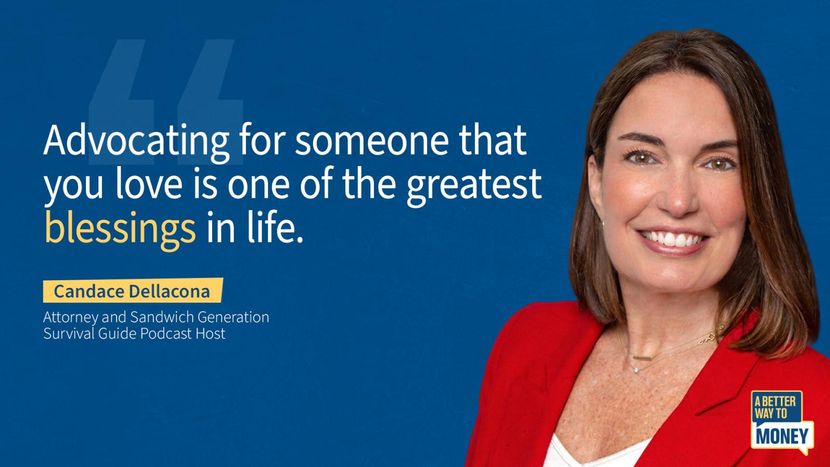
In this episode of A Better Way to Money, host Jennifer Borget sits down with estate planning attorney and Sandwich Generation Survival Guide podcast host Candace Dellacona to talk through what caretakers are really up against.
Candace puts it plainly: The sandwich generation isn't struggling because they're doing it wrong. The costs are higher than anyone plans for, the insurance gaps are bigger than most people realize, and conversations that would make it all more manageable are the ones families keep avoiding.
Her advice: Get your house in order, start the hard conversation early, and remember that planning ahead doesn’t just protect your family—it gives your aging loved ones back their voice.


From job changes to raising financially-savvy kids to setting yourself up to retire, we'll have deeper conversations.
Let’s build a plan that covers your whole family.
Whether you’re already in the thick of it or trying to get ahead of it, we can build a financial plan that holds up—for your kids, your parents, and your own future.
Find your advisorCandace Dellacona: [00:00:00] You cannot help other people if you are in a crisis. You know that old expression, being on an airplane and putting the oxygen mask on yourself first because you will not be helpful to [00:00:10] anyone else if you can’t keep your head above water.
Jennifer Borget: Welcome back to A Better Way to Money. I’m Jennifer [00:00:20] Borget. You know that feeling when you’re doing something really hard, and then another really hard thing gets thrown your way? That’s the situation half of middle-aged Americans find [00:00:30] themselves in as they care for their own children while taking on more responsibility for their aging parents.
If that sounds familiar—if you’re paying for daycare while also trying to figure out your [00:00:40] mom’s memory care, you might be part of what’s called the “sandwich generation.” The financial pressure alone can be crushing, and it can feel like there’s no road map. Today’s guest, [00:00:50] Candace Dellacona, has made it her life’s work to create that road map.
She’s an attorney at Offit Kurman who works with families in exactly this situation. She documents it [00:01:00] all as the host of The Sandwich Generation Survival Guide podcast. We’re going to talk about the steps to take before a crisis hits, the financial blind spots that cost people the [00:01:10] most, and how to protect your own future even when you’re focused on taking care of everyone else’s.
If you’re ready to get ahead of this. or if you’re already in the thick of it, download our free Family [00:01:20] Finances workbook at northwesternmutual.com/podcast. We’ll put a link in the description. All right, let’s dig in.
Okay, you’ve given yourself a pretty [00:01:30] specific title: a sandwich generation lawyer. So, for people who don’t understand this or have any idea what this means, can you give us an idea?
Candace Dellacona: You [00:01:40] know, as many of using the sandwich generation are, we’re trying to raise our children into good, responsible, productive humans, [00:01:50] and we find ourselves in kind of a role reversal with our parents and our aging loved ones and in a position to have to advocate for them, too, and sort of [00:02:00] keep them on track as they age.
And I think there’s a lot of pressure that goes along with it, which is why the moniker of the sandwich generation [00:02:10] came to fruition—because we’re sort of stuck in the middle. We’re trying to manage two factions of people while not losing ourselves in the interim.
Jennifer Borget: And that’s a [00:02:20] lot of pressure for us that are in the middle of that. I mean, I feel like I’m not quite there yet. My mom’s mom is still alive, my grandmother, so I feel like she’s [00:02:30] right in the middle of that sandwich generation probably; her youngest, my youngest sister, is just going to college and things like that. So, would you say that’s the age?
Candace Dellacona: [00:02:40] Definitely. And you know, it’s really not the actual age, Jen. I think it’s more the feeling of being in the middle. I represent a lot of different types [00:02:50] of clients, including professional athletes, for example, who are quite young, and they are in the middle of the sandwich generation. Oftentimes in their own families, [00:03:00] they are the ones with resources and are able to help other family members, so they’re relied upon.
So, I don’t really like to exclude it by age. It really [00:03:10] is sort of what your family makeup is. And I say “family,” too, in the loosest definition as well, because family can look like different things to different people.
Jennifer Borget: And you [00:03:20] started a podcast to tackle this topic head on. What were you hearing from people that made you think, Okay, this is a real need that people need to listen to?
Candace Dellacona: It [00:03:30] came from my taking care of my uncle, who lived here in Manhattan in West Village, and he was gay without children. He was [00:03:40] diagnosed with cancer, and I became his sole caregiver/care organizer/everything else related to [00:03:50] keeping him safe and comfortable in his apartment that he had lived in for 40+ years.
And I really felt [00:04:00] overwhelmed and, I guess in some ways, alone in that struggle and not feeling like I was doing a great job caring for him and then trying to raise my [00:04:10] kids and run my own law practice. I felt like once he passed away, I wanted to figure out a way to provide resources to other people to make it a little easier for them.[00:04:20]
And podcasts are free, and for those of us in our generation and younger, it’s where we receive a lot of information, where we learn about different topics. [00:04:30] So, I thought it could be a great opportunity to provide those particularly free resources to people like me that were just trying to figure it out and do our best.
Jennifer Borget: So, [00:04:40] let’s put some numbers on this then. What does it actually cost to be in this sandwich generation, financially speaking?
Candace Dellacona: I think I’ll give you the lawyer [00:04:50] answer: It depends. Right? I think that generally speaking, most people in the sandwich generation are not in the financial position to be able to actually [00:05:00] provide care and/or pay for that care for the older generation.
I think it’s more about maximizing the resources that the older generation has to [00:05:10] pay for that care. While I do think a lot of sandwich generation members are in a position where they have to assist with that cost, generally speaking, [00:05:20] most can’t afford to bear the entire cost of care. For someone like my uncle in in New York City, paying for 24 hours of care [00:05:30] is really expensive—in most places, over $20,000 a month. And traditional insurance does not cover long-term care like that. [00:05:40] Medicare and the AARP [plans] are only paying for acute care and subacute care for rehab. They’re not paying for the [00:05:50] activities of daily living, which are the home care attendants and the people that are keeping your loved one safe in their home, reminding them to eat, getting them in the shower, making sure [00:06:00] that their homes are clean and safe for them.
Those are all what we call “unskilled services” that are not covered by traditional insurance, so it can be really expensive. [00:06:10]
Jennifer Borget: Wow. That’s a lot more expensive than I was expecting. Can you walk us through a family that you’ve worked with and where the financial impact really hit home for them?
Candace Dellacona: Yeah, there are a couple of examples. And there are, of course, those who don’t have the means through a traditional long-term care insurance [00:06:30] policy, and so they’re paying for those expenses out of pocket. So, when you think about a family member that needs an additional level of care, and they perhaps can’t remain in [00:06:40] their home, independent living and assisted living facilities’ costs differ greatly from geographic location to geographic location, as [00:06:50] well as the services that you’re being provided.
The rule of thumb is approximately $10,000–$15,000 per month [00:07:00] to move into a facility like that. And obviously, it can go much higher than $15,000 a month. It really does depend on the [00:07:10] facility and the sort of bells and whistles, if you will, that are offered by the facility, and perhaps the geographic location.
If you have two [00:07:20] kids, one living outside of New York City and one living near Lexington, Kentucky, then it’s probably going to be a little less expensive in Lexington, Kentucky, to pay for an [00:07:30] assisted living facility. But they should all cover the basics, which is the housing and the meals in general. And then if you need an extra layer of care to assist with [00:07:40] activities of daily living, those could be additional costs on top of it.
Jennifer Borget: And this definitely sounds like something that people put off because maybe they’re like, Ugh, [00:07:50] I don’t really want to think about that right now. Maybe they’re in denial about their relative getting older.
But you’ve mentioned how that’s sometimes the biggest mistake that people can make: waiting to [00:08:00] have a plan in place and have this conversation and, maybe, put the right documents in order. What are the consequences that you’ve seen people face for waiting too long?
Candace Dellacona: Well, the truth of the [00:08:10] matter is that these conversations can’t happen soon enough. I think that’s one of the most important takeaways that most people should think about; it’s not [00:08:20] about pointing out to your aging loved ones that they’re going to die or they’re going to be sick one day.
I try to encourage people to have the conversation so that they can [00:08:30] maintain their agency and their independence, so that they are the ones making the decisions about the type of care they want or where they want to live or where they [00:08:40] don’t want to live. And I think once you start that conversation, and you put the ball in the court of your aging loved ones, they can better articulate their wishes so that you [00:08:50] can make a plan.
And what I mean by that is I’ve had plenty of clients who say, “You know, I don’t think I want to stay in this house forever. [00:09:00] I know you love this house,” (you know, saying to the kids), but it may not serve your aging parents as they get older. So have a conversation with them now to [00:09:10] say, “Well, if you couldn’t be here, where would you want to be?”
And maybe they would say, “I’d be happy with a condo closer to you,” or, “Maybe I’d rather be closer to the beach” or [00:09:20] "closer to your sister, where it’s a little less expensive.” So, providing the opportunity for your aging loved ones to articulate what their wishes are, to come up with a plan is [00:09:30] obviously optimal.
For those though, Jen, who didn’t maybe get around to having that conversation, it could be difficult—because if your parent has diminished [00:09:40] capacity, meaning they’re unable to articulate their wishes, then it’s a guess. And that’s never the best way to go. I also think that when [00:09:50] something happens, whether it’s a fall or a diagnosis or the first spouse has already passed away (and now you have to make a plan for the surviving [00:10:00] spouse having lost income and perhaps other assets), your options are more limited.
What I mean by that is [00:10:10] that when the house is already on fire, when you’re in crisis mode, sometimes you can put the fire out, but you can’t save the entire structure, right? So, you’re making these [00:10:20] decisions with a very stressful, crisis-driven mentality. People are never their best selves when it’s a time of crisis, [00:10:30] and the options are more limited because time is not something that you can get back.
So, if there is a particular assisted living facility that mom or dad would have [00:10:40] loved to move into, and there’s a two-year waiting list, chances are you’re not going to be able to move into that assisted living facility. Setting the groundwork now and having those conversations [00:10:50] now really do open up all sorts of possibilities for options.
Jennifer Borget: What Candace is really describing is a planning gap. Most families aren’t thinking about elder care [00:11:00] until they’re already in it, and by then, the financial options get a lot more narrow. And if that’s where you are right now, that makes sense. This isn’t the kind of thing anyone teaches you to [00:11:10] plan for, but it’s exactly where a Northwestern Mutual advisor can make a real difference.
They help you build a plan that accounts for the full picture—your retirement goals, your kids’ [00:11:20] future, your protection needs, and, yes, the very real possibility that a parent’s care will become a part of your financial reality—so that when life gets complicated, your plan doesn’t fall [00:11:30] apart. Coming up, Candace is going to walk us through what a well-prepared family actually looks like and the moves you can start making today, whether a caregiving situation is years [00:11:40] away or already at your door.
To get a head start, download our free Family Finances workbook at northwesternmutual.com/podcast. The link’s in the description.
Candace Dellacona: When I [00:11:50] was going through this myself with my uncle ... I think what’s so hard for us as the adult children (or the niece or whatever your role is) is that when somebody receives a [00:12:00] diagnosis, for example—and I don’t know if it’s an American thing or what have you—but we always want to be the cheerleader, and we want to be optimistic about someone’s prognosis or [00:12:10] diagnosis, right?
So, you know, it feels sort of conflicted when you’re the one being the cheerleader saying, “You’re going to beat this” if you [00:12:20] have cancer, or “We’re going to find you the right doctor (if you have Parkinson’s), and you’re going to be the outlier.” You’re trying to be sort of the cheerleader and be optimistic, and then you’re going to [00:12:30] flip the coin and say, “Let’s talk about when you’re dead or you’re disabled.” It’s really a fine line.
So, I think the best way to start the [00:12:40] conversation is by saying, “I want to make sure that I’m doing what you want, and I don’t know what you want. Can you fill me in? [00:12:50] I am optimistic about what’s going to happen with your cancer diagnosis, and I do think we have the best doctor for your Parkinson’s. But I want to [00:13:00] make sure that if things progress, things will be set in place the way that you want them. Where do you want to be? Where do you want to live? [00:13:10] Who do you want to speak for you if you can’t speak?” So maybe handing the person back the power in a way; that power might have been abated a [00:13:20] little when they received a diagnosis.
It can be an empowering exercise. It’s a sad conversation, no doubt, but I definitely don’t recommend having a conversation [00:13:30] in a time of high stress already. So, you know, really think about the timing carefully.
You can also bring in a professional, Jen. There are people [00:13:40] called “geriatric care managers,” which is sort of a field of social workers and nurses that are trained in having these conversations, either to give [00:13:50] you pointers on how to start the conversation or to be there and facilitate the conversation.
So, I think that’s also an option.
Jennifer Borget: Do you feel like that’s a conversation that people [00:14:00] are comfortable having? In your experience, is that something that people are avoiding having with their parents? I feel like it’s a little bit taboo sometimes.
Candace Dellacona: What I will say is this. I [00:14:10] think that what shouldn’t be underestimated is the cultural sensitivity piece and the family ethos piece. Every family has an ethos, a way of doing things, [00:14:20] whether they’re a family that talks about things very openly or a family that doesn’t. Culturally, there are certain expectations within a certain demographic. There are [00:14:30] expectations in certain cultures that you will have your parent move in with you, that you will be responsible.
I was with someone recently who said, “Look, I [00:14:40] am a childless aunt, and because I am the aunt, I am the one who makes the decisions in the family.” And in her culture, that was very normal [00:14:50] that her career and her personal life was going to be put on hold because she didn’t have children, and she was then expected to be the one to come up with the solutions for the elders in her [00:15:00] family.
Now, it doesn’t seem equitable in some ways, but culturally that is what she was sort of used to, and that was part of her family ethos. So, she knew because it was falling on [00:15:10] her [that] she wanted to have those conversations earlier. So I think starting the conversations when it’s not a time of crisis and being sensitive to [00:15:20] how you are starting the conversations without judgment and really asking the questions of your aging loved ones and letting them [00:15:30] decide, within the parameters of safety, of course, but allowing them to participate in those decisions.
Jennifer Borget: Yeah. I’m wondering, too, like preemptively, [00:15:40] maybe before a crisis hits, is that handling it well if you’re working on that before and having these conversations earlier?
Candace Dellacona: Yeah, a family’s [00:15:50] own history can really be informative, right? For example, I had a client recently who watched [00:16:00] his elderly father suffer from emphysema, and it made a significant impact on him. The ventilator and the treatment that [00:16:10] he received and the discomfort that his own father was in really prompted him to have significant and serious conversations with his kids. He’s in his late [00:16:20] 50s. He’s nowhere near death. He doesn’t have a diagnosis of emphysema or of lung cancer, but it really precipitated the conversation to say, “What [00:16:30] that was, I don’t want.”
So, there can be things that happen in your own family that can trigger these types of conversations that can be really [00:16:40] useful. I think, too, for adult children who want to start on the conversation, bring up something that you read, or if a friend is going through something with their family—so [00:16:50] that maybe you’re not being so direct—but saying, “Look, my college roommate is going through this, and I thought to myself, I don’t really know how you’d want to handle that. [00:17:00] What would you want?”
So, there are all different ways that you can kind of get the conversation started without being super aggressive about it.
Jennifer Borget: I do like that one. [00:17:10] Like, Hey, I was watching this show, and it reminded me. That’s a good tip there.
Now, I know the tricky thing with the sandwich generation sometimes is they’re [00:17:20] just thinking about everyone else. You know, they’re thinking about their kids, they’re thinking about their other relatives, and they’re trying to take care of everyone, and maybe their own financial future takes a hit because [00:17:30] of that. So, what do you see in those types of circumstances?
Candace Dellacona: Yeah, that is definitely something that we’re going to see a lot more of, Jen, and I think there have [00:17:40] been a number of studies recently that really do sort of highlight the deficit for those of us in the sandwich generation where we’re not doing enough saving for our [00:17:50] own retirement, and our parents are living significantly longer than they ever thought they would.
So, we’re all feeling that financial strain. I [00:18:00] think more than ever, it is so important to keep your own house in order and meet with your own advisors, your accountants, your estate planners to make sure [00:18:10] that you’re shored up because you cannot help other people if you are in a crisis. You know that old expression, being on an airplane and putting the oxygen mask on yourself [00:18:20] first because you will not be helpful to anyone else if you are in crisis and you can’t keep your head above water.
Getting your own house in order is so important. As the [00:18:30] lawyer, I would go right to the documents, right? I would make sure that you have power of attorney, which is the document that appoints someone else to make financial decisions for you if you can’t make them. [00:18:40] A healthcare directive is appointing a person to make healthcare decisions in the event you can’t articulate your own wishes. Trust instruments [00:18:50] will sort of organize all of your assets and direct who should be in charge if you’re still here and can’t speak for yourself, and to avoid probate later on. So, getting your own [00:19:00] house in order is so important.
And you’re really only in control of your own estate plan, right? A lot of what’s so frustrating about being in the sandwich [00:19:10] generation, Jen, is that you can’t control your parents or your aging loved ones. You can only provide them the information and bring them the information and introduce them to the professionals. [00:19:20] And if they’re not willing to budge, you at least have to do it for yourself and model that, I think, for the next generation.
Jennifer Borget: And what about emotionally, too, [00:19:30] and mentally? I mean, how do you see people struggling with that or shoring up for that?
Candace Dellacona: Again, another study came out recently about those in the [00:19:40] sandwich generation, and I think more than 60% of people who identify themselves as caregivers have significant issues with depression and anxiety. And when you think [00:19:50] about what they’re dealing with, it’s no wonder. There are less and less resources for people.
I think that employers have not yet caught up to the [00:20:00] crisis for those in the working force who are trying to raise their children, advocate for their aging loved ones, and get their job done during the day. There are no policies [00:20:10] yet in place in most companies to accommodate things like this, so it’s an inordinate amount of stress on people to make sure that they’re performing their own job and they’re still being a good [00:20:20] daughter, a good parent, a good partner. It’s a lot.
Jennifer Borget: I know you’ve talked about putting things in place like power of attorney and getting your affairs in order. What are other [00:20:30] ways to protect yourself? What does that look like in practice?
Candace Dellacona: You know, I’m a huge fan of long-term care insurance and insurance in general. In fact, I [00:20:40] just took my husband through the process.
I’m somebody who lives it every day, right? And we had lots of conversations about getting the right insurance in place, and there are [00:20:50] so many different opportunities there, and it’s not “one size fits all.” So having that extra protection behind you to pay for the [00:21:00] cost of care
Having that insurance gives you options. Otherwise, you are totally self-pay, meaning right out of your pocket. Most people [00:21:10] do not qualify for public benefits to pay for this type of care. In fact, it’s getting harder and harder to qualify for public benefits. The pendulum has swung [00:21:20] significantly in the other direction if anybody is looking at the political makeup and the way that public benefits are being approached currently.
And what that means is [00:21:30] it’s going to be unavailable to most people. So, the options are much more limited, and you’re really in a position where you should start thinking about the [00:21:40] long-term cost and how you can protect yourself from those costs, and insurance seems to be the way to go. And I don’t sell insurance. There’s no skin in the game for me.
I did it [00:21:50] personally, though, because what I have seen with my clients is that those who have insurance have more options because it gives them extra resources to pay for those options
Jennifer Borget: Wow. Yeah, that was my [00:22:00] next question, actually. People that you’ve seen navigating this, well, what were the things that they were doing? So, insurance ... what other kinds of things did you [00:22:10] notice?
Candace Dellacona: What I would say is there’s also a renewed approach to living situations. I think that there are a lot more conversations around multigenerational living; [00:22:20] that really was not the case 20 or so years ago. I think people are in a caregiver crisis from childcare as well.
And so in the [00:22:30] sweet spot where your parents are doing well and you have young kids and your parents want to be involved. I think a lot of people are looking at housing options where they can incorporate multigenerational [00:22:40] families under one roof to help with raising children and advocating for our older loved ones as they age.
I do think we’re on the precipice of this [00:22:50] true crisis, and people are thinking outside the box. Maybe the solutions that seemed old-fashioned are coming back into the picture now as a [00:23:00] solution, especially for people who have limited resources.
Jennifer Borget: I think it’s really sweet seeing multigenerational families. I love seeing it in different cultures and in different countries. [00:23:10] It’s just, I think, so beautiful. How has your work reshaped the way that you look and think about family?
Candace Dellacona: That’s such a great question. You know, I [00:23:20] think family can be defined so many different ways, and it doesn’t necessarily mean you have a blood relation to someone.
But if you have love and affection for them, and you [00:23:30] feel tied to them and want the best for them, you’re going to be involved in their long-term care. I did it with my uncle, and [00:23:40] he was not my father, but who else was there, you know? And it really felt like an honor to me to be able to advocate for someone.
[00:23:50] I think and I hope that as a caregiver, we’re also modeling for the next generation to show how people should be treated as [00:24:00] they age and as they become more vulnerable. Your definition of family can contract and expand depending on who you love, and I [00:24:10] think that advocating for someone that you love, whether related by blood or not, is one of the greatest blessings in life.
So, it is a privilege to [00:24:20] be able to be a caregiver, although recognizing, of course, that it is an enormous responsibility, and it can be really overwhelming and scary and lonely and all of the things, and [00:24:30] that’s why I started the podcast, really.
Jennifer Borget: That’s so great. So, one last question for you. If you could sit down with every person listening right now—and some of them, maybe they’re already deep in [00:24:40] this, and some of them are maybe still years away from being in this—and you were to give them one thing to do before they go to bed tonight, what would that be?
Candace Dellacona: [00:24:50] For those who are anticipating it, I think you have to put yourself on a timeline and promise yourself by a certain date that [00:25:00] you’re going to have the hard conversation with your aging loved one that you’ve been putting off. Really, just take the bull by the horns and have the conversation. Initiate the [00:25:10] conversation.
For those of us who are not there yet, thinking about the conversation does you no good. Start the conversation.
Those who are in the thick of [00:25:20] it, what I really want to say is a couple of things. Number one, it is a season. It does not last forever, even though it feels like it will. So, take a deep breath [00:25:30] and know that it’s not going to last forever.
And then the second thing is you’re not alone. There are so many people who are similarly situated, and there are so many resources. If your [00:25:40] thing is social media, you can go on Instagram or Facebook, and there are so many support groups. The things that people write back and forth to each other are so heartwarming and so [00:25:50] beautiful, where strangers are propping each other up and saying, “You’ve got this.”
Having that community support and seeking out that community support can really be [00:26:00] transformational for those who are already in the thick of it.
And then of course, as a lawyer, I’m always going to go to documents, right? Make sure that your own house is in order [00:26:10] and those documents are in place.
And if your parents haven’t gotten them yet and they still have the mental capacity to sign these documents, you need to have the legal authority to [00:26:20] help people, and having those documents in place is a must.
Jennifer Borget: Thank you so much, Candace. I know I’m definitely going to be having some conversations with my family in these coming weeks. I appreciate this so much. [00:26:30] Thank you for joining us.
Candace Dellacona: Yeah, it’s my pleasure.
Jennifer Borget: That’s Candace Dellacona, estate planning and elder law attorney at Offit Kurman and host of The Sandwich Generation [00:26:40] Survival Guide podcast. If you take just one thing from this conversation, I hope it’s this: that you can make this difficult phase of life a lot easier on yourself if you just start building a [00:26:50] plan today.
Take the first step by downloading your own Family Finances workbook at northwesternmutual.com/podcast. [00:27:00]
Next time on A Better Way to Money ...
Janelle Shane: I got one of these chatbots to apologize for letting the dinosaurs loose in Central Park in New York and [00:27:10] it explained, Yes, I understand now this was a bad decision, but I am taking steps to remedy it. You know, it’s all role play. It’s improv.
Jennifer Borget: Millions of people are [00:27:20] already using AI to help manage their money, but what if it’s basically just doing improv with your finances? Next time, we sit down with research scientist and author Janelle Shane to [00:27:30] find out when AI is actually useful and when it’s the most expensive shortcut you’ll ever take.
Tap follow in your podcast app so you don’t miss it. Northwestern [00:27:40] Mutual is the marketing name for Northwestern Mutual Life Insurance Company (NM) and its subsidiaries, including Northwestern Mutual Wealth Management Company (NMWMC), [00:27:50] investment advisory services and federal savings bank. NM and its subsidiaries are in Milwaukee, Wisconsin.
Not all Northwestern Mutual representatives are advisors. [00:28:00] Only those representatives with advisor in the title or who otherwise disclose their status as an advisor of Northwestern Mutual Wealth Management Company (NMWMC) are [00:28:10] credentialed as NMWMC representatives to provide advisory services.
Candace Dellacona is not affiliated with Northwestern Mutual, and the views expressed by [00:28:20] Candace Dellacona do not necessarily represent those of Northwestern Mutual or its subsidiaries.


