


If you’ve felt anxious thinking about money, you're not alone.
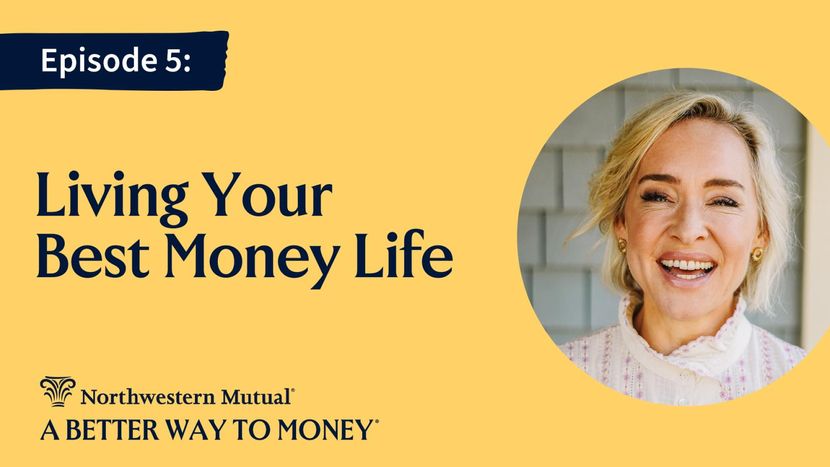
In this week’s episode of A Better Way to Money®, bestselling author and entrepreneur Kate Northrup joins host Jennifer Borget to discuss why we feel certain emotions about money. She offers actionable tips for taking a more holistic approach to money management and explains how living in alignment with your values can bring a sense of calm to your financial life.
Kate also discusses why she’s against hustle culture and shares how creating more space (instead of doing more) might be the key to financial clarity. Kate offers a different approach to money management—from nervous system regulation to the importance of slowing down—that focuses on looking inward and living with intention.
Our Better Way to Money eBook can help you get started.
Whether you're feeling stressed, overwhelmed, or just curious about how to practice financial wellness, this one's for you.


From job changes to raising financially-savvy kids to setting yourself up to retire, we'll have deeper conversations.
[00:00:00] Kate Northrup Looking at our lives, specifically our relationship with time and energy, through the lens of what matters, what doesn't. And ultimately, our relationship with money is very intertwined with this very same thing.
[00:00:18] Jennifer Borget No matter where we are in our lives, one thing is certain: Our relationship with money impacts every part of it. And yet many of us struggle to navigate that relationship in a way that supports our well-being. Today, I'm joined by Kate Northrup, an entrepreneur, coach and bestselling author who helps people lighten their mental loads and live in alignment with their values, financial and otherwise. Kate's work blends practical financial tactics with a deeper look at how our nervous systems, emotions, and beliefs influence how we feel about money.
And remember, if you enjoyed today's episode, please leave us a rating and review. For more episodes and helpful guides, visit us at NorthwesternMutual.com/podcast. All right, let's dig in.
Kate, I am so excited to chat. Thanks so much for joining us today. First, can you just start telling me a little bit about yourself?
[00:01:13] Kate Northrup First of all, I'm so excited to be here. Thanks for having me. I've been in the personal finance, healing your relationship with money field for over 20 years. And I stepped into this work because when my parents got divorced when I was in high school, my mom, who was 50 at the time, made this vow that she was going to get financially literate. So even though she was a doctor, she was very successful, she just had given all financial decisions to my dad, just kind of assuming because he was a man, he would know better. And at the age of 50, she's like, I better get it together because I'm here on my own now. I was 16, and for whatever reason, I just had this insatiable appetite for learning about money. And despite trying all these different ways to get it together financially, I just could not get myself to essentially lean in and become a full financial adult because all of the money advice I was following from what was available in the personal finance world at that time felt very shame-based.
[00:02:36] Jennifer Borget So what does wellness mean to you when we're talking about money?
[00:02:41] Kate Northrup Level of stress directly impacts our well-being. What we know is that at the root of nearly every single disease that is bringing our health care system to its knees really is stress. And we also know that money is the number one leading cause of stress or at least in the top five. So, when it comes to wellness, our relationship with money needs to be at the forefront. Honestly, wellness can be expensive. We can't separate our money from our well-being because every single day for the rest of our lives, we're going to be interacting with money. And for most people, those interactions come with fear, stress, anxiety—contraction, a feeling of pressure. But what if every single interaction with money could come with a sense of abundance and joy and consciousness and agency and help us to feel more of ourselves as opposed to less of ourselves?
[00:03:50] Jennifer Borget So, how do we do that? How do we get it to where we're feeling that way?
[00:03:57] Kate Northrup We want to change our results when it comes to money. Whether it's that we want a higher income, we want to be better at saving, we want to have our retirement covered. We want to be able to go on vacations. We want to become investors. We want to feel safe and secure. How do you want to feel with money? I want to feel safe, secure and free. So, we think, Oh, a number in the bank is going to get me that feeling because our nervous systems are wired for survival. We are animals. It does not want us to experience anything new. It only wants us to experienced that which we've experienced before, which is tricky when every single one of our financial goals requires us to experience something new.
[00:04:43] Jennifer Borget So many of us are stuck in that cycle: earning, spending, stressing, and thinking more money will solve the stress. Next, Kate will reveal how you can break that cycle and unlock your version of financial wellness. Before we dive back in, let's briefly hear from Northwestern Mutual on how planning can help.
[00:05:03] Speaker Financial wellness is a crucial part of your overall well-being, but it's often overlooked. In fact, research from EY and Dr. Hal Hershfield has shown that following a comprehensive financial plan can lead to better outcomes for you, financially and emotionally. The first step in creating your plan should be a deep, meaningful conversation with your advisor. This is where they really get to know you, your values and your goals. These kinds of conversations can help uncover blind spots and opportunities you might not have seen on your own, so you can work together to grow and protect your money, making it easier to achieve your goals. If you want to learn more about comprehensive planning and how it can boost your financial wellness, visit NorthwesternMutual.com/podcast and download our A Better Way to Money e-book. Then reach out to your advisor to get started.
[00:05:49] Jennifer Borget Okay, Kate, your most recent book, Do Less, talks about your Do Less philosophy. Can you break down what that's all about?
[00:05:56] Kate Northrup So, Do Less was my second book, and Do Less is really looking at our lives, specifically our relationship with time and energy, through the lens of what matters, what doesn't. And ultimately, our relationship with money is very intertwined with this very same thing. Money is designed for us to align our lives with what really matters to us, right? Like currency, the money system is pretend. It was invented by humans to be able to trade value for value: that which I find valuable with that which you find valuable.
Fundamentally, that's like a deeply emotional process, and it's actually pretty unique, that which each of us finds valuable or thinks that matters is unique. But we are so conditioned by media, culture, family, friends, whatever, to get disconnected from what really matters in our lives. And so, we overwork. We overspend. We get lifestyle inflation. And we end up living these lives in terms of our work, our time, what we think about. What we put our attention on and what we spend our money on are completely disconnected from who we actually are on a soul level.
The Do Less philosophy is really about Okay, how can I take my actual most precious asset, which is my time? It is non-renewable, right? We only get what we get. How can I actually reorganize myself so that I'm able to invest my time and energy in what matters? And reap the rewards of that as opposed to being stuck in this unconscious programming, which says if I do more, I will be more valuable.
[00:07:58] Jennifer Borget Not everyone has the same definition maybe of what success looks like. I mean, maybe we've all kind of been programmed to have the same definitions, but I like how you're talking about how it doesn't have to be that way. So, how do you define financial success outside of the norms of traditional wealth?
[00:08:16] Kate Northrup Designing your life so that you are experiencing that which makes you come alive. And that requires investing your money and planning in such a way that it protects the things that matter to you. Whether those are your assets, whether that's your time ... you know, I'm a business owner, so I think a lot about a million different ways that I could make money in my business, for sure. And you know what, only a very small percentage of them is actually something I'm going to do because my freedom and having very little on my calendar is actually my number one priority. That to me is financial success. And people might say, Oh, well, you're leaving money on the table. And I don't care because my time is mine.
[00:09:04] Jennifer Borget How can listeners start to identify the ways that their financial habits could be actually harming their well-being?
[00:09:11] Kate Northrup Oh, love this question so much, I cannot even tell you. Right now I have a student body of a thousand people inside my Relaxed Money student body. While it's certainly not a statistical model, it is a cross-section of humanity. We're a global program, or at least it's a cross-section of people who invest in online programs who have an internet connection. We're doing something right now called the expense edit. And what I'm finding is that most people actually are not aware of where their money is going, or if they are aware, they're not aware of the totals.
Our goal for everyone right at the outset is to find a way to save a minimum of $300 a month: Okay, how can we just reclaim $300 month? Immediately that gives us a sense of agency. And I have a process that I take people through because one of the things that causes depression is a feeling of victimization, a feeling I don't have control over my life. Same thing with anxiety, right? A feeling of life is being done to me, and I have no choice about it. The sooner we can put ourselves in a feeling of taking our personal power back, the better.
Where we start is Let's look at your subscriptions. Let's just look at what your automated charges are, and people are finding that Oh my gosh, I've been paying for this thing for three years monthly that I didn't even notice because it's automatic. I'm not paying attention ... because here, it's back to the nervous system. People think, Oh, I'm just not disciplined, or I'm not good with money, or I am not a numbers person, or my husband does that, or Ooh, I just don't want to log in, right? All of that is simply your nervous system wanting to make sure you don't pay conscious attention to your money. If you don't pay conscious attention to your money, that will ensure that you stay below a certain amount of wealth and expansion, which doesn't feel good. But it feels safe and familiar.
And so, what we do is really start by building small bits of consciousness, and people are realizing Oh, wow, when I log in and I pay attention here, I'm realizing I have all these subscriptions. I bought them on Apple Pay, and now it's just getting automated. And you think, oh, $9.99 a month, whatever, that's not going to make a difference. You know what? It really does when you have five things at $9.99 a month. And then when you do the totals, you realize Oh, what else could I do with that money? Well, I could invest it in the stock market and get an 8 percent return on average year over year, or I could put it in my kids' college 529.
It's starting to see our spending choices as an extension of our personal power and reclaiming it so that we're making those conscious choices—not so it's like Oh, you have to spend as little money as possible because I'm really not about deprivation. But the truth is when we spend in alignment with what we truly value, what really matters to us, we don't feel deprived. We actually feel incredibly abundant, and most people find they can spend less money and actually be getting more out of life because they're spending on what matters to them, not trying to keep up with their neighbors with whatever car or how their house looks like. No one cares what you have. No one cares about your belongings. No one cares. No one notices. Doesn't matter.
[00:13:17] Jennifer Borget What do you feel the importance is of having a plan or goals in place to create a sense of money wellness?
[00:13:25] Kate Northrup The way I think about it is that money is like water, right? We have abundance, and it will flow; however, if we want a river to flow well, we need a strong riverbank that's not eroded, that has that nice boundary.
So, I love thinking about financial systems, financial plans, goals as the beautiful strong boundary of a river, which allows the water to flow in a clear direction and actually helps to increase the speed of the water flow itself. That's where having a strong financial system, having a stronger financial plan, comes into place. And when we have a great plan, when we have goals, when we have a system, it actually vastly reduces the amount of mental bandwidth that money takes up. We actually have to think about it far less when we have a good plan and system in place.
[00:14:29] Jennifer Borget I love that riverbank analogy. That makes so much sense. I think you're right that sometimes we get scared of Ooh, I'm going to look at my bank account, and then I'm going to start feeling this sense of lack versus the sense of abundance, thinking that ignoring it is going to help with that. Just thinking of the positive but actually having a plan gives you that structure. That's just the perfect analogy. It can flow toward you. I really like that.
What does holistic planning mean to you?
[00:15:04] Kate Northrup A holistic financial plan is really about the soul-searching of asking, Who am I? Also, who was I before the world told me who I was supposed to be? What makes me come alive? And then matching our financial plans to that.
I was just reading about a couple who decided to retire early, and they decided to live on very little and live in the mountains so that they can be outside every day, and they organized their whole life around that. I think we really need to encourage people to look less at What am I supposed to do? This comes up again in my work all the time; people really want me to tell them. And I'm like, Of course I can give you guidelines. I will give you questions to ask yourself, but I cannot tell you because I am not in your heart.
[00:16:01] Jennifer Borget Okay, you've talked about rest being a money strategy, too. How is that a strategy?
[00:16:08] Kate Northrup One of the things we know is that when we are constantly going and paying attention to every ping and every request and all the notifications and the social media and the news and constantly listening to a podcast and running from thing to thing, we cannot tap into our intuition. That is such an important wealth strategy. Because the things that are going to move the needle the most for us, whether it's an investment strategy, a way we can save a bunch of money, something creative for our business or our career, or some other insight, are going to come in the still, small moments when you turn off the noise. When we do too much, too fast, too soon, it actually has negative implications. It actually doubles down on that neural pattern of fear and contraction versus just small openings when it's like, Okay, it's safe for me to sit here for a minute until the water boils.
[00:17:12] Jennifer Borget That is what I think a lot of people feel: going from thing to thing and being busy. Do you have advice for someone who maybe feels like they're burned out, trying to do it all, maybe not in the moment? Okay, going from thing to thing to thing like a lot of us are, but maybe in life in general, like career, family, finances, self-care, what advice would you give to someone who's feeling that?
[00:17:38] Kate Northrup Oh, it's so real. And it depends, right? If you have children, first of all, that's just exhausting. So, you know, I think sometimes I just have to ... listen, it's rough out there. I have a seven-year-old, a nine-year-old. It's definitely gotten a lot easier. But I always say, look at what actually is the mental load that you are carrying. And I love to talk about asking for help and not only asking for but passing on ownership of parts of that mental load to others. I really like to work with people. Let's reconfigure what you already have without anything needing to change externally. And then certainly we can change things externally, but most people can get huge results with some reorganization of their existing plate with money and time.
[00:18:35] Jennifer Borget Is there another small shift that you think listeners can do today to just invite more calm, clarity, and maybe intention to their money life?
[00:18:45] Kate Northrup One of the things that I love recommending as a starting place is, when you check your bank account balance, do it after calling to mind some things that you're grateful for and allowing yourself to feel the feeling of gratitude for what's already abundant in your life. For example, when I was in a lot of credit card debt, I was also frequently going into overdraft on my checking account. And I was so avoidant, I just never opened it because somehow I thought that if I didn't look at it, it would fix itself. I was like, Okay, what we put our attention on grows. So, I want to put loving attention on this. However, I felt scared. So, what I did was, each morning, look around my apartment, and I would maybe see that Oh, that house plant is doing really well, or I have leftover pad thai in my fridge that I'm excited to eat for dinner later, or whatever. It doesn't have to be complicated, right? And then I would go look at my bank account balance while I was already grounded in the reality that abundance is available to me right now. I am okay right now, and then if I was in the red, I wouldn't then create this whole fear response in my body that would then create fear-based behavior all day, which then of course creates a result that creates more fear.
[00:20:22] Jennifer Borget Oh, that's good. I love that tangible tip. That's good: Get yourself grounded in gratitude before you open up your bank account. And then whatever you're going to feel there, at least you started from a grounded point, and that can help you manage that.
All right, one more: What's one thing that everyone should take off their to-do list today?
[00:20:40] Kate Northrup Our tendency to worry is a nervous system-based pattern. We can learn to heal our nervous systems and have some practices in place to get us out of the mental loops. And, you know, one of the most simple ones is to take a three-minute walk around the block. That will reset your nervous system so that your body can catch up to the fact there is not an impending threat present right now. Actually, I'm completely safe, and it immediately frees up your mental bandwidth to be more present, more proactive, more creative, more resourceful. So, just any time you're worrying, you need a nervous system reset.
[00:21:24] Jennifer Borget Great. I love that. So many good, tangible tips. Thank you so much, Kate. Was there anything else that you wanted to add that I didn't ask you?
[00:21:31] Kate Northrup I will just say, as a final word, there is not one person who was on the planet who was born being good with money. It is a skill set that absolutely anyone can learn. And if you can learn to do third-, fourth-grade math, you can be good with money. It's just time to get engaged with it because it actually also can be really fun.
[00:21:57] Jennifer Borget It was such a pleasure to talk to Kate. Her experience has proved that financial wellness isn't about chasing someone else's version of success. It's about creating one that actually fits you.
If you're ready to align your finances with your values, your financial advisor can help you get there. Head to NorthwesternMutual.com/podcast to download our free e-books on the power of planning and start your own path to clarity and confidence.
[00:19:01] Speaker Northwestern Mutual is the marketing name for the Northwestern Mutual Life Insurance Company, NM, and its subsidiaries in Milwaukee, Wisconsin. Not all Northwestern Mutual representatives are advisors. Only those representatives with “Advisor” in their title or who otherwise disclose their status as an advisor of Northwestern Mutual Wealth Management Company (NMWMC) are credentialed as NMWMC representatives to provide advisory services. Kate Northrup is not affiliated with Northwestern Mutual and the views expressed by Kate Northrup do not necessarily represent those of Northwestern Mutual or its subsidiaries. Research mentioned comes from The Northwestern Mutual 2025 Planning & Progress Study.
Let’s talk about what matters.
Together we can design a plan that aligns your finances with your values and allows you to live your best money life.
Find your advisor